Leonard Davis Institute of Health Economics, University of Pennsylvania, Philadelphia, PA, USA; Department of Medicine, Perelman School of Medicine, University of Pennsylvania, Philadelphia, PA, USA; Corporal Michael J. Crescenz VA Medical Center, Philadelphia, PA, USA.
Leonard Davis Institute of Health Economics, University of Pennsylvania, Philadelphia, PA, USA; Department of Medicine, Perelman School of Medicine, University of Pennsylvania, Philadelphia, PA, USA; Corporal Michael J. Crescenz VA Medical Center, Philadelphia, PA, USA.
J Am Med Dir Assoc. 2021 Dec;22(12):2496-2499. doi: 10.1016/j.jamda.2021.09.001. Epub 2021 Sep 7.
To examine the effect of the COVID-19 pandemic on post-acute care utilization and spending.
We used a large national multipayer claims data set from January 2019 through October 2020 to examine trends in posthospital discharge location and spending.
We identified and included 975,179 hospital discharges who were aged ≥65 years.
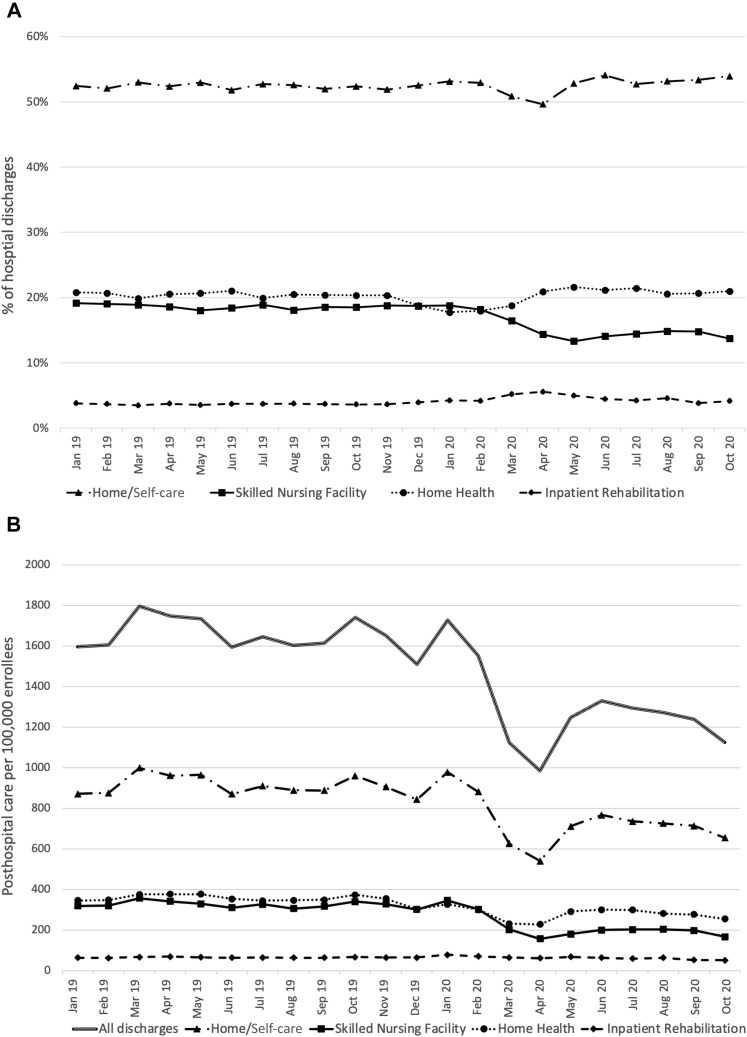
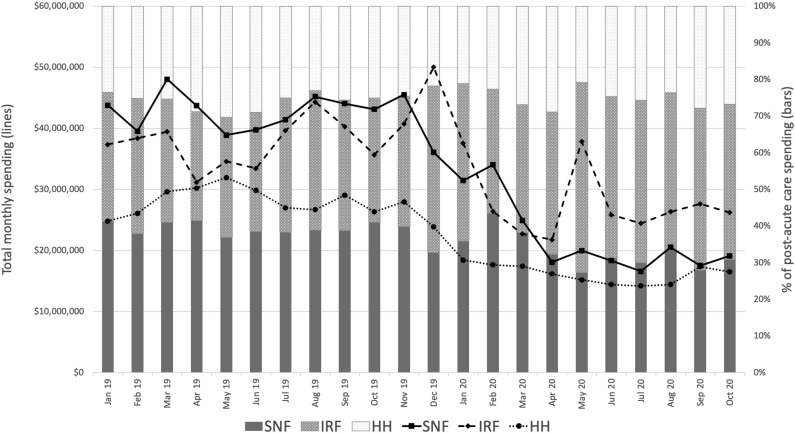
We summarized postdischarge utilization and spending in each month of the study: (1) the percentage of patients discharged from the hospital to home for self-care and to the 3 common post-acute care locations: home with home health, skilled nursing facility (SNF), and inpatient rehabilitation; (2) the rate of discharge to each location per 100,000 insured members in our cohort; (3) the total amount spent per month in each post-acute care location; and (4) the percentage of spending in each post-acute care location out of the total spending across the 3 post-acute care settings.
The percentage of patients discharged from the hospital to home or to inpatient rehabilitation did not meaningfully change during the pandemic whereas the percentage discharged to SNF declined from 19% of discharges in 2019 to 14% by October 2020. Total monthly spending declined in each of the 3 post-acute care locations, with the largest relative decline in SNFs of 55%, from an average of $42 million per month in 2019 to $19 million in October 2020. Declines in total monthly spending were smaller in home health (a 41% decline) and inpatient rehabilitation (a 32% decline). As a percentage of all post-acute care spending, spending on SNFs declined from 39% to 31%, whereas the percentage of post-acute care spending on home health and inpatient rehabilitation both increased.
Changes in posthospital discharge location of care represent a significant shift in post-acute care utilization, which persisted 9 months into the pandemic. These shifts could have profound implications on the future of post-acute care.
研究 COVID-19 大流行对急性后护理利用和支出的影响。
我们使用了一个大型的全国多付款人索赔数据集,从 2019 年 1 月至 2020 年 10 月,以研究出院后地点和支出的趋势。
我们确定并纳入了 975179 名年龄≥65 岁的住院患者。
我们总结了研究期间每个月的出院后利用和支出情况:(1)出院后自行护理并到 3 个常见急性后护理地点的患者比例:家中有家庭保健、熟练护理设施(SNF)和住院康复;(2)我们队列中每 10 万名参保成员的每个地点的出院率;(3)每个急性后护理地点每月的总支出;(4)每个急性后护理地点的支出占 3 个急性后护理设置的总支出的百分比。
在大流行期间,出院到家庭或住院康复的患者比例没有明显变化,而出院到 SNF 的比例从 2019 年的 19%下降到 2020 年 10 月的 14%。3 个急性后护理地点的每月总支出均下降,SNF 的相对降幅最大,为 55%,从 2019 年每月平均 4200 万美元降至 2020 年 10 月的 1900 万美元。家庭保健(下降 41%)和住院康复(下降 32%)的总支出下降幅度较小。作为所有急性后护理支出的百分比,SNF 的支出比例从 39%降至 31%,而家庭保健和住院康复的急性后护理支出比例均有所增加。
出院后护理地点的变化代表了急性后护理利用的重大转变,这种转变持续了 9 个月。这些转变可能对急性后护理的未来产生深远影响。