Glance Laurent G, Joynt Maddox Karen E, Stone Patricia W, Shang Jingjing, Furuya E Yoko, Chastain Ashley M, Lee Ji Won, Morse-Karzen Bridget, Dick Andrew W
Department of Anesthesiology and Perioperative Medicine, University of Rochester School of Medicine, Rochester, New York.
Department of Public Health Sciences, University of Rochester School of Medicine, Rochester, New York.
JAMA Netw Open. 2025 Jan 2;8(1):e2456816. doi: 10.1001/jamanetworkopen.2024.56816.
Long-term nursing home stay or death (long-term NH stay or death), defined as new long-term residence in a nursing home or death following hospital discharge, is an important patient-centered outcome.
To examine whether the COVID-19 pandemic was associated with changes in long-term NH stay or death among older adults with sepsis, and whether these changes were greater in individuals from racial and ethnic minoritized groups.
DESIGN, SETTING, AND PARTICIPANTS: This cross-sectional study used patient-level data from the Medicare Provider Analysis and Review File, the Master Beneficiary Summary File, and the Minimum Data Set. Community-dwelling individuals aged at least 65 years hospitalized with sepsis between January 2016 and June 2021 were included. Data were analyzed from May to November 2024.
Race and ethnicity and the COVID-19 pandemic.
Patients discharged alive experienced long-term NH stay or death if they resided in a nursing home more than 100 days after hospital discharge and had no period at home greater than 30 days, or died more than 30 days following hospital discharge. Interrupted time series analysis was used to evaluate the association between long-term NH stay or death and the pandemic and race and ethnicity.
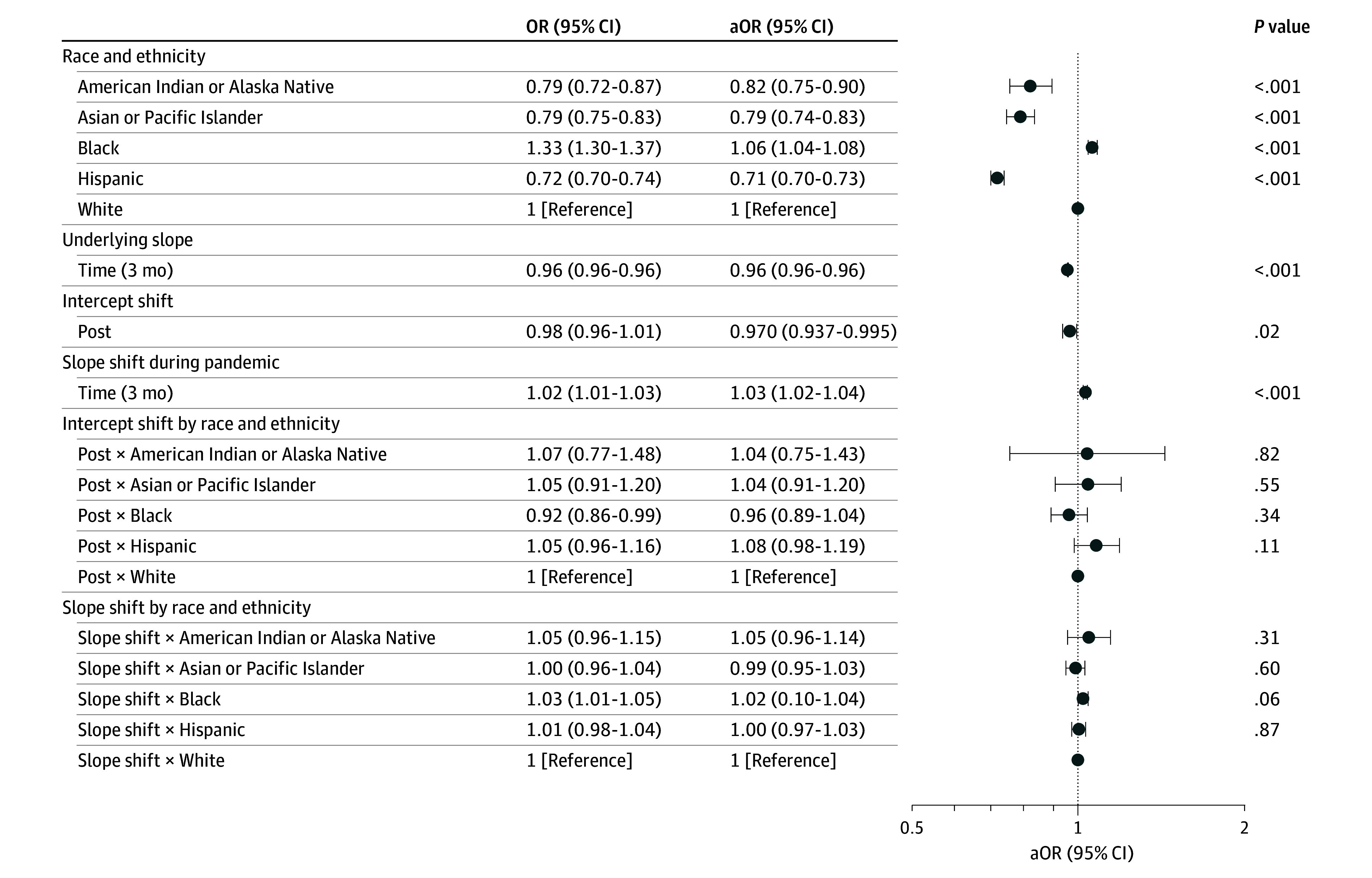
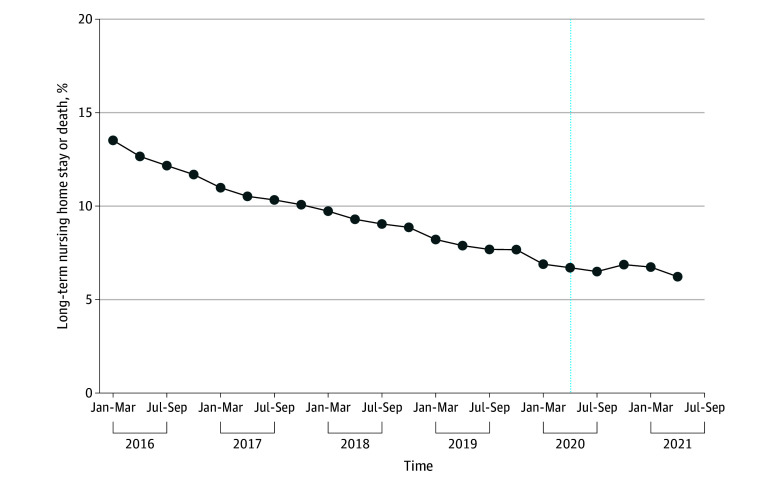
A total of 2 964 517 hospitalizations for sepsis of community-dwelling patients discharged alive (1 468 754 [49.5%] female; 19 549 [0.7%] American Indian or Alaska Native, 95 308 [3.2%] Asian or Pacific Islander, 282 646 [9.5%] Black, 279 011 [9.4%] Hispanic, 2 288 003 [71.2%] White individuals; mean [SD] age, 76 [8.3] years) were included. Compared with non-Hispanic White individuals, Black individuals were more likely to experience long-term NH stay or death (adjusted odds ratio [aOR], 1.33; 95% CI, 1.30-1.37; P < .001), while Asian or Pacific Islander (aOR, 0.79; 95% CI, 0.75-0.83; P < .001), Hispanic (aOR, 0.72; 95% CI, 0.70-0.74; P < .001), and American Indian or Alaska Native (aOR, 0.79; 95% CI, 0.72-0.87; P < .001) individuals were less likely to experience long-term NH stay or death. Long-term NH stay or death declined from 13.5% in the first quarter of 2016 to 6.9% in the first quarter of 2020. After adjustment, long-term NH stay or death decreased each quarter (aOR, 0.958; 95% CI, 0.957-0.959; P < .001) before the pandemic. The pandemic was associated with increased risk of long-term NH stay or death over time (aOR, 1.03; 95% CI, 1.02-1.04; P < .001 [each quarter]) compared with before the pandemic for non-Hispanic White individuals. The pandemic was not associated with differential changes in long-term NH stay or death for minoritized individuals compared with non-Hispanic White individuals.
In this cross-sectional study, older adults hospitalized with sepsis experienced an approximately 50% reduction in long-term NH stay or death over a 5-year period before the pandemic. These results suggest that during the pandemic, all individuals, regardless of race and ethnicity, experienced increased long-term NH stay or death compared with before the pandemic.
长期入住养老院或死亡(长期入住养老院或死亡),定义为在养老院新的长期居住或出院后死亡,是一个以患者为中心的重要结局。
研究新冠疫情是否与脓毒症老年患者长期入住养老院或死亡的变化有关,以及这些变化在少数族裔群体个体中是否更大。
设计、背景和参与者:这项横断面研究使用了医疗保险提供者分析与审查文件、主要受益人汇总文件和最低数据集的患者层面数据。纳入了2016年1月至2021年6月期间因脓毒症住院的至少65岁的社区居住个体。数据于2024年5月至11月进行分析。
种族和族裔以及新冠疫情。
存活出院的患者,如果在出院后在养老院居住超过100天且在家停留时间不超过30天,或在出院后30天以上死亡,则经历长期入住养老院或死亡。采用中断时间序列分析来评估长期入住养老院或死亡与疫情以及种族和族裔之间的关联。
共纳入了2964517例社区居住患者因脓毒症存活出院的住院病例(1468754例[49.5%]为女性;19549例[0.7%]为美洲印第安人或阿拉斯加原住民,95308例[3.2%]为亚裔或太平洋岛民,282646例[9.5%]为黑人,279011例[9.4%]为西班牙裔,2288003例[71.2%]为白人个体;平均[标准差]年龄为76[8.3]岁)。与非西班牙裔白人个体相比,黑人个体更有可能经历长期入住养老院或死亡(调整后的优势比[aOR]为1.33;95%置信区间[CI]为1.30 - 1.37;P <.001),而亚裔或太平洋岛民(aOR为0.79;95% CI为0.75 - 0.83;P <.001)、西班牙裔(aOR为0.72;95% CI为0.70 - 0.74;P <.001)以及美洲印第安人或阿拉斯加原住民(aOR为0.79;95% CI为0.72 - 0.87;P <.001)个体经历长期入住养老院或死亡的可能性较小。长期入住养老院或死亡从2016年第一季度的13.5%下降到2020年第一季度的6.9%。调整后,在疫情之前长期入住养老院或死亡每季度都在下降(aOR为0.958;95% CI为0.957 - 0.959;P <.001)。与疫情之前相比,疫情期间非西班牙裔白人个体长期入住养老院或死亡的风险随时间增加(aOR为1.03;95% CI为1.02 - 1.04;P <.001[每季度])。与非西班牙裔白人个体相比,疫情与少数族裔个体长期入住养老院或死亡的差异变化无关。
在这项横断面研究中,因脓毒症住院的老年患者在疫情前的5年期间长期入住养老院或死亡的情况减少了约50%。这些结果表明,在疫情期间,所有个体,无论种族和族裔,与疫情之前相比,长期入住养老院或死亡的情况都有所增加。