
在接种固氮细菌的情况下,使用蚯蚓堆肥进行有机土壤改良以实现水稻可持续生产。
Organic soil amendments using vermicomposts under inoculation of N-fixing bacteria for sustainable rice production.
作者信息
Ghadimi Mehdi, Sirousmehr Alireza, Ansari Mohammad Hossein, Ghanbari Ahmad
机构信息
Department of Agronomy, University of Zabol, Zabol, Sistan-o-Baluchestan, Iran.
Department of Agronomy, Rasht Branch, Islamic Azad University, Rasht, Iran.
出版信息
PeerJ. 2021 Sep 2;9:e10833. doi: 10.7717/peerj.10833. eCollection 2021.
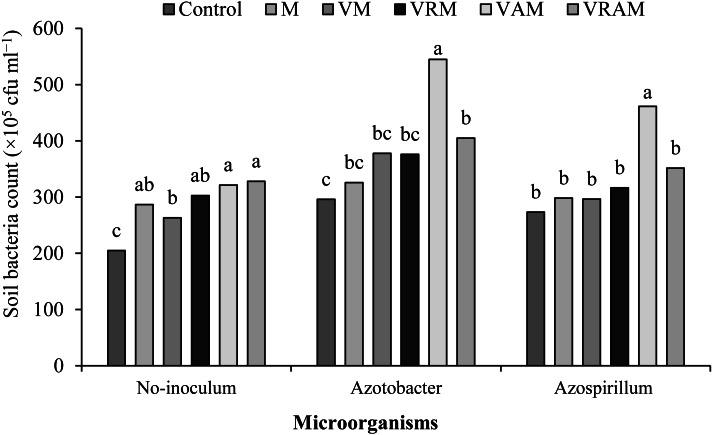
Organic and biological fertilizers are considered as a very important source of plant nutrients. A field experiment was conducted during 2017-2018 in paddy soil to investigate the effect of vermicomposting of cattle manure mixture with and rice straw on soil microbial activity, nutrient uptake, and grain yield under inoculation of N-fixing bacteria. Experimental factors consisted of organic amendments at six levels (vermicomposts prepared from manure (VM); manure + rice straw (VRM); manure + mixture (VAM); manure + rice straw + mixture (VRAM); raw manure without vermicomposting (M), and a control) and N-fixing bacteria at three levels (, , and non-inoculation). The results showed that, vermicompost treatments compared to control and raw manure significantly increased the number and biomass-C of soil microorganisms, urease activity, number of tillers hill, phosphorus (P) and potassium (K) uptake, and grain and protein yield. Inoculation of plants with N-fixing bacteria, especially increased the efficiency of organic amendments, so that the maximum urease activity, soil microbial activity, P and N uptake, and grain yield (4,667 (2017) and 5,081 (2018) kg/h) were observed in vermicompost treatments containing (VAM and VRAM) under inoculation with . The results of the study suggested that, using an organic source along with inoculation with appropriate N-fixing bacteria for vermicompost has a great effect on enzyme activity, soil biology, nutrient uptake and grain yield has a synergistic interaction on agronomic traits under flooded conditions. Therefore, this nutrient method can be used as one of the nutrient management strategies in the sustainable rice production.
有机肥料和生物肥料被认为是植物养分的非常重要的来源。2017 - 2018年在稻田土壤中进行了一项田间试验,以研究牛粪与稻草混合进行蚯蚓堆肥处理对土壤微生物活性、养分吸收以及在接种固氮菌条件下对水稻产量的影响。试验因素包括六个水平的有机改良剂(由粪便制备的蚯蚓堆肥(VM);粪便 + 稻草(VRM);粪便 + 混合物(VAM);粪便 + 稻草 + 混合物(VRAM);未进行蚯蚓堆肥的生粪便(M),以及一个对照)和三个水平的固氮菌(、、不接种)。结果表明,与对照和生粪便相比,蚯蚓堆肥处理显著增加了土壤微生物的数量和生物量碳、脲酶活性、每蔸分蘖数、磷(P)和钾(K)吸收量以及谷物和蛋白质产量。用固氮菌接种植物,特别是增加了有机改良剂的效率,以至于在接种的情况下,在含有(VAM和VRAM)的蚯蚓堆肥处理中观察到最大脲酶活性、土壤微生物活性、P和N吸收量以及谷物产量(2017年为4667,2018年为5081千克/公顷)。研究结果表明,在淹水条件下,将有机源与接种合适的固氮菌用于蚯蚓堆肥对酶活性、土壤生物学、养分吸收和谷物产量有很大影响,对农艺性状具有协同作用。因此,这种养分管理方法可作为可持续水稻生产中的养分管理策略之一。




 Zotero 插件