Department of Medicine, Cedars-Sinai Medical Center, Los Angeles, CA, USA.
Biostatistics and Bioinformatics Research Center, Cedars-Sinai Medical Center, Los Angeles, CA, USA.
Hepatol Commun. 2022 Jan;6(1):223-236. doi: 10.1002/hep4.1795. Epub 2021 Aug 25.
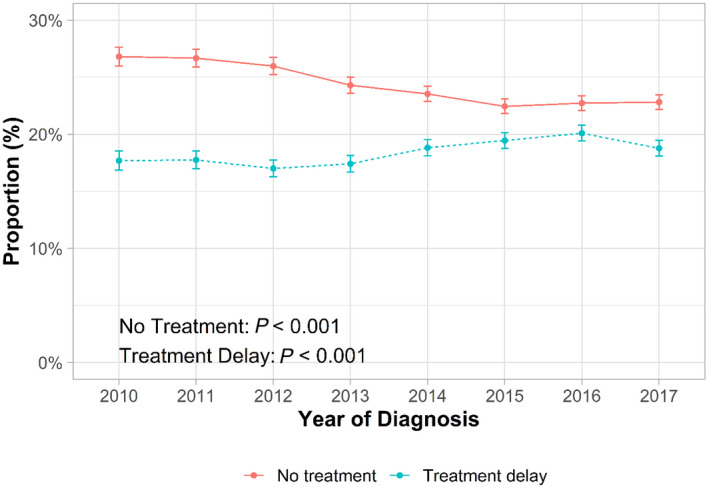
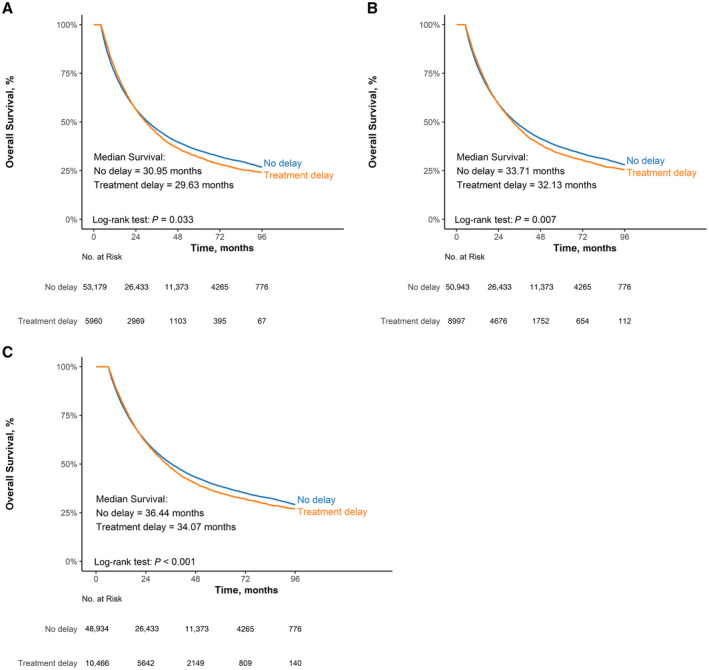
Prognosis of hepatocellular carcinoma (HCC) could be affected by lack of or delayed therapy. We aimed to characterize the prevalence, correlates, and clinical impact of therapeutic underuse and delay in patients with HCC. Patients with HCC diagnosed between 2010 and 2017 were analyzed from the United States National Cancer Database. Logistic regression analysis identified factors associated with no and delayed (>90 days after diagnosis) HCC treatment. Cox proportional hazards regression with landmark analysis assessed the association between therapeutic delay and overall survival (OS), accounting for immortal time bias. Of 116,299 patients with HCC, 24.2% received no treatment and 18.4% of treated patients had delayed treatment. Older age, Black, Hispanic, lower socioeconomic status, earlier year of diagnosis, treatment at nonacademic centers, Northeast region, increased medical comorbidity, worse liver dysfunction, and higher tumor burden were associated with no treatment. Among treated patients, younger age, Hispanic, Black, treatment at academic centers, West region, earlier tumor stage, and receipt of noncurative treatment were associated with treatment delays. In multivariable Cox regression with a landmark of 150 days, patients with and without treatment delays had similar OS (adjusted hazard ratio [aHR], 1.01; 95% confidence interval [CI], 0.98-1.04) with a median survival of 33.7 vs. 32.1 months, respectively. However, therapeutic delay was associated with worse OS in patients who had tumor, nodes, and metastases (TNM) stage 1 (aHR, 1.06; 95% CI, 1.01-1.11) or received curative treatment (aHR, 1.12; 95% CI, 1.05-1.18). Conclusion: One-fourth of patients with HCC receive no therapy and one-fifth of treated patients experience treatment delays. Both were associated with demographic, socioeconomic, and clinical characteristics of patients as well as facility type and region. The association between therapeutic delay and survival was stage and treatment dependent.
肝癌(HCC)的预后可能受到治疗不足或延迟的影响。我们旨在描述 HCC 患者治疗不足和治疗延迟的流行率、相关性和临床影响。从美国国家癌症数据库中分析了 2010 年至 2017 年间诊断为 HCC 的患者。使用逻辑回归分析确定与无 HCC 治疗和治疗延迟(>90 天)相关的因素。使用带有里程碑分析的 Cox 比例风险回归评估治疗延迟与总生存(OS)之间的关联,以考虑 Immortal Time Bias。在 116299 例 HCC 患者中,24.2%未接受治疗,18.4%接受治疗的患者治疗延迟。年龄较大、黑人、西班牙裔、社会经济地位较低、诊断年份较早、在非学术中心治疗、东北地区、合并症较多、肝功能较差和肿瘤负荷较高与未治疗相关。在接受治疗的患者中,年龄较小、西班牙裔、黑人、在学术中心治疗、西部地区、较早的肿瘤分期以及接受非治愈性治疗与治疗延迟相关。在带有 150 天里程碑的多变量 Cox 回归中,有和没有治疗延迟的患者的 OS 相似(调整后的危险比 [aHR],1.01;95%置信区间 [CI],0.98-1.04),中位生存时间分别为 33.7 个月和 32.1 个月。然而,在肿瘤、淋巴结和转移(TNM)分期为 1 期的患者(aHR,1.06;95%CI,1.01-1.11)或接受治愈性治疗的患者(aHR,1.12;95%CI,1.05-1.18)中,治疗延迟与较差的 OS 相关。结论:四分之一的 HCC 患者未接受治疗,五分之一接受治疗的患者存在治疗延迟。两者均与患者的人口统计学、社会经济学和临床特征以及设施类型和地区相关。治疗延迟与生存之间的关联与分期和治疗有关。