Saitou Marie, Resendez Skyler, Pradhan Apoorva J, Wu Fuguo, Lie Natasha C, Hall Nancy J, Zhu Qihui, Reinholdt Laura, Satta Yoko, Speidel Leo, Nakagome Shigeki, Hanchard Neil A, Churchill Gary, Lee Charles, Atilla-Gokcumen G Ekin, Mu Xiuqian, Gokcumen Omer
Department of Biological Sciences, University at Buffalo, Buffalo, NY, USA.
Department of Chemistry, University at Buffalo, Buffalo, NY, USA.
Sci Adv. 2021 Sep 24;7(39):eabi4476. doi: 10.1126/sciadv.abi4476.
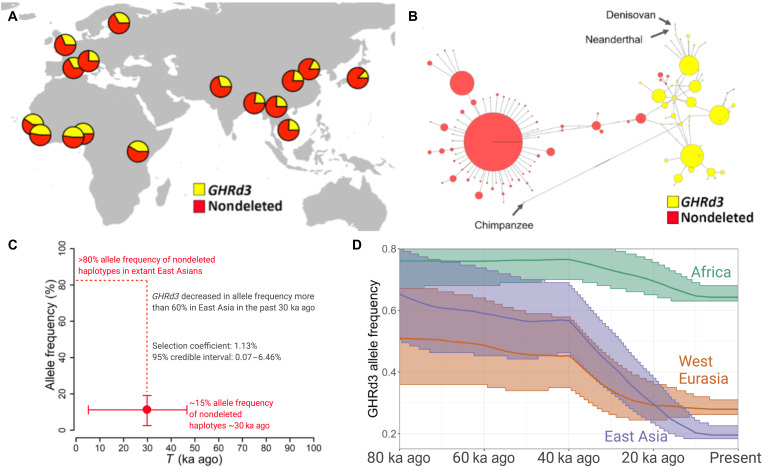
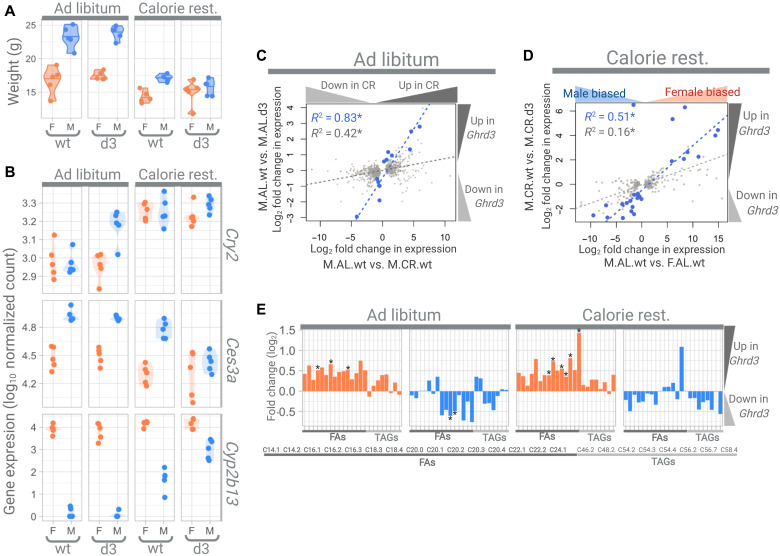
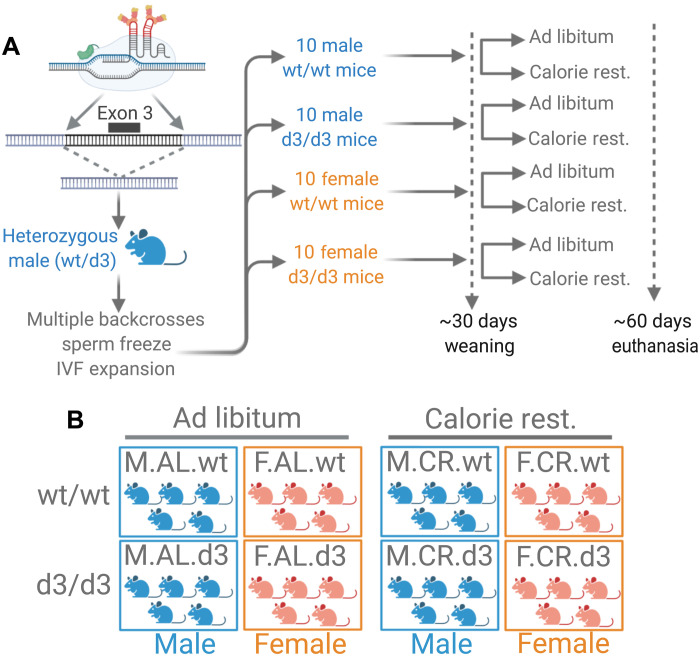
The common deletion of the third exon of the growth hormone receptor gene () in humans is associated with birth weight, growth after birth, and time of puberty. However, its evolutionary history and the molecular mechanisms through which it affects phenotypes remain unresolved. We present evidence that this deletion was nearly fixed in the ancestral population of anatomically modern humans and Neanderthals but underwent a recent adaptive reduction in frequency in East Asia. We documented that is associated with protection from severe malnutrition. Using a novel mouse model, we found that, under calorie restriction, leads to the female-like gene expression in male livers and the disappearance of sexual dimorphism in weight. The sex- and diet-dependent effects of GHRd3 in our mouse model are consistent with a model in which the allele frequency of GHRd3 varies throughout human evolution as a response to fluctuations in resource availability.
人类生长激素受体基因第三外显子的常见缺失与出生体重、出生后的生长以及青春期时间有关。然而,其进化历史以及影响表型的分子机制仍未明确。我们提供的证据表明,这种缺失在解剖学上现代人类和尼安德特人的祖先群体中几乎是固定的,但最近在东亚地区其频率经历了适应性降低。我们记录到该缺失与预防严重营养不良有关。使用一种新型小鼠模型,我们发现,在热量限制条件下,该缺失导致雄性肝脏中出现类似雌性的基因表达,并且体重上的性别二态性消失。我们小鼠模型中GHRd3的性别和饮食依赖性效应与这样一种模型一致,即GHRd3的等位基因频率在人类进化过程中随着资源可利用性的波动而变化。