Department of Pediatrics, Severance Children's Hospital, Yonsei University College of Medicine, Seoul, Korea.
Institute for Immunology and Immunological Diseases, Yonsei University College of Medicine, Seoul, Korea.
BMC Infect Dis. 2021 Sep 25;21(1):1003. doi: 10.1186/s12879-021-06508-7.
Mycoplasma pneumoniae is a common pathogen that causes community-acquired pneumonia in school-age children. Macrolides are considered a first-line treatment for M. pneumoniae infection in children, but macrolide-refractory M. pneumoniae (MRMP) strains have become more common. In this study, we assessed the efficacy of tetracyclines and fluoroquinolones in MRMP treatment in children through a systematic review and meta-analysis.
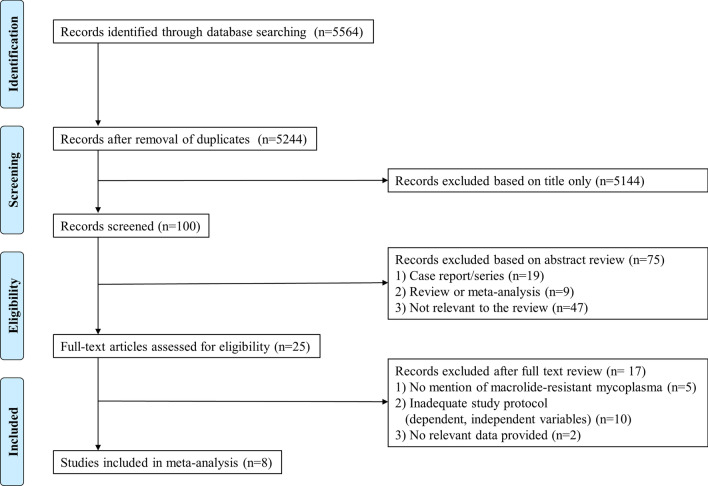
Two reviewers individually searched 10 electronic databases (Medline/Pubmed, Embase, the Cochrane Library, and core Korean, Chinese, and Japanese journals) for papers published from January 1, 1990 to March 8, 2018. The following data for each treatment group were extracted from the selected studies: intervention (tetracyclines and fluoroquinolones/comparator), patient characteristics (age and sex), and outcomes (fever duration, hospital stay length, treatment success rate, and defervescence rates 24, 48, and 72 h after starting treatment).
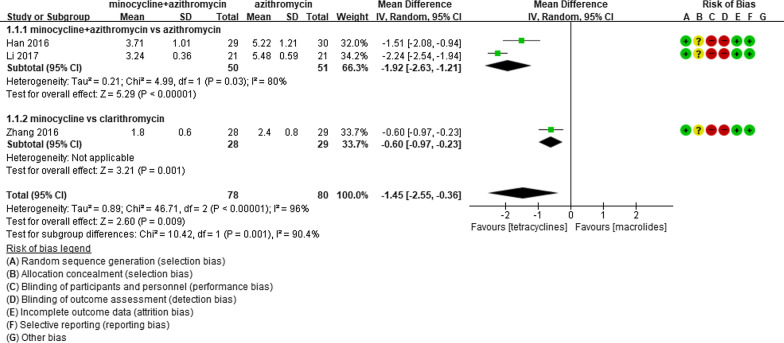
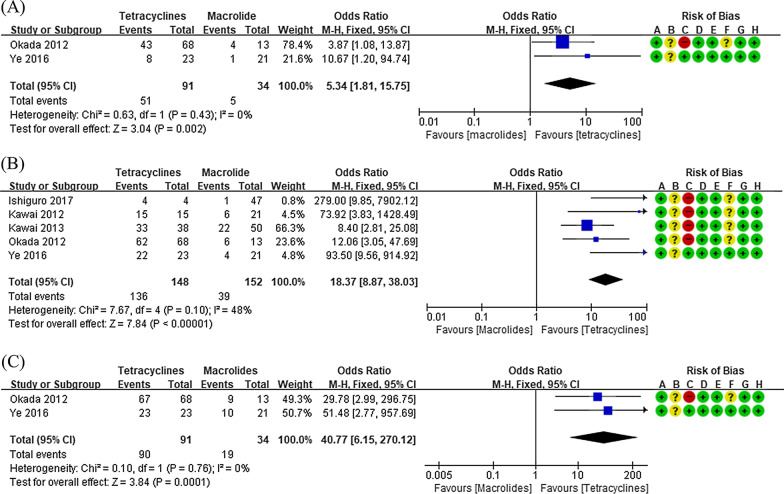
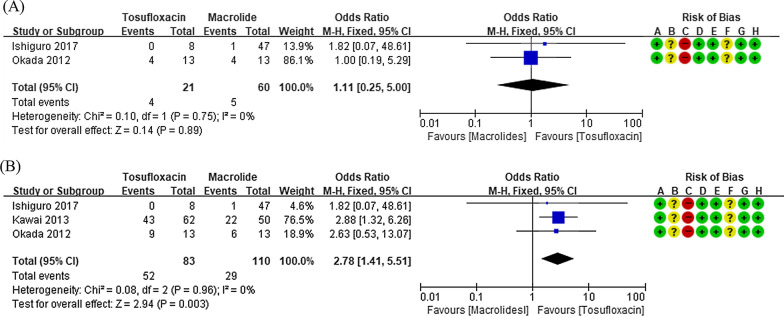
Eight studies involving 537 participants were included. Fever duration and hospital stay length were shorter in the tetracycline group than in the macrolide group (weighted mean difference [WMD] = - 1.45, 95% confidence interval [CI]: - 2.55 to - 0.36, P = 0.009; and WMD = - 3.33, 95% CI: - 4.32 to - 2.35, P < 0.00001, respectively). The therapeutic efficacy was significantly higher in the tetracycline group than in the macrolide group (odds ratio [OR]: 8.80, 95% CI: 3.12-24.82). With regard to defervescence rate, patients in the tetracycline group showed significant improvement compared to those in the macrolide group (defervescence rate after 24 h, OR: 5.34, 95% CI: 1.81-15.75; after 48 h, OR 18.37, 95% CI: 8.87-38.03; and after 72 h, OR: 40.77, 95% CI: 6.15-270.12). There were no differences in fever improvement within 24 h in patients in the fluoroquinolone group compared to those in the macrolide group (OR: 1.11, 95% CI: 0.25-5.00), although the defervescence rate was higher after 48 h in the fluoroquinolone group (OR: 2.78, 95% CI: 1.41-5.51).
Tetracyclines may shorten fever duration and hospital stay length in patients with MRMP infection. Fluoroquinolones may achieve defervescence within 48 h in patients with MRMP infection. However, these results should be carefully interpreted as only a small number of studies were included, and they were heterogeneous.
肺炎支原体是引起学龄儿童社区获得性肺炎的常见病原体。大环内酯类药物被认为是儿童肺炎支原体感染的一线治疗药物,但耐大环内酯类肺炎支原体(MRMP)菌株越来越常见。本研究通过系统评价和荟萃分析评估了四环素类和氟喹诺酮类药物在儿童 MRMP 治疗中的疗效。
两位审稿人分别从 1990 年 1 月 1 日至 2018 年 3 月 8 日检索了 10 个电子数据库(Medline/Pubmed、Embase、Cochrane 图书馆以及核心韩国、中国和日本期刊)中的论文。从选定的研究中提取了每个治疗组的以下数据:干预措施(四环素类和氟喹诺酮类/对照)、患者特征(年龄和性别)和结局(发热持续时间、住院时间、治疗成功率和开始治疗后 24、48 和 72 小时的退热率)。
共纳入 8 项研究,涉及 537 名参与者。与大环内酯类药物组相比,四环素组的发热持续时间和住院时间更短(加权均数差[WMD] = -1.45,95%置信区间[CI]:-2.55 至-0.36,P = 0.009;WMD = -3.33,95%CI:-4.32 至-2.35,P < 0.00001)。四环素组的治疗效果明显高于大环内酯类药物组(比值比[OR]:8.80,95%CI:3.12-24.82)。至于退热率,与大环内酯类药物组相比,四环素组的患者有显著改善(24 小时退热率,OR:5.34,95%CI:1.81-15.75;48 小时,OR:18.37,95%CI:8.87-38.03;72 小时,OR:40.77,95%CI:6.15-270.12)。氟喹诺酮类药物组患者在开始治疗后 24 小时内的退热改善情况与大环内酯类药物组无差异(OR:1.11,95%CI:0.25-5.00),尽管氟喹诺酮类药物组在 48 小时后的退热率更高(OR:2.78,95%CI:1.41-5.51)。
四环素类药物可能缩短耐大环内酯类肺炎支原体感染患者的发热持续时间和住院时间。氟喹诺酮类药物可能在耐大环内酯类肺炎支原体感染患者中在 48 小时内达到退热效果。然而,由于纳入的研究数量较少,且存在异质性,这些结果应谨慎解释。