Department of Population Health Sciences, School of Medicine, Duke University, Durham, NC, USA.
Duke Cancer Institute, School of Medicine, Duke University, Durham, NC, USA.
BMC Cancer. 2021 Sep 25;21(1):1051. doi: 10.1186/s12885-021-08775-8.
The association between obesity and breast cancer (BC) has been extensively studied among US, European and Asian study populations, with often conflicting evidence. However, despite the increasing prevalence of obesity and associated conditions in Africa, the continent with the highest age-standardized BC mortality rate globally, few studies have evaluated this association, and none has examined in relation to molecular subtypes among African women. The current analysis examines the association between body composition, defined by body mass index (BMI), height, and weight, and BC by molecular subtype among African women.
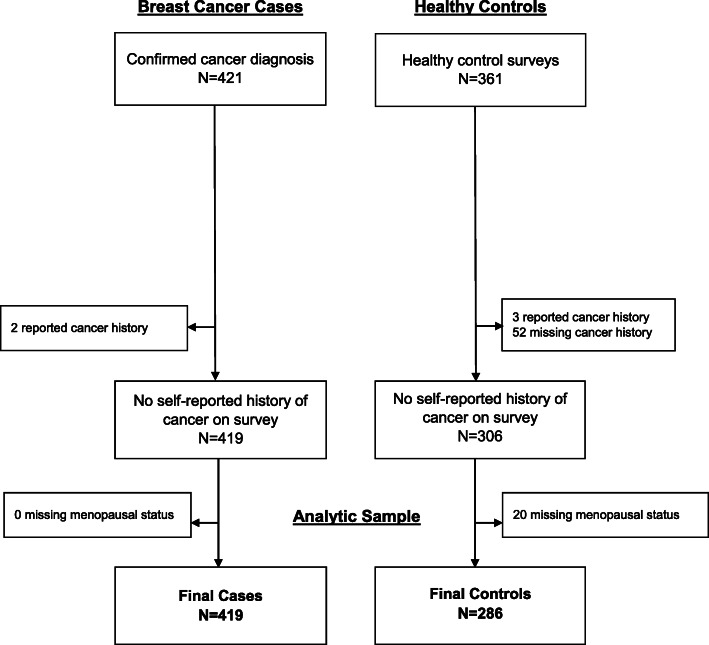
We estimated odds ratios (ORs) and 95% confidence intervals (95% CI) for the association between measures of body composition and BC and molecular subtypes among 419 histologically confirmed cases of BC and 286 healthy controls from the Mechanisms for Established and Novel Risk Factors for Breast Cancer in Women of Nigerian Descent (MEND) case-control study.
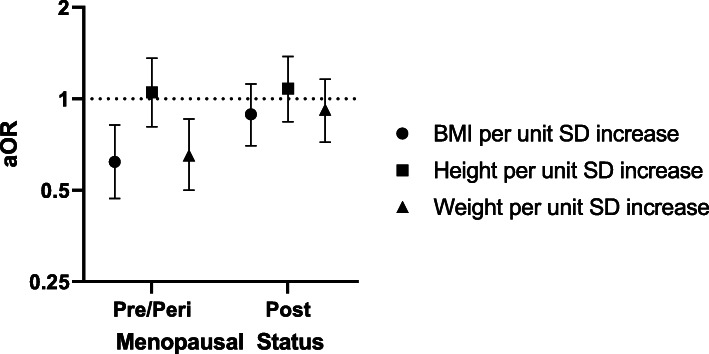
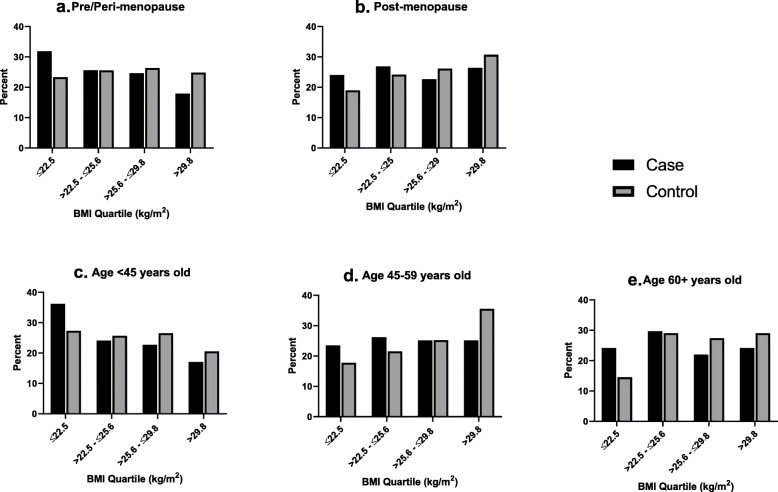
Higher BMI (aOR: 0.79; 95% CI: 0.67, 0.95) and weight (aOR: 0.83; 95% CI: 0.69, 0.98) were associated with reduced odds of BC in adjusted models, while height was associated with non-statistically significant increased odds of BC (aOR: 1.07, 95% CI: 0.90, 1.28). In pre/peri-menopausal, but not post-menopausal women, both higher BMI and weight were significantly associated with reduced odds of BC. Further, higher BMI was associated with reduced odds of Luminal A, Luminal B, and HER2-enriched BC among pre/peri-menopausal women, and reduced odds of triple-negative BC among post-menopausal women.
Higher BMI and weight were associated with reduced odds of BC overall and by molecular subtype among West African women. Larger studies of women of African descent are needed to definitively characterize these associations and inform cancer prevention strategies.
肥胖与乳腺癌(BC)之间的关联已在美国、欧洲和亚洲的研究人群中进行了广泛研究,但证据常常相互矛盾。然而,尽管非洲的肥胖症和相关疾病的患病率不断上升,且该大陆的乳腺癌死亡率全球最高,但很少有研究评估这种关联,也没有研究探讨非洲女性的分子亚型。目前的分析研究了身体成分(由体重指数(BMI)、身高和体重定义)与非洲女性乳腺癌及分子亚型之间的关联。
我们估计了 419 例组织学确诊的乳腺癌病例和 286 例来自尼日利亚裔女性乳腺癌的新发病和已确立风险因素的机制(MEND)病例对照研究的健康对照者中,身体成分测量值与乳腺癌和分子亚型之间的关联的优势比(OR)和 95%置信区间(95%CI)。
在调整后的模型中,较高的 BMI(调整后的 OR:0.79;95%CI:0.67,0.95)和体重(调整后的 OR:0.83;95%CI:0.69,0.98)与乳腺癌的患病风险降低相关,而身高与乳腺癌的患病风险呈非统计学显著增加相关(调整后的 OR:1.07,95%CI:0.90,1.28)。在绝经前/围绝经期女性中,较高的 BMI 和体重与乳腺癌的患病风险降低显著相关,但在绝经后女性中则没有。此外,较高的 BMI 与绝经前/围绝经期女性中 Luminal A、Luminal B 和 HER2 丰富型乳腺癌的患病风险降低相关,与绝经后女性中三阴性乳腺癌的患病风险降低相关。
在西非女性中,较高的 BMI 和体重与乳腺癌的总体患病风险和分子亚型患病风险降低相关。需要对非洲裔女性进行更大规模的研究,以明确这些关联,并为癌症预防策略提供信息。