• 文献检索
  • 文档翻译
  • 深度研究
  • 学术资讯
  • Suppr Zotero 插件Zotero 插件
  • 邀请有礼
  • 套餐&价格
  • 历史记录
应用&插件
Suppr Zotero 插件Zotero 插件浏览器插件Mac 客户端Windows 客户端微信小程序
定价
高级版会员购买积分包购买API积分包
服务
文献检索文档翻译深度研究API 文档MCP 服务
关于我们
关于 Suppr公司介绍联系我们用户协议隐私条款
关注我们

Suppr 超能文献

核心技术专利:CN118964589B侵权必究
粤ICP备2023148730 号-1Suppr @ 2026

文献检索

告别复杂PubMed语法,用中文像聊天一样搜索,搜遍4000万医学文献。AI智能推荐,让科研检索更轻松。

立即免费搜索

文件翻译

保留排版,准确专业,支持PDF/Word/PPT等文件格式,支持 12+语言互译。

免费翻译文档

深度研究

AI帮你快速写综述,25分钟生成高质量综述,智能提取关键信息,辅助科研写作。

立即免费体验

1 型糖尿病成人 COVID-19 封锁期间的血糖控制:观察性研究的荟萃分析。

Glycaemic control during the lockdown for COVID-19 in adults with type 1 diabetes: A meta-analysis of observational studies.

机构信息

Section of Diabetes and Metabolic Disease, Department of Clinical and Experimental Medicine, University of Pisa and Azienda Ospedaliero-Universitaria Pisana, Pisa, Italy.

Section of Endocrinology, ASL Brindisi, DSS-1, Brindisi, Italy.

出版信息

Diabetes Res Clin Pract. 2021 Oct;180:109066. doi: 10.1016/j.diabres.2021.109066. Epub 2021 Sep 23.

DOI:10.1016/j.diabres.2021.109066
PMID:34563586
原文链接:https://pmc.ncbi.nlm.nih.gov/articles/PMC8458100/
Abstract

AIMS

To assess the effects of lockdown due to COVID-19 pandemic on glucose metrics, measured by glucose monitoring systems, in adult individuals with type 1 diabetes.

METHODS

We conducted a systematic literature search for English language articles from MEDLINE, Scopus and Web of Science up to February 28, 2021, using "diabetes", "lockdown", and "glucose" as key search terms. Time in range (TIR) was the main outcome; other metrics were time above range (TAR), time below range (TBR), mean blood glucose (MBG) and its variability (%CV), estimated HbA1c (eA1c) or glucose management indicator (GMI).

RESULTS

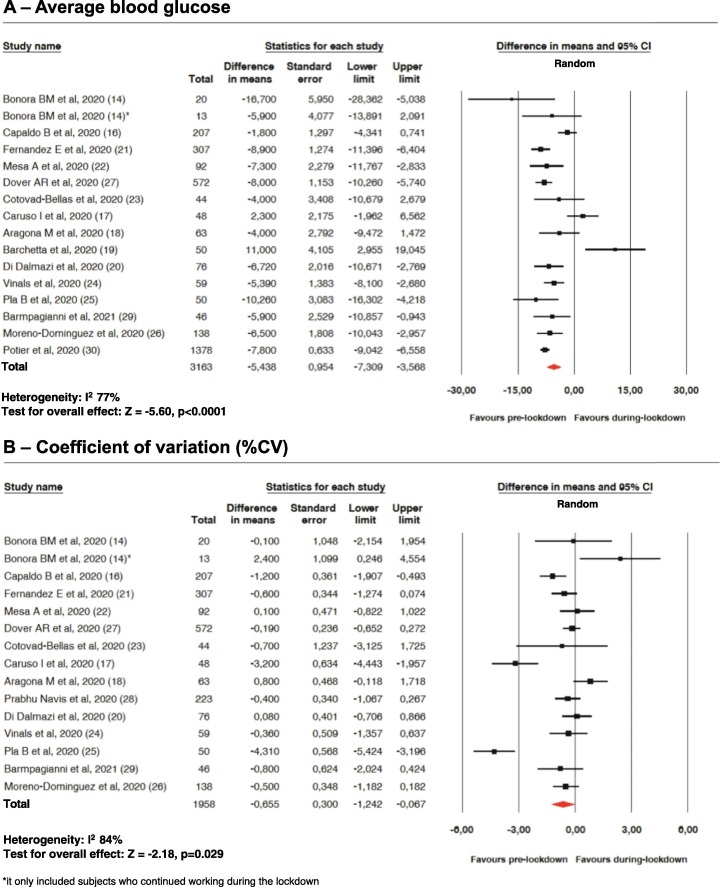
Seventeen studies for a total of 3,441 individuals with type 1 diabetes were included in the analysis. In the lockdown period, TIR 70-180 mg/dl increased by 3.05% (95% CI 1.67-4.43%; p < 0.0001) while TAR (>180 mg/dL and > 250 mg/dL) declined by 3.39% (-5.14 to -1.63%) and 1.96% (-2.51 to -1.42%), respectively (p < 0.0001 for both). Both TBR < 70 and <54 mg/dL remained unchanged. MBG slightly decreased by 5.40 mg/dL (-7.29 to -3.51 mg/dL; p < 0.0001) along with a reduction in %CV. Pooled eA1c and GMI decreased by 0.18% (-0.24 to -0.11%; p < 0.0001) and a similar reduction was observed when GMI alone was considered (0.15%, -0.23 to -0.07%; p < 0.0001). Sensor use was only slightly but not significantly reduced during lockdown.

CONCLUSIONS

This meta-analysis shows that well-controlled people with type 1 diabetes on both MDI and CSII with continuous or flash glucose monitoring did not experience a deterioration in glucose control throughout the COVID-19 lockdown, showing a modest, though statistically significant improvement in many glucose control parameters.

摘要

目的

评估 COVID-19 大流行期间的封锁对 1 型糖尿病成人患者通过血糖监测系统测量的血糖指标的影响。

方法

我们使用“糖尿病”、“封锁”和“血糖”作为关键搜索词,对 MEDLINE、Scopus 和 Web of Science 上截至 2021 年 2 月 28 日的英文文章进行了系统文献检索。范围时间(TIR)是主要结局;其他指标包括血糖高于范围(TAR)、血糖低于范围(TBR)、平均血糖(MBG)及其变异性(%CV)、估计糖化血红蛋白(eA1c)或血糖管理指标(GMI)。

结果

共有 17 项研究,总计 3441 名 1 型糖尿病患者纳入分析。在封锁期间,70-180mg/dL 的 TIR 增加了 3.05%(95%CI 1.67-4.43%;p<0.0001),而 TAR(>180mg/dL 和>250mg/dL)分别下降了 3.39%(-5.14 至-1.63%)和 1.96%(-2.51 至-1.42%)(均 p<0.0001)。TBR<70 和<T54mg/dL 保持不变。MBG 略有下降 5.40mg/dL(-7.29 至-3.51mg/dL;p<0.0001),同时 %CV 降低。汇总的 eA1c 和 GMI 分别下降 0.18%(-0.24 至-0.11%;p<0.0001),当仅考虑 GMI 时也观察到类似的降低(0.15%,-0.23 至-0.07%;p<0.0001)。在封锁期间,传感器的使用仅略有但无统计学意义的减少。

结论

这项荟萃分析表明,接受 MDI 和 CSII 治疗且使用连续或闪光血糖监测的血糖控制良好的 1 型糖尿病患者在整个 COVID-19 封锁期间血糖控制没有恶化,许多血糖控制参数显示出适度但有统计学意义的改善。

https://cdn.ncbi.nlm.nih.gov/pmc/blobs/11c6/8458100/68dfa0cd9015/gr4_lrg.jpg
https://cdn.ncbi.nlm.nih.gov/pmc/blobs/11c6/8458100/58f0bc14e58d/gr1_lrg.jpg
https://cdn.ncbi.nlm.nih.gov/pmc/blobs/11c6/8458100/e00ddf9ae446/gr2a_lrg.jpg
https://cdn.ncbi.nlm.nih.gov/pmc/blobs/11c6/8458100/d00fadda432c/gr3_lrg.jpg
https://cdn.ncbi.nlm.nih.gov/pmc/blobs/11c6/8458100/68dfa0cd9015/gr4_lrg.jpg
https://cdn.ncbi.nlm.nih.gov/pmc/blobs/11c6/8458100/58f0bc14e58d/gr1_lrg.jpg
https://cdn.ncbi.nlm.nih.gov/pmc/blobs/11c6/8458100/e00ddf9ae446/gr2a_lrg.jpg
https://cdn.ncbi.nlm.nih.gov/pmc/blobs/11c6/8458100/d00fadda432c/gr3_lrg.jpg
https://cdn.ncbi.nlm.nih.gov/pmc/blobs/11c6/8458100/68dfa0cd9015/gr4_lrg.jpg

相似文献

1
Glycaemic control during the lockdown for COVID-19 in adults with type 1 diabetes: A meta-analysis of observational studies.1 型糖尿病成人 COVID-19 封锁期间的血糖控制:观察性研究的荟萃分析。
Diabetes Res Clin Pract. 2021 Oct;180:109066. doi: 10.1016/j.diabres.2021.109066. Epub 2021 Sep 23.
2
Glycemic control in people with type 1 diabetes using a hybrid closed loop system and followed by telemedicine during the COVID-19 pandemic in Italy.在意大利 COVID-19 大流行期间,使用混合闭环系统控制血糖的 1 型糖尿病患者,并在之后接受远程医疗随访。
Diabetes Res Clin Pract. 2020 Nov;169:108440. doi: 10.1016/j.diabres.2020.108440. Epub 2020 Sep 12.
3
The impact of COVID lockdown on glycaemic control in paediatric patients with type 1 diabetes: A systematic review and meta-analysis of 22 observational studies.COVID 封锁对 1 型糖尿病患儿血糖控制的影响:22 项观察性研究的系统评价和荟萃分析。
Front Endocrinol (Lausanne). 2022 Nov 30;13:1069559. doi: 10.3389/fendo.2022.1069559. eCollection 2022.
4
Comparison of the effects of lockdown due to COVID-19 on glucose patterns among children, adolescents, and adults with type 1 diabetes: CGM study.COVID-19 大流行导致的封锁对 1 型糖尿病儿童、青少年和成人血糖模式影响的比较:CGM 研究。
BMJ Open Diabetes Res Care. 2020 Oct;8(2). doi: 10.1136/bmjdrc-2020-001664.
5
Impact of COVID-19 lockdown on flash and real-time glucose sensor users with type 1 diabetes in England.英格兰 COVID-19 封锁对 1 型糖尿病患者的闪存式和实时血糖传感器使用者的影响。
Acta Diabetol. 2021 Feb;58(2):231-237. doi: 10.1007/s00592-020-01614-5. Epub 2020 Oct 16.
6
The impact of strict COVID-19 lockdown in Spain on glycemic profiles in patients with type 1 Diabetes prone to hypoglycemia using standalone continuous glucose monitoring.西班牙严格的 COVID-19 封锁对使用独立连续血糖监测的易发生低血糖的 1 型糖尿病患者血糖谱的影响。
Diabetes Res Clin Pract. 2020 Sep;167:108354. doi: 10.1016/j.diabres.2020.108354. Epub 2020 Jul 30.
7
The impact of a prolonged lockdown and use of telemedicine on glycemic control in people with type 1 diabetes during the COVID-19 outbreak in Saudi Arabia.沙特阿拉伯 COVID-19 疫情期间,长时间封锁和使用远程医疗对 1 型糖尿病患者血糖控制的影响。
Diabetes Res Clin Pract. 2021 Mar;173:108682. doi: 10.1016/j.diabres.2021.108682. Epub 2021 Feb 2.
8
Glycemic Control Assessed by Intermittently Scanned Glucose Monitoring in Type 1 Diabetes during the COVID-19 Pandemic in Austria.在 COVID-19 大流行期间奥地利 1 型糖尿病患者通过间歇性扫描葡萄糖监测评估血糖控制情况。
Sensors (Basel). 2024 Jul 12;24(14):4514. doi: 10.3390/s24144514.
9
Teleassistance for Patients With Type 1 Diabetes During the COVID-19 Pandemic: Results of a Pilot Study.COVID-19 大流行期间 1 型糖尿病患者的远程医疗援助:一项试点研究的结果。
J Med Internet Res. 2021 Apr 6;23(4):e24552. doi: 10.2196/24552.
10
Effects of work status changes and perceived stress onglycaemiccontrol in individuals with type 1 diabetes during COVID-19 lockdown in Italy.在意大利 COVID-19 封锁期间,工作状态变化和感知压力对 1 型糖尿病个体血糖控制的影响。
Diabetes Res Clin Pract. 2020 Dec;170:108513. doi: 10.1016/j.diabres.2020.108513. Epub 2020 Oct 16.

引用本文的文献

1
The effects of public health and social measures (PHSM) implemented during the COVID-19 pandemic: An overview of systematic reviews.2019年冠状病毒病大流行期间实施的公共卫生和社会措施的效果:系统评价概述
Cochrane Evid Synth Methods. 2024 Apr 29;2(5):e12055. doi: 10.1002/cesm.12055. eCollection 2024 May.
2
Diabetes visits in paediatric versus adult clinics for young adults (YA) with T1D: Pre-pandemic and pandemic care.1型糖尿病青年(YA)在儿科与成人诊所的糖尿病就诊情况:疫情前和疫情期间的护理。
Diabet Med. 2025 May;42(5):e15509. doi: 10.1111/dme.15509. Epub 2025 Jan 18.
3
Comparison of BMI and HbA1c changes before and during the COVID-19 pandemic in type 1 diabetes: a longitudinal population-based study.

本文引用的文献

1
Telemonitoring, Telemedicine and Time in Range During the Pandemic: Paradigm Change for Diabetes Risk Management in the Post-COVID Future.疫情期间的远程监测、远程医疗与血糖达标时间:后新冠时代糖尿病风险管理的范式转变
Diabetes Ther. 2021 Sep;12(9):2289-2310. doi: 10.1007/s13300-021-01114-x. Epub 2021 Aug 2.
2
Glucose control in diabetes during home confinement for the first pandemic wave of COVID-19: a meta-analysis of observational studies.COVID-19 大流行第一波期间居家隔离的糖尿病患者血糖控制:观察性研究的荟萃分析。
Acta Diabetol. 2021 Dec;58(12):1603-1611. doi: 10.1007/s00592-021-01754-2. Epub 2021 Jun 22.
3
1型糖尿病患者在新冠疫情之前及期间体重指数(BMI)和糖化血红蛋白(HbA1c)变化的比较:一项基于人群的纵向研究
J Diabetes Metab Disord. 2023 Oct 25;23(1):573-583. doi: 10.1007/s40200-023-01316-z. eCollection 2024 Jun.
4
Metabolic and Clinical Outcomes in Type 1 Diabetes in the COVID-19 Pre- and Post-Vaccination Periods in Spain: The COVID-SED1 Study.西班牙1型糖尿病患者在COVID-19疫苗接种前后时期的代谢和临床结局:COVID-SED1研究
J Clin Med. 2024 Mar 26;13(7):1922. doi: 10.3390/jcm13071922.
5
Stress and human health in diabetes: A report from the 19 Chicago Biomedical Consortium symposium.糖尿病中的压力与人类健康:来自芝加哥生物医学联盟研讨会的报告。
J Clin Transl Sci. 2023 Nov 20;7(1):e263. doi: 10.1017/cts.2023.646. eCollection 2023.
6
Research design and baseline participant characteristics of the Resilient, Empowered, Active Living with Diabetes - Telehealth (REAL-T) Study: A randomized controlled trial for young adults with type 1 diabetes.韧性、赋权、积极生活与糖尿病-远程医疗(REAL-T)研究的设计和基线参与者特征:一项针对 1 型糖尿病年轻成年人的随机对照试验。
Contemp Clin Trials. 2023 Dec;135:107386. doi: 10.1016/j.cct.2023.107386. Epub 2023 Nov 4.
7
Comparison of Glycemic Control Between In-Person and Virtual Diabetes Consults in Hospitalized Patients With Diabetes.住院糖尿病患者面对面与虚拟糖尿病会诊的血糖控制比较
J Diabetes Sci Technol. 2025 Mar;19(2):400-406. doi: 10.1177/19322968231199470. Epub 2023 Sep 20.
8
Clinical Team Response to the Impact of COVID-19 on Diabetes Self-Management: Findings From a Qualitative Study.临床团队对2019冠状病毒病对糖尿病自我管理影响的应对措施:一项定性研究的结果
Front Clin Diabetes Healthc. 2022 Mar 10;3:835845. doi: 10.3389/fcdhc.2022.835845. eCollection 2022.
9
The Impact of a Lockdown for the COVID-19 Pandemic on Seasonal HbA1c Variation in Patients with Type 2 Diabetes.2019年冠状病毒病疫情封锁措施对2型糖尿病患者糖化血红蛋白季节性变化的影响
Life (Basel). 2023 Mar 11;13(3):763. doi: 10.3390/life13030763.
10
Effect of COVID-19 on Glycemic Control, Insulin Resistance, and pH in Elderly Patients With Type 2 Diabetes.2019冠状病毒病对老年2型糖尿病患者血糖控制、胰岛素抵抗及pH值的影响
Cureus. 2023 Feb 23;15(2):e35390. doi: 10.7759/cureus.35390. eCollection 2023 Feb.
The impact of a prolonged lockdown and use of telemedicine on glycemic control in people with type 1 diabetes during the COVID-19 outbreak in Saudi Arabia.
沙特阿拉伯 COVID-19 疫情期间,长时间封锁和使用远程医疗对 1 型糖尿病患者血糖控制的影响。
Diabetes Res Clin Pract. 2021 Mar;173:108682. doi: 10.1016/j.diabres.2021.108682. Epub 2021 Feb 2.
4
Glycaemic control in the paediatric and young adult population with type 1 diabetes following a single telehealth visit - what have we learned from the COVID-19 lockdown?1 型糖尿病儿科和青年人群单次远程医疗就诊后的血糖控制 - 从 COVID-19 封锁中我们学到了什么?
Acta Diabetol. 2021 Jun;58(6):697-705. doi: 10.1007/s00592-021-01673-2. Epub 2021 Jan 28.
5
Glycemic Control Improvement in Italian Children and Adolescents With Type 1 Diabetes Followed Through Telemedicine During Lockdown Due to the COVID-19 Pandemic.在 COVID-19 大流行期间,通过远程医疗对意大利的 1 型糖尿病儿童和青少年进行随访,改善血糖控制。
Front Endocrinol (Lausanne). 2020 Dec 7;11:595735. doi: 10.3389/fendo.2020.595735. eCollection 2020.
6
Efficacy of telemedicine for persons with type 1 diabetes during Covid19 lockdown.新冠疫情封锁期间 1 型糖尿病患者远程医疗的疗效。
Nutr Diabetes. 2021 Jan 5;11(1):1. doi: 10.1038/s41387-020-00147-8.
7
Stay-at-Home Orders During the COVID-19 Pandemic, an Opportunity to Improve Glucose Control Through Behavioral Changes in Type 1 Diabetes.新冠疫情期间的居家令,为 1 型糖尿病患者通过行为改变改善血糖控制提供了机会。
Diabetes Care. 2021 Mar;44(3):839-843. doi: 10.2337/dc20-2019. Epub 2020 Dec 23.
8
Risks of and risk factors for COVID-19 disease in people with diabetes: a cohort study of the total population of Scotland.患有糖尿病的人感染 COVID-19 疾病的风险和风险因素:苏格兰全人群的队列研究。
Lancet Diabetes Endocrinol. 2021 Feb;9(2):82-93. doi: 10.1016/S2213-8587(20)30405-8. Epub 2020 Dec 23.
9
Factors Related to Improvement of Glycemic Control Among Adults with Type 1 Diabetes During Lockdown Due to COVID-19.2019年冠状病毒病疫情封锁期间1型糖尿病成年患者血糖控制改善的相关因素
Diabetes Technol Ther. 2021 May;23(5):399-400. doi: 10.1089/dia.2020.0550. Epub 2020 Dec 8.
10
Glycemic Control of Patients with Type 1 Diabetes Using an Insulin Pump Before and During the COVID-19-Associated Quarantine.1型糖尿病患者在COVID-19相关隔离期间及之前使用胰岛素泵的血糖控制情况
Diabetes Technol Ther. 2021 Apr;23(4):320-321. doi: 10.1089/dia.2020.0423. Epub 2020 Nov 23.