Balkancı Uğur Berkay, Demirkol Demet, Yeşiltepe Mutlu Gül, Birben Esra, Soyer Özge, Yılmaz Özlem, Saçkesen Cansın
Koç University Faculty of Medicine, İstanbul, Turkey
Koç University Faculty of Medicine, Department of Pediatric Intensive Care; İstanbul University, İstanbul Faculty of Medicine, Department of Pediatric Intensive Care, İstanbul, Turkey
J Clin Res Pediatr Endocrinol. 2023 May 29;15(2):210-213. doi: 10.4274/jcrpe.galenos.2021.2021.0053. Epub 2021 Sep 27.
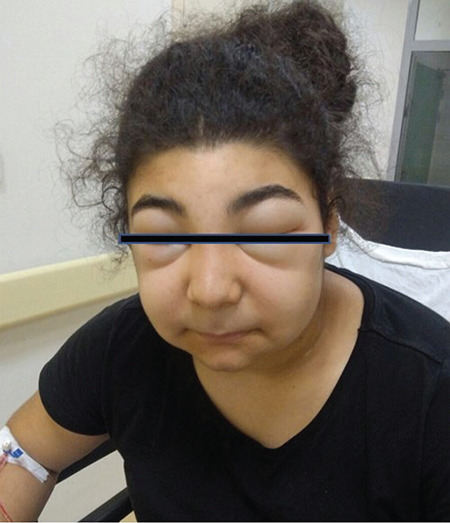
Hereditary angioedema (HAE) is characterized by recurrent angioedema attacks with no urticaria. This disease has a high mortality due to asphyxia. Level of complement component 4 (C4), C1 esterase inhibitor (C1-INH) level and function, and genetic mutations determine different endotypes of HAE. Clinical presentation and the triggers of vasogenic edema may change according to the endotypes. An adolescent girl with oligomenorrhea, obesity, hirsutism, and acanthosis nigricans was diagnosed with polycystic ovary syndrome and prescribed ethinyl estradiol and cyproterone acetate containing oral contraceptive (OC). On the sixteenth day of treatment, she developed angioedema of the face, neck, and chest leading to dyspnea. Adrenaline, antihistamine, and corticosteroid treatments were ineffective. In the family history, the patient’s mother and two cousins had a history of angioedema. C1-INH concentrate was administered with a diagnosis of HAE. C4 and C1-INH level and activity were normal. Genetic analysis identified a mutation in the factor 12 () gene, and the diagnosis of F12-related HAE was made. OC treatment was discontinued. She has had no additional angioedema attacks in the follow-up period of two years. OC containing estrogen may induce the life-threatening first attack of F12-related HAE even in children. Recurring angioedema attacks in the family should be asked before prescribing estrogen-containing OC pills.
遗传性血管性水肿(HAE)的特征是反复出现血管性水肿发作且无荨麻疹。由于窒息,这种疾病具有较高的死亡率。补体成分4(C4)水平、C1酯酶抑制剂(C1-INH)水平和功能以及基因突变决定了HAE的不同内型。临床表现和血管性水肿的触发因素可能因内型而异。一名患有月经过少、肥胖、多毛症和黑棘皮病的青春期女孩被诊断为多囊卵巢综合征,并开具了含有炔雌醇和醋酸环丙孕酮的口服避孕药(OC)。在治疗的第16天,她出现了面部、颈部和胸部的血管性水肿,导致呼吸困难。肾上腺素、抗组胺药和皮质类固醇治疗均无效。在家族史中,患者的母亲和两个表亲有血管性水肿病史。给予C1-INH浓缩物后诊断为HAE。C4和C1-INH水平及活性正常。基因分析在凝血因子12(F12)基因中发现了一个突变,从而做出了F12相关HAE的诊断。停用OC治疗。在两年的随访期内,她没有再次出现血管性水肿发作。含雌激素的OC即使在儿童中也可能诱发危及生命的F12相关HAE首次发作。在开具含雌激素的OC药丸之前,应询问家族中是否有反复出现的血管性水肿发作情况。