Zhang Haipeng, Wu Ti, Tian Xiaolin, Lyu Panpan, Wang Jianfei, Cao Yang
Department of Clinical Laboratory, The Second Hospital of Tianjin Medical University, Tianjin, China.
Department of Neurology, Tianjin Medical University General Hospital, Tianjin, China.
Front Neurol. 2021 Sep 8;12:705790. doi: 10.3389/fneur.2021.705790. eCollection 2021.
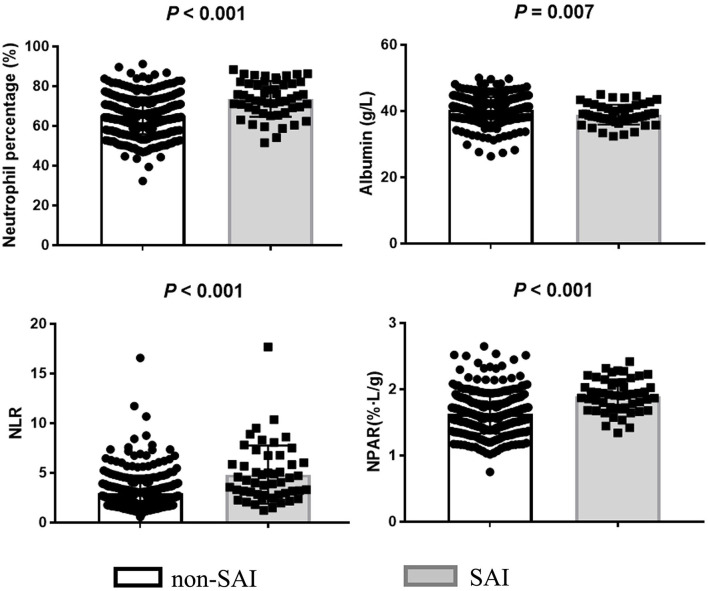
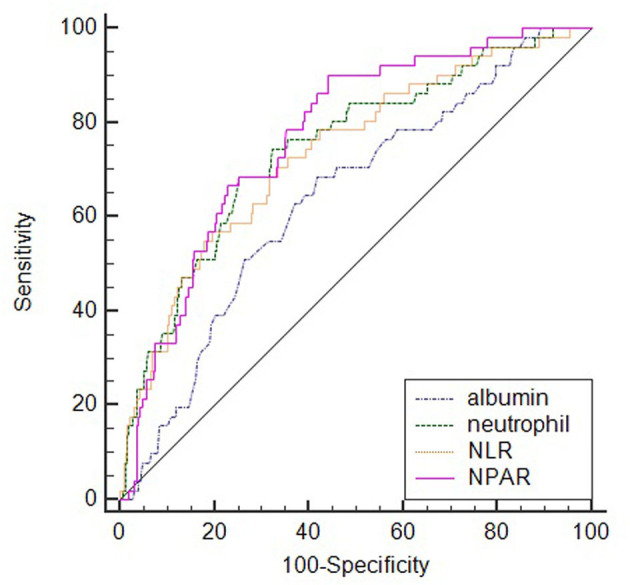
Stroke-associated infection (SAI) is associated with adverse outcomes in patients with acute ischemic stroke (AIS). In this study, we aimed to evaluate the association between neutrophil percentage-to-albumin ratio (NPAR) and SAI occurrence in patients with AIS. We retrospectively analyzed all AIS patients who were admitted to the Neurology ward of The Second Hospital of Tianjin Medical University from November 2018 to October 2020. The relationship between NPAR and SAI was analyzed by multivariable analysis. The receiver operating characteristic (ROC) curve was used to compare the predicted value of albumin, neutrophil percentage, neutrophil-to-lymphocyte ratio (NLR), and NPAR. We included 379 AIS patients out of which 51 (13.5%) developed SAI. The NPAR was independently associated with increased risk of SAI adjusting for confounders [adjusted odds ratio (aOR) = 10.52; 95% confidence interval (CI), 3.33-33.28; <0.001]. The optimal cutoff value of NPAR for predicting SAI incidence was 1.64, with sensitivity and specificity of 90.2 and 55.8%, respectively. The area under the curve (AUC) value of NPAR [0.771 (0.725-0.812)] was higher than that of albumin [0.640 (0.590-0.689)], neutrophil percentage [0.747 (0.700-0.790)], and NLR [0.736 (0.689-0.780)], though the statistical significance appeared only between NPAR and albumin. We demonstrated that a higher NPAR could predict the occurrence of SAI. Thus, NPAR might be a more effective biomarker to predict SAI compared with albumin, neutrophil percentage, and NLR.
卒中相关性感染(SAI)与急性缺血性卒中(AIS)患者的不良预后相关。在本研究中,我们旨在评估中性粒细胞百分比与白蛋白比值(NPAR)与AIS患者SAI发生之间的关联。我们回顾性分析了2018年11月至2020年10月在天津医科大学第二医院神经内科病房收治的所有AIS患者。通过多变量分析来分析NPAR与SAI之间的关系。采用受试者工作特征(ROC)曲线比较白蛋白、中性粒细胞百分比、中性粒细胞与淋巴细胞比值(NLR)和NPAR的预测价值。我们纳入了379例AIS患者,其中51例(13.5%)发生了SAI。在对混杂因素进行校正后,NPAR与SAI风险增加独立相关[校正比值比(aOR)=10.52;95%置信区间(CI),3.33 - 33.28;P<0.001]。预测SAI发生率的NPAR最佳截断值为1.64,敏感性和特异性分别为90.2%和55.8%。NPAR的曲线下面积(AUC)值[0.771(0.725 - 0.812)]高于白蛋白[0.640(0.590 - 0.689)]、中性粒细胞百分比[0.747(0.700 - 0.790)]和NLR[0.736(0.689 - 0.780)],尽管统计学显著性仅在NPAR与白蛋白之间出现。我们证明较高的NPAR可预测SAI的发生。因此,与白蛋白、中性粒细胞百分比和NLR相比,NPAR可能是预测SAI更有效的生物标志物。