Department of Psychiatry, First Hospital/First Clinical Medical College of Shanxi Medical University, Taiyuan, China.
School of Systems Biology, George Mason University, Fairfax, VA, United States.
Front Immunol. 2021 Sep 8;12:665160. doi: 10.3389/fimmu.2021.665160. eCollection 2021.
Deciphering the genetic relationships between major depressive disorder (MDD) and atopic diseases (asthma, hay fever, and eczema) may facilitate understanding of their biological mechanisms as well as the development of novel treatment regimens. Here we tested the genetic correlation between MDD and atopic diseases by linkage disequilibrium score regression.
A polygenic overlap analysis was performed to estimate shared genetic variations between the two diseases. Causal relationships between MDD and atopic diseases were investigated using two-sample bidirectional Mendelian randomization analysis. Genomic loci shared between MDD and atopic diseases were identified using cross-trait meta-analysis. Putative functional genes were evaluated by fine-mapping of transcriptome-wide associations.
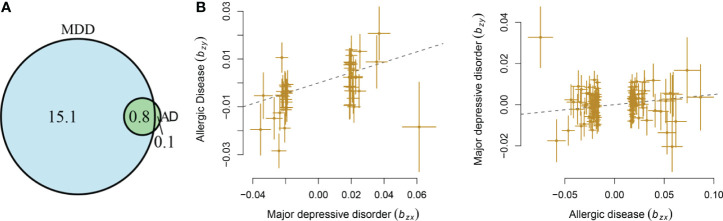
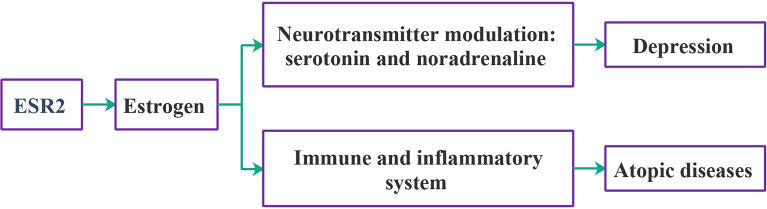
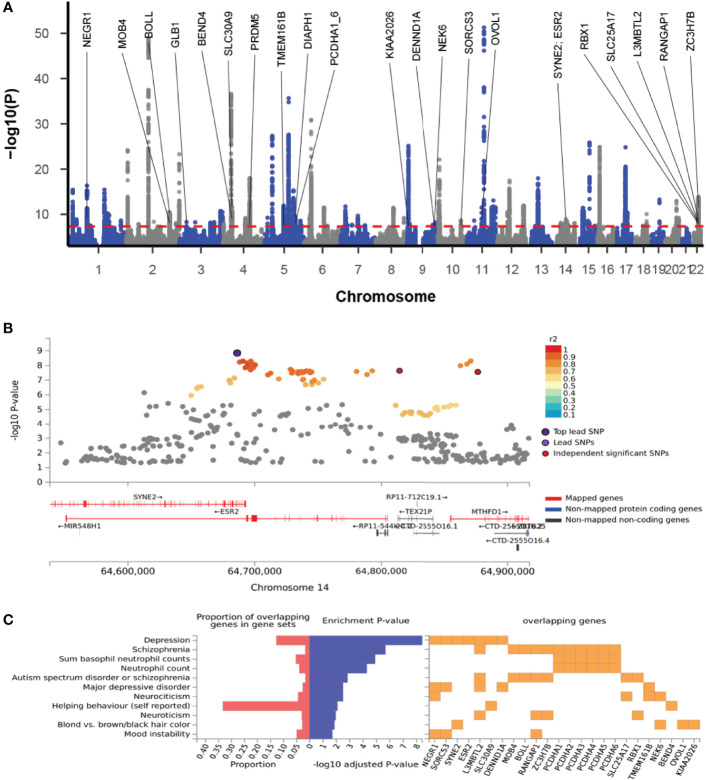
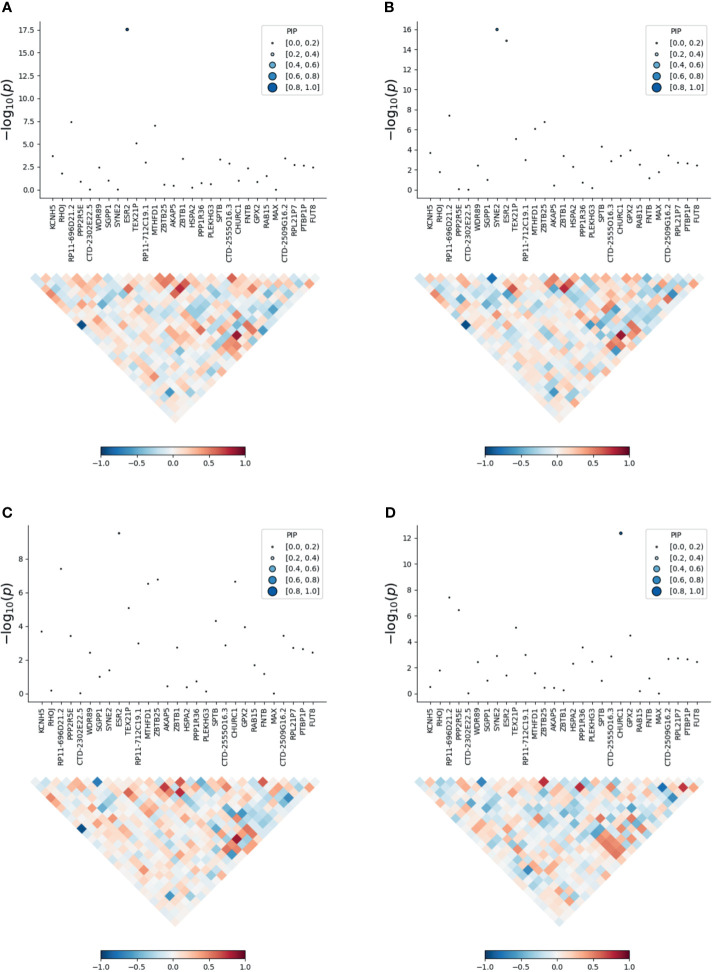
The polygenic analysis revealed approximately 15.8 thousand variants causally influencing MDD and 0.9 thousand variants influencing atopic diseases. Among these variants, approximately 0.8 thousand were shared between the two diseases. Mendelian randomization analysis indicates that genetic liability to MDD has a causal effect on atopic diseases (b = 0.22, p = 1.76 × 10), while genetic liability to atopic diseases confers a weak causal effect on MDD (b = 0.05, p = 7.57 × 10). Cross-trait meta-analyses of MDD and atopic diseases identified 18 shared genomic loci. Both fine-mapping of transcriptome-wide associations and analysis of existing literature suggest the estrogen receptor β-encoding gene as one of the potential risk factors for both MDD and atopic diseases.
Our findings reveal shared genetic liability and causal links between MDD and atopic diseases, which shed light on the phenotypic relationship between MDD and atopic diseases.
解析重度抑郁症(MDD)和特应性疾病(哮喘、花粉热和湿疹)之间的遗传关系,有助于理解它们的生物学机制以及新的治疗方案的开发。在这里,我们通过连锁不平衡评分回归来测试 MDD 和特应性疾病之间的遗传相关性。
进行多基因重叠分析,以估计两种疾病之间的共同遗传变异。使用两样本双向孟德尔随机化分析来研究 MDD 和特应性疾病之间的因果关系。使用跨性状荟萃分析确定 MDD 和特应性疾病之间共享的基因组位置。通过转录组关联的精细映射评估潜在的功能基因。
多基因分析显示,约有 15800 个变异可导致 MDD,约有 900 个变异可导致特应性疾病。在这些变异中,大约有 0.8 千个变异在两种疾病之间共享。孟德尔随机化分析表明,MDD 的遗传易感性对特应性疾病有因果影响(b=0.22,p=1.76×10),而特应性疾病的遗传易感性对 MDD 有微弱的因果影响(b=0.05,p=7.57×10)。MDD 和特应性疾病的跨性状荟萃分析确定了 18 个共享的基因组位置。转录组关联的精细映射和现有文献的分析均表明雌激素受体β编码基因是 MDD 和特应性疾病的潜在风险因素之一。
我们的发现揭示了 MDD 和特应性疾病之间存在共同的遗传易感性和因果关系,这为 MDD 和特应性疾病之间的表型关系提供了启示。