Schonmann Yochai, Mansfield Kathryn E, Hayes Joseph F, Abuabara Katrina, Roberts Amanda, Smeeth Liam, Langan Sinéad M
Department of Non-Communicable Disease Epidemiology, Faculty of Epidemiology and Population Health, London School of Hygiene and Tropical Medicine, London, United Kingdom; Clalit Health Services, Department of Family Medicine, Rabin Medical Center, Petah Tikva, Israel; Department of Family Medicine, Sackler Faculty of Medicine, Tel-Aviv University, Tel-Aviv, Israel.
Department of Non-Communicable Disease Epidemiology, Faculty of Epidemiology and Population Health, London School of Hygiene and Tropical Medicine, London, United Kingdom.
J Allergy Clin Immunol Pract. 2020 Jan;8(1):248-257.e16. doi: 10.1016/j.jaip.2019.08.030. Epub 2019 Aug 31.
Atopic eczema is a common and debilitating condition associated with depression and anxiety, but the nature of this association remains unclear.
To explore the temporal relationship between atopic eczema and new depression/anxiety.
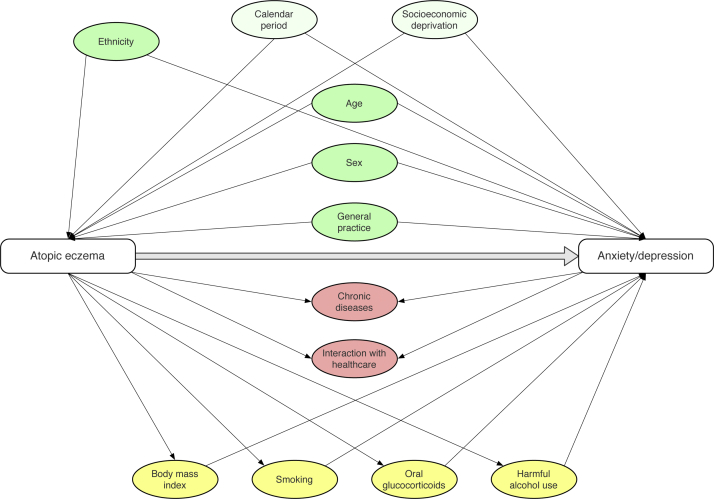
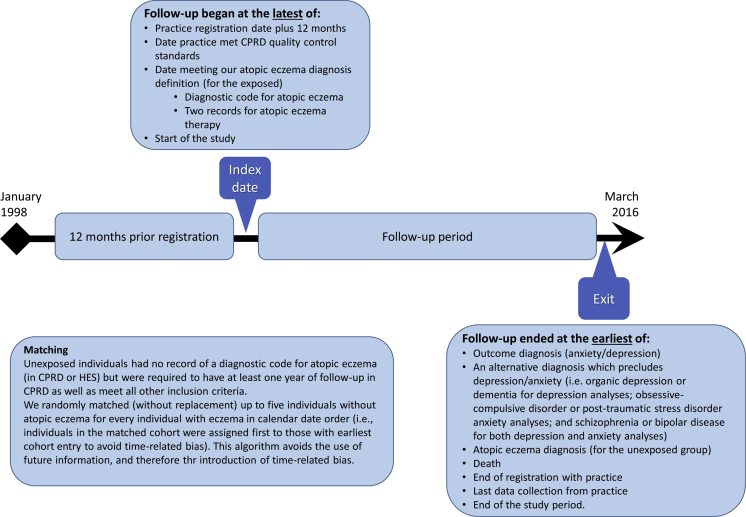
This matched cohort study used routinely collected data from the UK Clinical Practice Research Datalink, linked to hospital admissions data. We identified adults with atopic eczema (1998-2016) using a validated algorithm, and up to 5 individuals without atopic eczema matched on date of diagnosis, age, sex, and general practice. We estimated the hazard ratio (HR) for new depression/anxiety using stratified Cox regression to account for age, sex, calendar period, Index of Multiple Deprivation, glucocorticoid treatment, obesity, smoking, and harmful alcohol use.
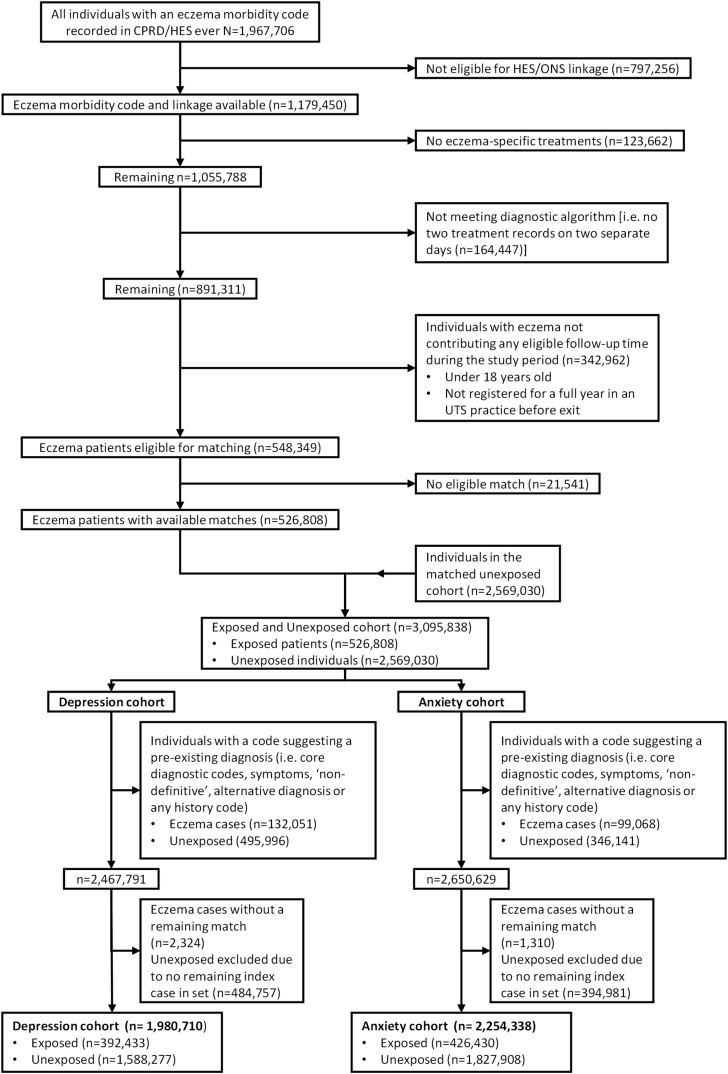
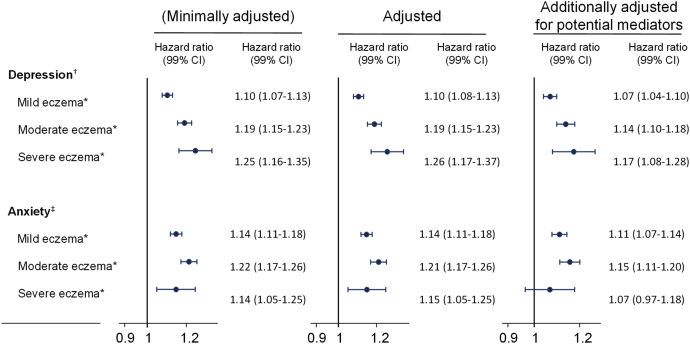
We identified 526,808 adults with atopic eczema who were matched to 2,569,030 without. Atopic eczema was associated with increased incidence of new depression (HR, 1.14; 99% CI, 1.12-1.16) and anxiety (HR, 1.17; 99% CI, 1.14-1.19). We observed a stronger effect of atopic eczema on depression with increasing atopic eczema severity (HR [99% CI] compared with no atopic eczema: mild, 1.10 [1.08-1.13]; moderate, 1.19 [1.15-1.23]; and severe, 1.26 [1.17-1.37]). A dose-response association, however, was less apparent for new anxiety diagnosis (HR [99% CI] compared with no atopic eczema: mild, 1.14 [1.11-1.18]; moderate, 1.21 [1.17-1.26]; and severe, 1.15; [1.05-1.25]).
Adults with atopic eczema are more likely to develop new depression and anxiety. For depression, we observed a dose-response relationship with atopic eczema severity.
特应性湿疹是一种常见且使人衰弱的疾病,与抑郁和焦虑相关,但这种关联的本质仍不清楚。
探讨特应性湿疹与新发抑郁/焦虑之间的时间关系。
这项匹配队列研究使用了从英国临床实践研究数据链常规收集的数据,并与医院入院数据相链接。我们使用经过验证的算法识别出患有特应性湿疹的成年人(1998 - 2016年),并为每位患者匹配多达5名在诊断日期、年龄、性别和全科医疗方面相匹配但无特应性湿疹的个体。我们使用分层Cox回归估计新发抑郁/焦虑的风险比(HR),以考虑年龄、性别、日历时期、多重剥夺指数、糖皮质激素治疗、肥胖、吸烟和有害饮酒情况。
我们识别出526,808名患有特应性湿疹的成年人,他们与2,569,030名无特应性湿疹的成年人相匹配。特应性湿疹与新发抑郁(HR,1.14;99%CI,1.12 - 1.16)和焦虑(HR,1.17;99%CI,1.14 - 1.19)的发病率增加相关。随着特应性湿疹严重程度的增加,我们观察到特应性湿疹对抑郁的影响更强(与无特应性湿疹相比,HR[99%CI]:轻度,1.10[1.08 - 1.13];中度,1.19[1.15 - 1.23];重度,1.26[1.17 - 1.37])。然而,对于新发焦虑诊断,剂量反应关联不太明显(与无特应性湿疹相比,HR[99%CI]:轻度,1.14[1.11 - 1.18];中度,1.21[1.17 - 1.26];重度,1.15;[1.05 - 1.25])。
患有特应性湿疹的成年人更有可能出现新发抑郁和焦虑。对于抑郁,我们观察到与特应性湿疹严重程度存在剂量反应关系。