Department of Cardiovascular Sciences, University of Leicester, Leicester, United Kingdom.
John Walls Renal Unit, University Hospitals of Leicester National Health Service (NHS) Trust, Leicester, United Kingdom.
Front Immunol. 2021 Sep 9;12:712572. doi: 10.3389/fimmu.2021.712572. eCollection 2021.
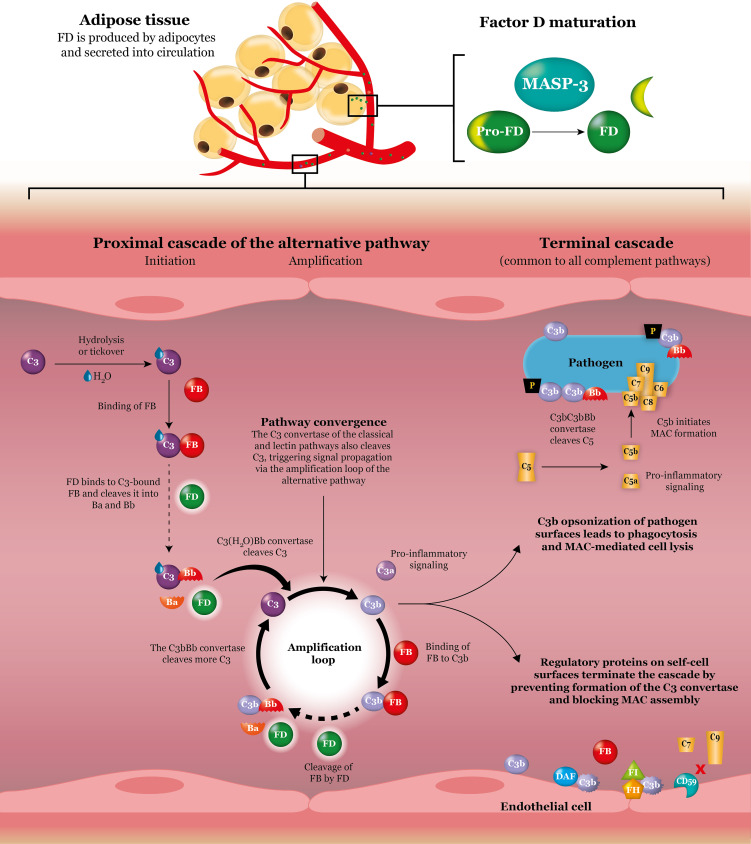
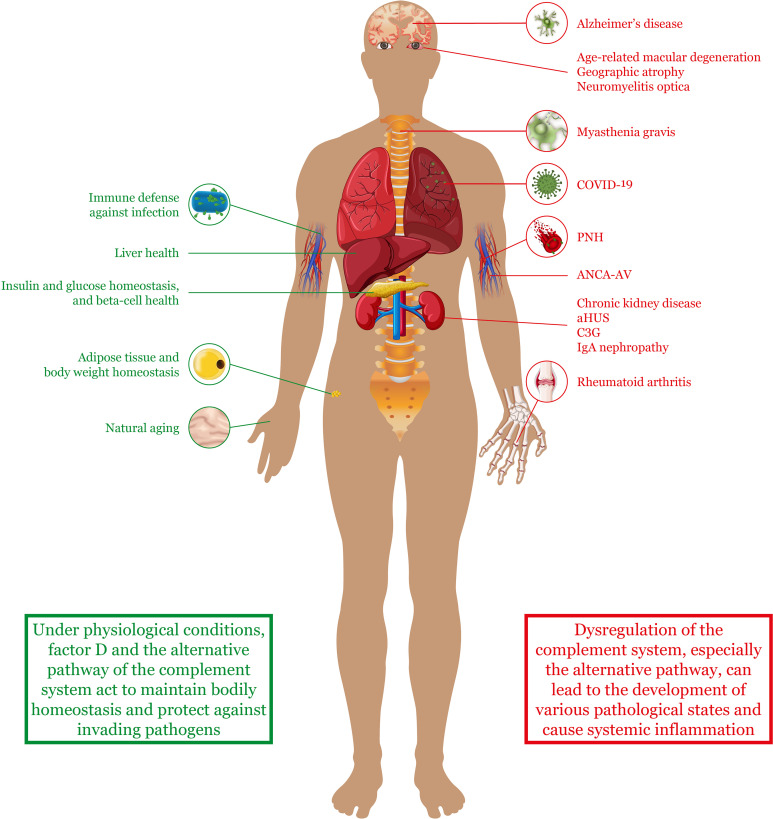
The complement system is central to first-line defense against invading pathogens. However, excessive complement activation and/or the loss of complement regulation contributes to the development of autoimmune diseases, systemic inflammation, and thrombosis. One of the three pathways of the complement system, the alternative complement pathway, plays a vital role in amplifying complement activation and pathway signaling. Complement factor D, a serine protease of this pathway that is required for the formation of C3 convertase, is the rate-limiting enzyme. In this review, we discuss the function of factor D within the alternative pathway and its implication in both healthy physiology and disease. Because the alternative pathway has a role in many diseases that are characterized by excessive or poorly mediated complement activation, this pathway is an enticing target for effective therapeutic intervention. Nonetheless, although the underlying disease mechanisms of many of these complement-driven diseases are quite well understood, some of the diseases have limited treatment options or no approved treatments at all. Therefore, in this review we explore factor D as a strategic target for advancing therapeutic control of pathological complement activation.
补体系统是抵御入侵病原体的第一道防线的核心。然而,补体过度激活和/或补体调节缺失导致自身免疫性疾病、全身炎症和血栓形成。补体系统的三条途径之一,即替代补体途径,在放大补体激活和途径信号方面发挥着至关重要的作用。补体因子 D 是该途径中的一种丝氨酸蛋白酶,是形成 C3 转化酶所必需的,是限速酶。在这篇综述中,我们讨论了因子 D 在替代途径中的功能及其在健康生理和疾病中的意义。由于替代途径在许多以补体过度激活或调节不良为特征的疾病中发挥作用,因此该途径是有效治疗干预的诱人靶点。尽管许多补体驱动的疾病的潜在疾病机制已经相当清楚,但其中一些疾病的治疗选择有限,甚至根本没有批准的治疗方法。因此,在这篇综述中,我们探讨了因子 D 作为推进病理性补体激活治疗控制的战略靶点。