Nicolau Jéssica Silva, Lopez Rossana Veronica Mendoza, de Moraes Luizaga Carolina Terra, Ribeiro Karina Braga, Roela Rosimeire Aparecida, Maistro Simone, Katayama Maria Lucia Hirata, Natalino Renato José Mendonça, de Castro Gilberto, Neto Jose Eluf, Folgueira Maria Aparecida Azevedo Koike
Instituto do Câncer do Estado de São Paulo (ICESP), Hospital das Clinicas HCFMUSP, Faculdade de Medicina, Universidade de Sao Paulo, Sao Paulo, SP, 01246-000, Brazil.
JSN and RVML contributed equally to this work.
Ecancermedicalscience. 2021 Aug 24;15:1279. doi: 10.3332/ecancer.2021.1279. eCollection 2021.
The influence of age at diagnosis in non-small cell lung cancer (NSCLC) prognosis is unclear.
To compare in a Brazilian cohort of NSCLC patients of different age groups: 1) The overall survival; 2) Clinical features and treatment options.
This is a retrospective cohort study using a hospital-based registry, for NSCLC patients registered in years 2000-2009. Patients were grouped into three age groups: Young adults (YA: < 40 years), middle-aged (MA: 40-64 years) and elderly (E: ≥ 65 years). Kaplan-Meier was used to estimate overall survival and Cox regression for hazard ratios (HRs) and 95% confidence intervals.
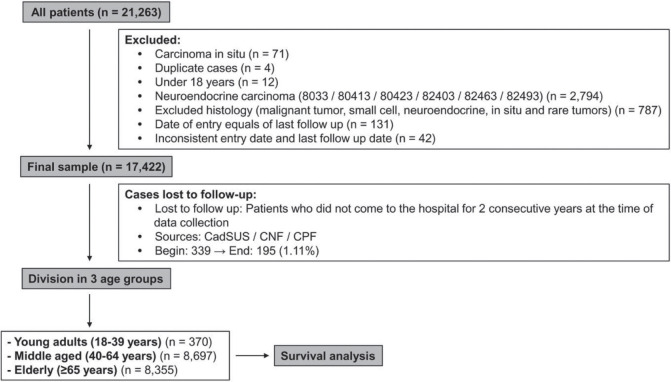
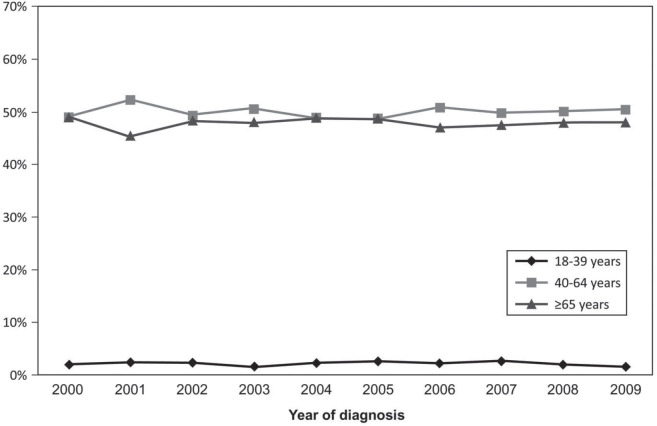
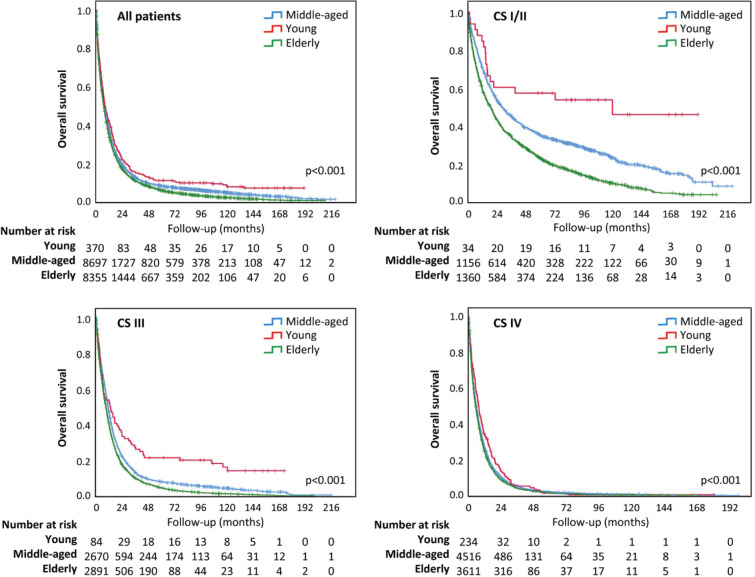
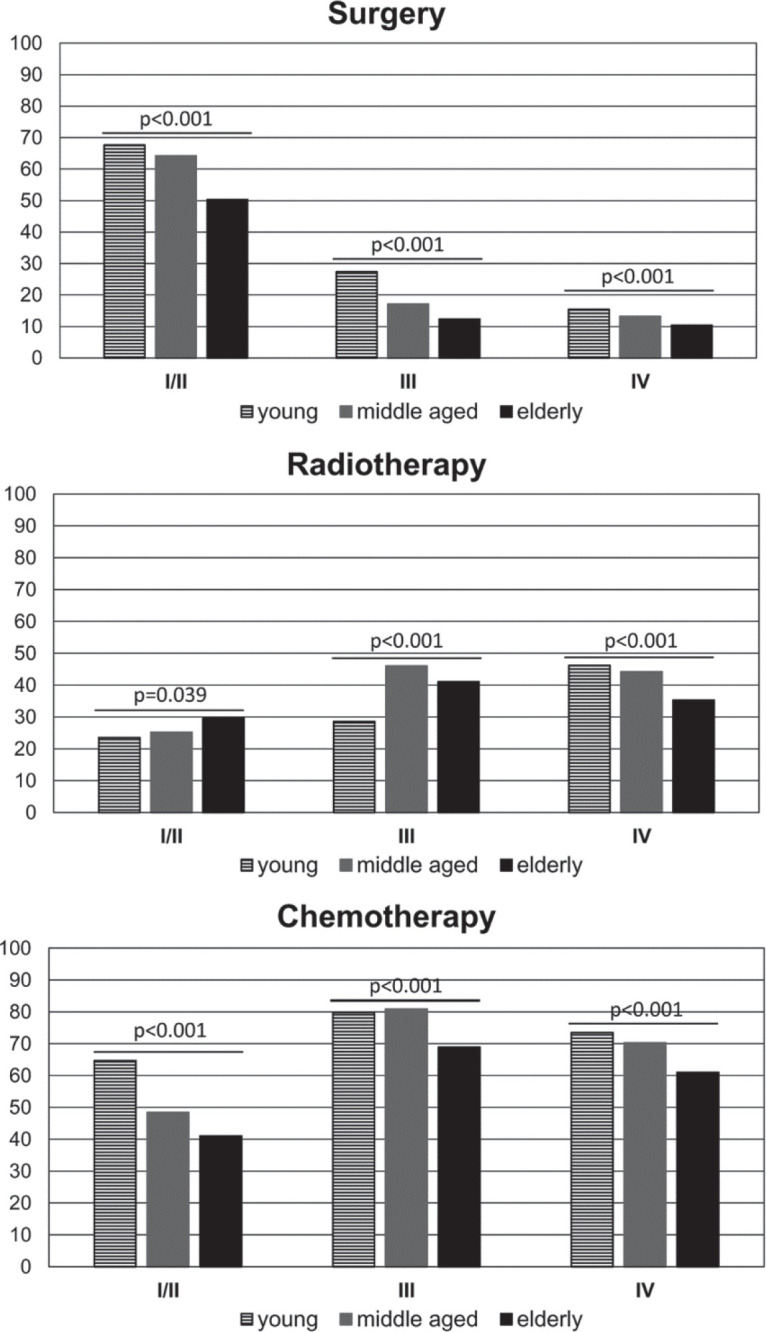
17,422 NSCLC patients were included: 370 YA (2.1%), 8,697 MA (49.9%) and 8,355 E (48.0%). Compared with older age groups, the YA group had a higher proportion of females, patients diagnosed with adenocarcinoma and metastatic disease (63.2%). Overall survival was longer in YA in the entire cohort and in all clinical stages (CSs) (p < 0.001). For YA, higher education level was a good prognosis factor (compared with illiterate and incomplete elementary); advanced or metastatic disease (compared with early-stage disease) and treatment based in radiotherapy or chemotherapy (CT) (without surgery), compared with treatment combinations with surgery, were poor prognostic factors. Young men (but not women) had lower HR of death compared with older groups; YA had lower HR of death in all CSs compared with patients from older groups. A higher percentage of YA were treated with surgery or CT in early-stage disease compared with older groups. Besides that, YA and MA patients treated with surgery or CT had a better prognosis than elderlies. Conclusions: In this Brazilian cohort of NSCLC patients, most young individuals were diagnosed with metastatic disease. YA presented longer survival than older age groups in all CSs, but mainly in CS I/II and III, where some patients may achieve long remissions or cure.
非小细胞肺癌(NSCLC)诊断时的年龄对预后的影响尚不清楚。
在巴西一组不同年龄组的NSCLC患者中进行比较:1)总生存期;2)临床特征和治疗选择。
这是一项回顾性队列研究,使用基于医院的登记系统,纳入2000 - 2009年登记的NSCLC患者。患者分为三个年龄组:青年成人(YA:<40岁)、中年(MA:40 - 64岁)和老年(E:≥65岁)。采用Kaplan - Meier法估计总生存期,并采用Cox回归分析风险比(HRs)和95%置信区间。
共纳入17422例NSCLC患者:370例青年成人(2.1%)、8697例中年患者(49.9%)和8355例老年患者(48.0%)。与老年组相比,青年成人组女性、诊断为腺癌和转移性疾病的患者比例更高(63.2%)。在整个队列以及所有临床分期(CSs)中,青年成人组的总生存期更长(p < 0.001)。对于青年成人组,较高的教育水平是一个良好的预后因素(与文盲和小学未毕业相比);晚期或转移性疾病(与早期疾病相比)以及基于放疗或化疗(CT)(无手术)的治疗,与手术联合治疗相比,是不良预后因素。与老年组相比,青年男性(但女性不是)的死亡HR较低;与老年组患者相比,青年成人组在所有CSs中的死亡HR较低。与老年组相比,青年成人组在早期疾病中接受手术或CT治疗的比例更高。此外,接受手术或CT治疗的青年成人和中年患者的预后比老年患者更好。结论:在这个巴西的NSCLC患者队列中,大多数年轻个体被诊断为转移性疾病。青年成人组在所有CSs中均表现出比老年组更长的生存期,但主要在CS I/II和III期,其中一些患者可能实现长期缓解或治愈。