Abu-Halima Masood, Meese Eckart, Abdul-Khaliq Hashim, Raedle-Hurst Tanja
Institute of Human Genetics, Saarland University Medical Center, Homburg, Germany.
Department of Pediatric Cardiology, Saarland University Medical Center, Homburg, Germany.
Front Cardiovasc Med. 2021 Sep 8;8:730364. doi: 10.3389/fcvm.2021.730364. eCollection 2021.
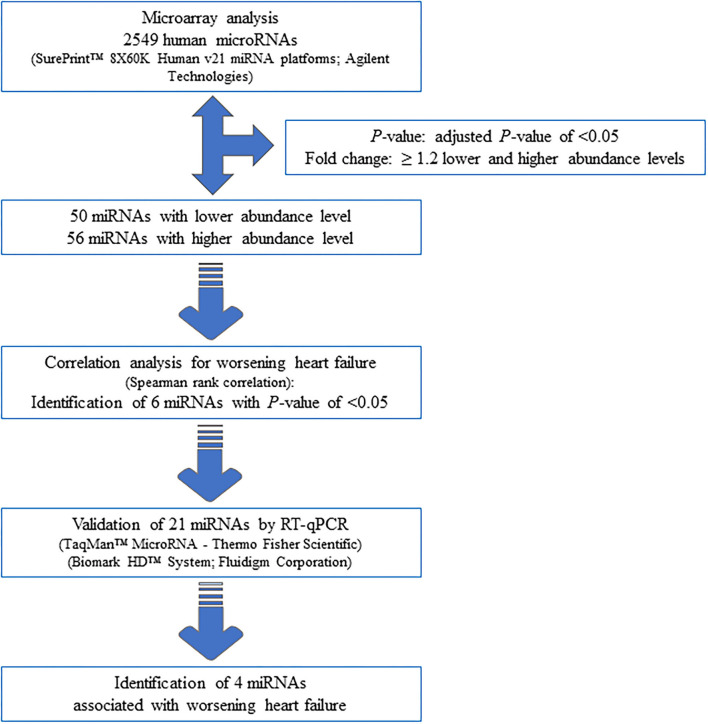
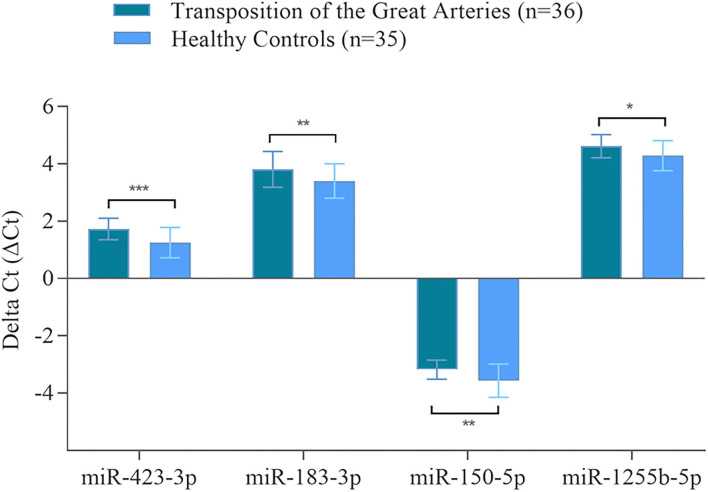
MicroRNAs (miRNAs) have been shown to play an important role in the progression of heart failure (HF). The aim of our study was to analyze miRNAs in the blood of patients with transposition of the great arteries and a systemic right ventricle (TGA-RV) in order to identify those that predict worsening HF. In 36 patients with TGA-RV, SurePrint™ 8 × 60K Human v21 miRNA microarrays were used to determine the miRNA abundance profiles and compared to 35 age- and gender-matched healthy volunteers (HVs). MiRNAs that were most significantly abundant or best related to worsening HF were further validated by RT-qPCR. Using miRNA array analysis, a total of 50 down-regulated and 56 up-regulated miRNAs were found to be differentially abundant in TGA-RV patients compared to HVs. Six of these 106 miRNAs were significantly related to worsening HF. After validation by RT-qPCR, four miRNAs turned out to be significantly associated with worsening HF, namely miR-150-5p, miR-1255b-5p, miR-423-3p, and miR-183-3p. In the stepwise multivariable Cox regression analysis, ejection fraction of the systemic RV, high sensitive TNT and miR-183-3p were found to be independent predictors of worsening HF ( = 0.001, = 0.002, and = 0.001, respectively). In patients with TGA-RV, miR-183-3p is an independent predictor of worsening HF and thus may be used as additional biomarker in the risk assessment of these patients.
微小RNA(miRNA)已被证明在心力衰竭(HF)进展中起重要作用。我们研究的目的是分析大动脉转位合并体循环右心室(TGA-RV)患者血液中的miRNA,以识别那些可预测HF恶化的miRNA。在36例TGA-RV患者中,使用SurePrint™ 8×60K人类v21 miRNA微阵列来确定miRNA丰度谱,并与35名年龄和性别匹配的健康志愿者(HV)进行比较。与HF恶化最显著相关或最密切相关的miRNA通过逆转录定量聚合酶链反应(RT-qPCR)进一步验证。使用miRNA阵列分析,发现与HV相比,TGA-RV患者中共有50种下调和56种上调的miRNA存在差异丰度。这106种miRNA中的6种与HF恶化显著相关。经RT-qPCR验证后,四种miRNA被证明与HF恶化显著相关,即miR-150-5p、miR-1255b-5p、miR-423-3p和miR-183-3p。在逐步多变量Cox回归分析中,发现体循环右心室射血分数、高敏肌钙蛋白T和miR-183-3p是HF恶化的独立预测因子(分别为P = 0.001、P = 0.002和P = 0.001)。在TGA-RV患者中,miR-183-3p是HF恶化的独立预测因子,因此可作为这些患者风险评估中的额外生物标志物。