Adachi Yuya, Kinoshita Yoshihisa, Murata Akira, Kawase Yoshiaki, Okubo Munenori, Suzuki Yoriyasu, Ito Tatsuya, Matsuo Hitoshi, Suzuki Takahiko
Department of Cardiology, Toyohashi Heart Center, Aichi, Japan.
Department of Cardiology, Nagoya Heart Center, Aichi, Japan.
Int J Cardiol Heart Vasc. 2021 Sep 16;36:100873. doi: 10.1016/j.ijcha.2021.100873. eCollection 2021 Oct.
The aim of this study was to identify the predictive factors for suboptimal result in side branch (SB) in chronic total occlusion (CTO) bifurcation lesions and clinical outcomes of patients with suboptimal result in SB.
There is little evidence on the optimal strategy for bifurcation lesions in CTO.
We retrospectively reviewed 314 consecutive bifurcation lesions in CTO with SB ≥ 2.5 mm in 3 hospitals from March 2010 to June 2018. Patients were divided into the two groups based on the suboptimal SB treatment (SST) and optimal SB treatment (OST) groups. The baseline characteristics, procedural and clinical outcomes were compared between the two groups. This study also evaluated the predictors of suboptimal result in SB.
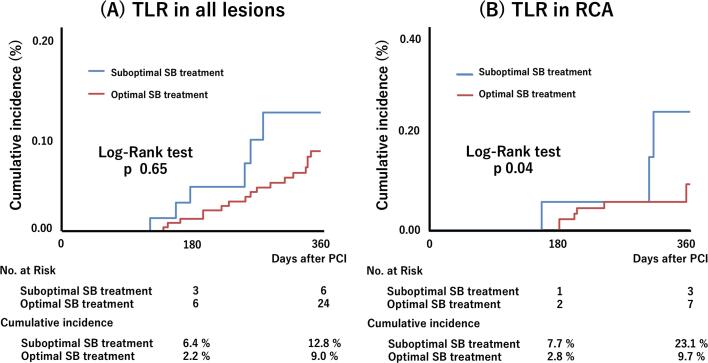
Suboptimal result in SB occurred in 47 cases. Presence of stenosis in SB, bifurcations located within the occluded segment and sub-intimal tracking at SB ostium was an independent predictor of suboptimal result in SB. The cumulative incidence of target lesion revascularization (TLR) in all lesions was not significantly different between the two groups, however, TLR in right coronary artery (RCA) was significantly higher in the SST group. In the Cox regression analysis, suboptimal result in SB in RCA and sub-intimal tracking were independent predictors of TLR for MB. In patients with bifurcations located within the occluded segment, usage of two-stent technique was significantly lower in the SST group.
Meticulous procedures are required for SB preservation to improve not only SB prognosis but also MB, especially in RCA.
本研究旨在确定慢性完全闭塞(CTO)分叉病变边支(SB)预后欠佳的预测因素以及SB预后欠佳患者的临床结局。
关于CTO分叉病变的最佳策略,证据较少。
我们回顾性分析了2010年3月至2018年6月期间3家医院连续收治的314例CTO分叉病变患者,这些患者的SB≥2.5 mm。根据边支治疗欠佳(SST)组和边支治疗最佳(OST)组将患者分为两组。比较两组患者的基线特征、手术和临床结局。本研究还评估了SB预后欠佳的预测因素。
47例患者出现SB预后欠佳。SB存在狭窄、分叉位于闭塞段内以及SB开口处的内膜下走行是SB预后欠佳的独立预测因素。两组所有病变的靶病变血运重建(TLR)累积发生率无显著差异,然而,SST组右冠状动脉(RCA)的TLR显著更高。在Cox回归分析中,RCA中SB预后欠佳和内膜下走行是MB发生TLR的独立预测因素。在分叉位于闭塞段内的患者中,SST组双支架技术的使用率显著更低。
为改善SB及主支(MB)的预后,尤其是RCA的预后,保留SB需要细致的操作。