Braun Erik, Sebestyén Tamás, Kiss Tibor
Faculty of Business and Economics, University of Pécs, Pecs, Hungary.
Institute of Regional Studies, Eötvös Loránd Research Network, Centre for Economic and Regional Studies, Pecs, Hungary.
Appl Netw Sci. 2021;6(1):69. doi: 10.1007/s41109-021-00411-5. Epub 2021 Sep 19.
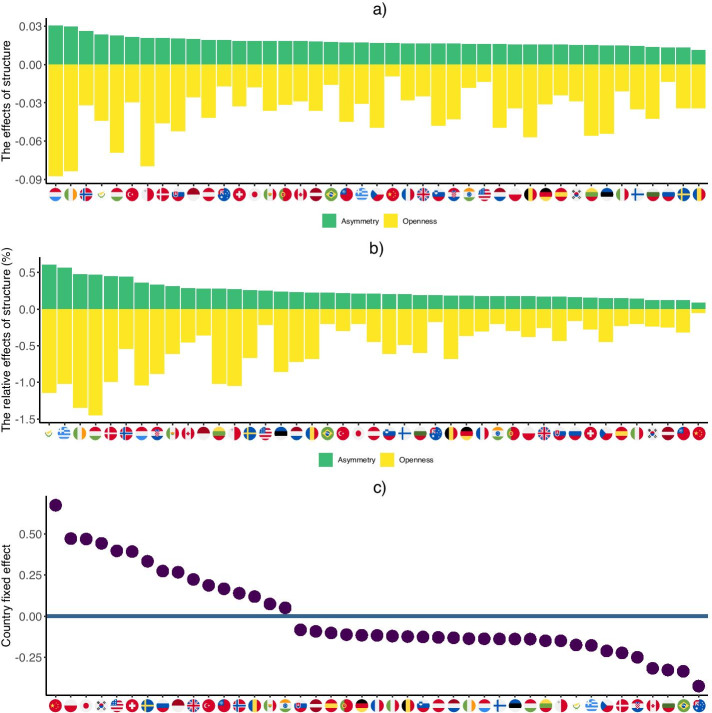
There has been an increasing interest in analyzing the structure of domestic and global supply chains/networks in the past decade. Concerns about potential (systemic) risks resulting from overdependence on global supply networks have been magnified during the lockdowns triggered by the COVID-19 pandemic in the last year. Strengthening local and/or domestic networks may be an adequate approach to overcome the severe economic implications of this overdependence, but it also rises the question of how one can measure the strength of domestic supply/production networks and design an appropriate structure. The objective of this paper is to propose a method for measurement and to provide a first-cut analysis with this method on a sample of economies. Building on ecological network analysis, we borrow the Finn cycling index from its toolbox and show a ranking of countries with respect to the strength of their domestic production networks based on this index. The results suggest that the countries are very heterogeneous both in terms of the level of cycling index and its sectoral decomposition. Using panel-econometric techniques, we point out the role of the openness and structural asymmetry in shaping this strength, also controlling for other macroeconomic characteristics of the economies. The estimates reveal that openness has a negative, while asymmetry has a positive effect on this index, but other country-specific characteristics also play a role in shaping the systemic operation of national economies as measured by the Finn cycling index.
在过去十年中,人们对分析国内和全球供应链/网络的结构越来越感兴趣。去年,由新冠疫情引发的封锁期间,对过度依赖全球供应网络所带来的潜在(系统性)风险的担忧被放大。加强本地和/或国内网络可能是克服这种过度依赖所带来的严重经济影响的一种适当方法,但这也引发了一个问题,即如何衡量国内供应/生产网络的强度并设计出合适的结构。本文的目的是提出一种衡量方法,并使用该方法对一些经济体样本进行初步分析。基于生态网络分析,我们从其工具箱中借用芬循环指数,并基于该指数展示各国国内生产网络强度的排名。结果表明,各国在循环指数水平及其部门分解方面差异很大。使用面板计量技术,我们指出了开放性和结构不对称性在塑造这种强度方面的作用,同时也控制了经济体的其他宏观经济特征。估计结果显示,开放性对该指数有负面影响,而不对称性有正面影响,但其他特定国家的特征在塑造以芬循环指数衡量的国民经济系统运行方面也发挥着作用。