Instituto Nacional de Salud Pública, Centro Regional de Investigación en Salud Pública, Tapachula, Chiapas, México.
El Colegio de la Frontera Sur, Unidad Tapachula, Tapachula, Chiapas, México.
PLoS Negl Trop Dis. 2021 Sep 27;15(9):e0009746. doi: 10.1371/journal.pntd.0009746. eCollection 2021 Sep.
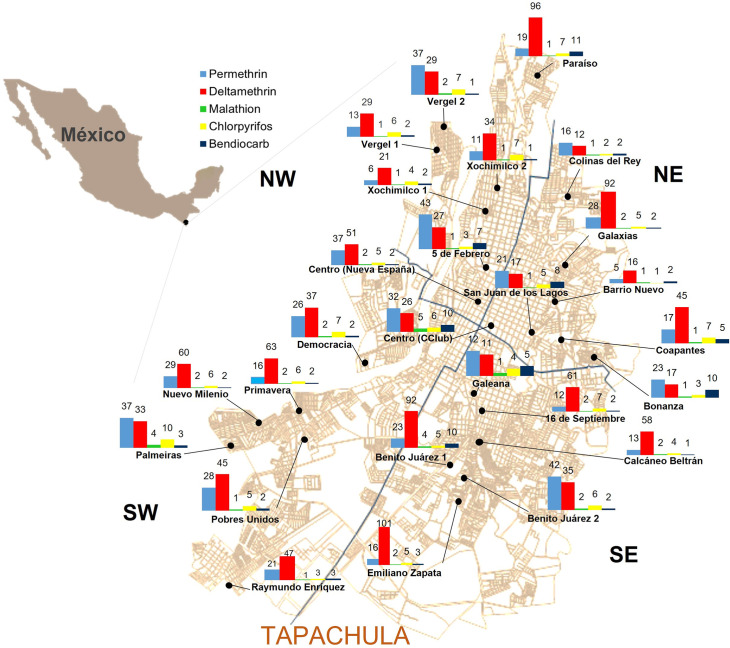
Insecticide use continues as the main strategy to control Aedes aegypti, the vector of dengue, Zika, chikungunya, and yellow fever. In the city of Tapachula, Mexico, mosquito control programs switched from pyrethroids to organophosphates for outdoor spatial spraying in 2013. Additionally, the spraying scheme switched from total coverage to focused control, prioritizing areas with higher entomological-virological risk. Five years after this strategy had been implemented, we evaluated the status and variability of insecticide resistance among Ae. aegypti collected at 26 sites in Tapachula.
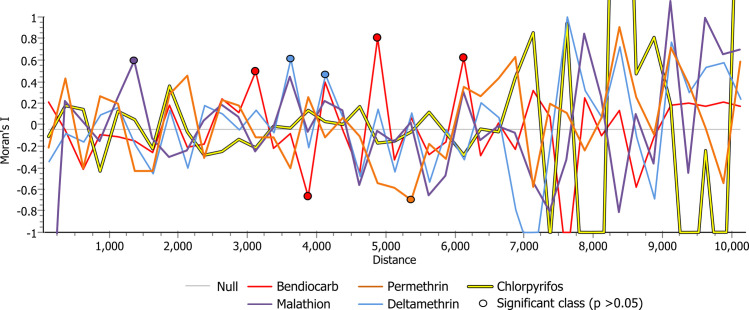
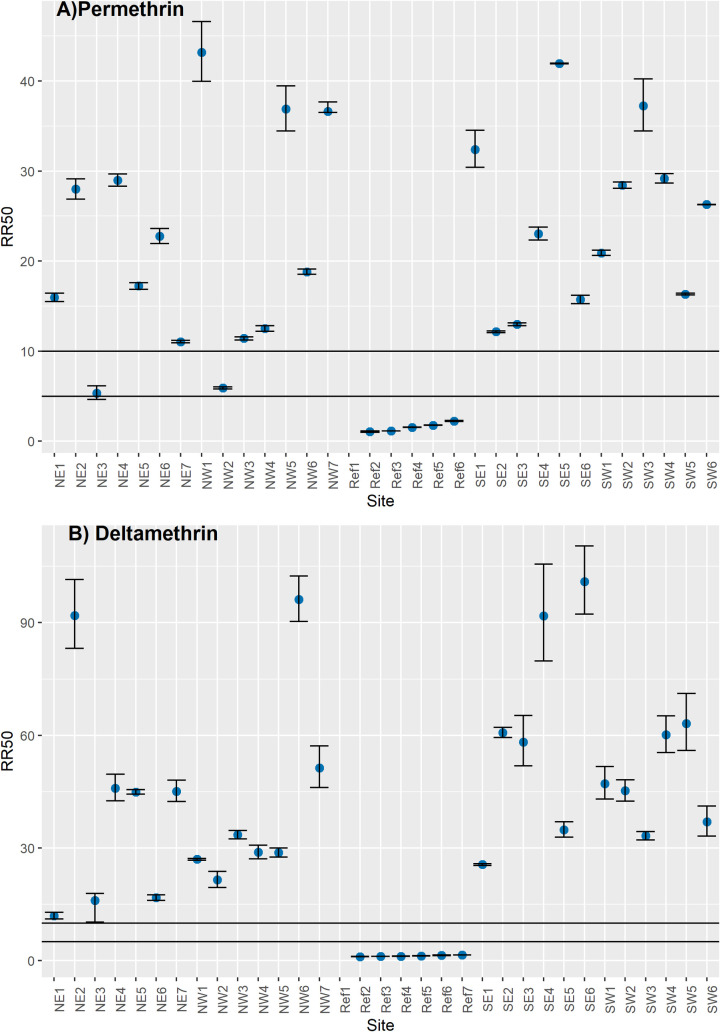
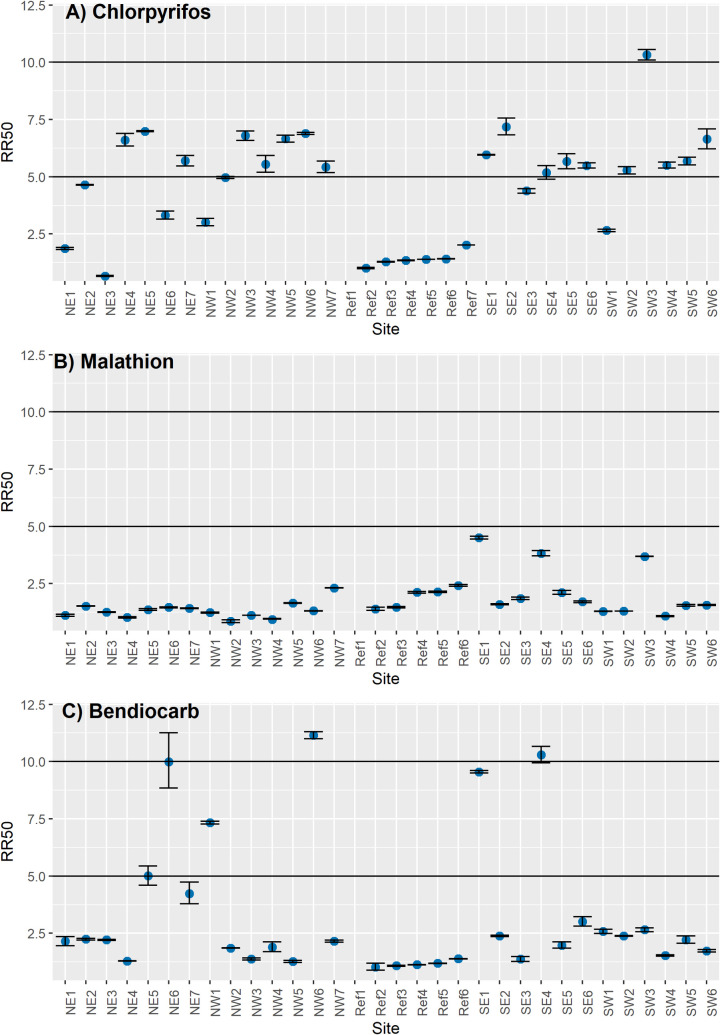
METHODOLOGY/PRINCIPAL FINDINGS: We determined the lethal concentrations at 50% of the tested populations (LC50) using a bottle bioassay, and then, we calculated the resistance ratio (RR) relative to the susceptible New Orleans strain. Permethrin and deltamethrin (pyrethroids), chlorpyrifos and malathion (organophosphates), and bendiocarb (carbamate) were tested. The frequencies of the substitutions V1016I and F1534C, which are in the voltage-gated sodium channel and confer knockdown-resistance (kdr) to pyrethroid insecticides, were calculated. Despite 5 years having passed since the removal of pyrethroids from the control programs, Ae. aegypti remained highly resistant to permethrin and deltamethrin (RR > 10-fold). In addition, following 5 years of chlorpyrifos use, mosquitoes at 15 of 26 sites showed moderate resistance to chlorpyrifos (5- to 10-fold), and the mosquitoes from one site were highly resistant. All sites had low resistance to malathion (< 5-fold). Resistance to bendiocarb was low at 19 sites, moderate at five, and high at two. Frequencies of the V1016I ranged from 0.16-0.71, while C1534 approached fixation at 23 sites (0.8-1). Resistance profiles and kdr allele frequencies varied across Tapachula. The variability was not associated with a spatial pattern at the scale of the sampling.
CONCLUSION/SIGNIFICANCE: Mosquito populations respond to selection pressure at a focal scale in the field. Spatial variation across sites highlights the importance of testing multiple sites within geographical regions.
杀虫剂的使用仍是控制登革热、寨卡病毒、基孔肯雅热和黄热病传播媒介埃及伊蚊的主要策略。在墨西哥塔帕丘拉市,2013 年,蚊虫控制项目将户外空间喷洒的杀虫剂从拟除虫菊酯类更换为有机磷类。此外,喷洒方案从全面覆盖改为重点控制,优先考虑具有更高虫媒病毒风险的区域。在实施该策略五年后,我们评估了在塔帕丘拉的 26 个地点收集的埃及伊蚊的抗药性现状和变化情况。
方法/主要发现:我们使用瓶测法确定了测试种群的半数致死浓度(LC50),然后计算了与敏感的新奥尔良品系的抗性比值(RR)。测试了拟除虫菊酯类的氯菊酯和溴氰菊酯、有机磷类的毒死蜱和马拉硫磷以及氨基甲酸酯类的丁醚脲。计算了电压门控钠离子通道中的 V1016I 和 F1534C 取代的频率,这些取代赋予了对拟除虫菊酯类杀虫剂的击倒抗性(kdr)。尽管在控制项目中停止使用拟除虫菊酯已经过去 5 年,但埃及伊蚊对氯菊酯和溴氰菊酯仍保持高度抗性(RR>10 倍)。此外,在使用毒死蜱 5 年后,26 个地点中的 15 个地点的蚊子对毒死蜱表现出中等抗性(5-10 倍),一个地点的蚊子则表现出高度抗性。所有地点对马拉硫磷的抗性均较低(<5 倍)。19 个地点对丁醚脲的抗性较低,5 个地点为中度,2 个为高度。V1016I 的频率范围为 0.16-0.71,而 C1534 在 23 个地点接近固定(0.8-1)。抗药性谱和 kdr 等位基因频率在塔帕丘拉各地有所不同。这种变异性与采样规模的空间模式无关。
结论/意义:蚊子种群在现场的焦点尺度上对选择压力作出反应。各地之间的差异突出了在地理区域内测试多个地点的重要性。