Division of Cardiovascular Disease, The University of Alabama at Birmingham, Birmingham, AL 35294, USA.
School of Health Professions, The University of Alabama at Birmingham, Birmingham, AL 35294, USA.
Cells. 2021 Sep 14;10(9):2412. doi: 10.3390/cells10092412.
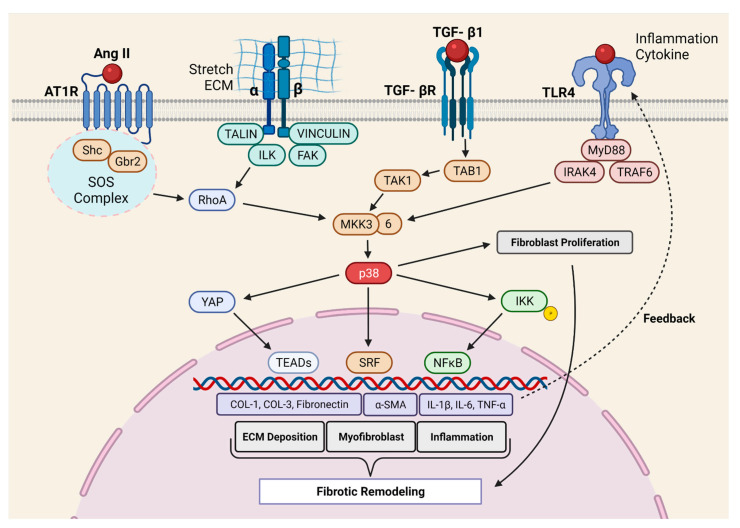
Heart failure (HF) is a leading cause of morbidity and mortality across the world. Cardiac fibrosis is associated with HF progression. Fibrosis is characterized by the excessive accumulation of extracellular matrix components. This is a physiological response to tissue injury. However, uncontrolled fibrosis leads to adverse cardiac remodeling and contributes significantly to cardiac dysfunction. Fibroblasts (FBs) are the primary drivers of myocardial fibrosis. However, until recently, FBs were thought to play a secondary role in cardiac pathophysiology. This review article will present the evolving story of fibroblast biology and fibrosis in cardiac diseases, emphasizing their recent shift from a supporting to a leading role in our understanding of the pathogenesis of cardiac diseases. Indeed, this story only became possible because of the emergence of FB-specific mouse models. This study includes an update on the advancements in the generation of FB-specific mouse models. Regarding the underlying mechanisms of myocardial fibrosis, we will focus on the pathways that have been validated using FB-specific, in vivo mouse models. These pathways include the TGF-β/SMAD3, p38 MAPK, Wnt/β-Catenin, G-protein-coupled receptor kinase (GRK), and Hippo signaling. A better understanding of the mechanisms underlying fibroblast activation and fibrosis may provide a novel therapeutic target for the management of adverse fibrotic remodeling in the diseased heart.
心力衰竭(HF)是全球发病率和死亡率的主要原因。心脏纤维化与 HF 进展有关。纤维化的特征是细胞外基质成分的过度积累。这是对组织损伤的生理反应。然而,不受控制的纤维化会导致不良的心脏重构,并对心脏功能障碍有重大贡献。成纤维细胞(FBs)是心肌纤维化的主要驱动因素。然而,直到最近,FBs 才被认为在心脏病理生理学中起次要作用。这篇综述文章将介绍成纤维细胞生物学和纤维化在心脏疾病中的发展历程,强调它们在我们对心脏疾病发病机制的理解中从辅助作用转变为主要作用。事实上,这个故事之所以成为可能,仅仅是因为 FB 特异性小鼠模型的出现。本研究包括对 FB 特异性小鼠模型生成进展的更新。关于心肌纤维化的潜在机制,我们将重点介绍使用 FB 特异性、体内小鼠模型验证的途径。这些途径包括 TGF-β/SMAD3、p38 MAPK、Wnt/β-Catenin、G 蛋白偶联受体激酶(GRK)和 Hippo 信号通路。更好地了解成纤维细胞激活和纤维化的机制可能为心脏疾病中不良纤维性重塑的管理提供新的治疗靶点。