Brunner Reinald, Taylor William R, Visscher Rosa M S
Orthopaedic Department, Children's University Hospital, Spitalstrasse 33, 4053 Basel, Switzerland.
Department of Biomedical Engineering, University of Basel, Gewerbestrasse 14, 4123 Basel, Switzerland.
Children (Basel). 2021 Sep 2;8(9):773. doi: 10.3390/children8090773.
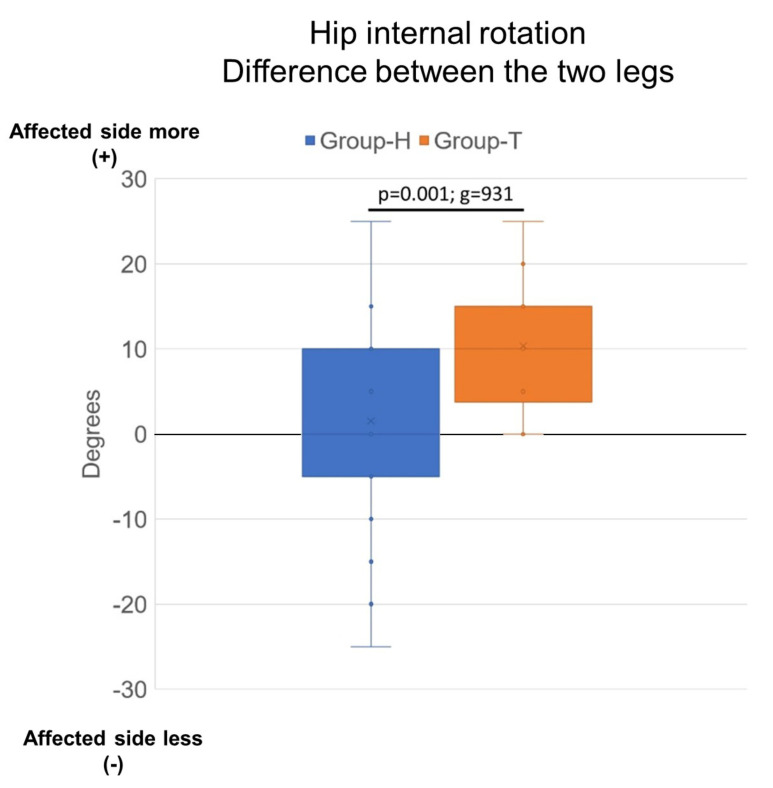
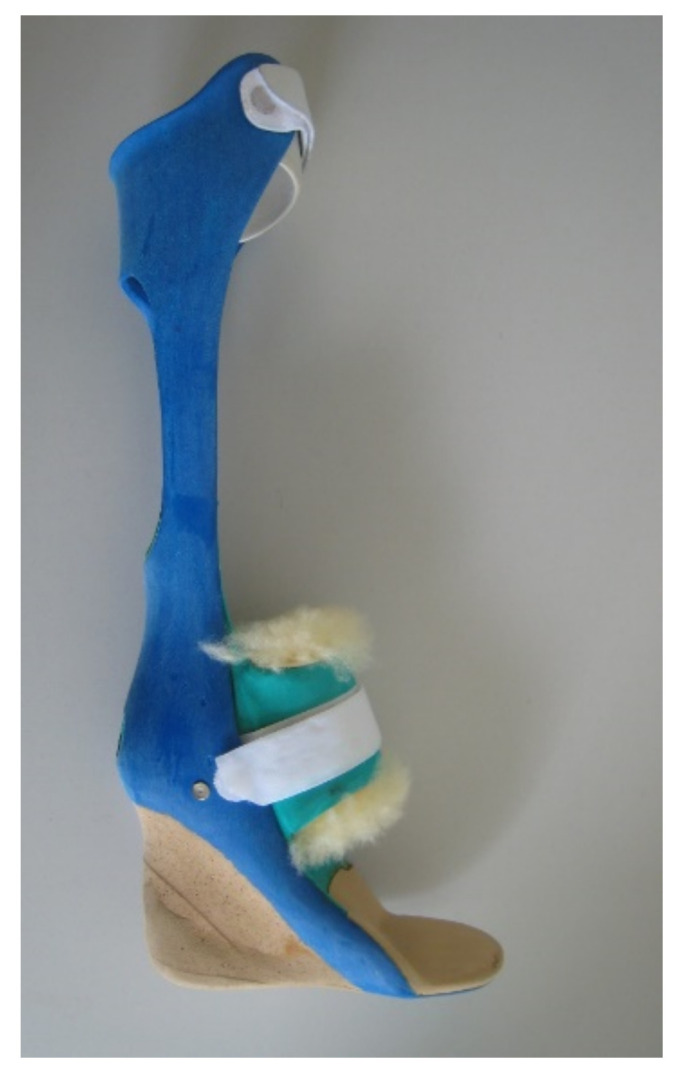
Forward modelling has indicated hip internal rotation as a secondary physical effect to plantar flexion under load. It could therefore be of interest to focus the treatment for patients with unilateral spastic cerebral palsy on achieving a heel-toe gait pattern, to prevent development of asymmetrical hip internal rotation. The aim of this preliminary retrospective cohort investigation was to evaluate the effect of restoring heel-toe gait, through use of functional orthoses, on passive hip internal rotation. In this study, the affected foot was kept in an anatomically correct position, aligned to the leg and the gait direction. In case of gastrosoleus shortness, a heel raise was attached to compensate for the equinus and yet to provide heel-floor contact (mean equinus = -2.6 degrees of dorsiflexion). Differences in passive hip internal rotation between the two sides were clinically assessed while the hip was extended. Two groups were formed according to the achieved correction of their gait patterns through orthotic care: patients with a heel-toe gait (with anterograde rocking) who wore the orthosis typically for at least eight hours per day for at least a year, or patients with toe-walking (with retrograde rocking) in spite of wearing the orthosis who used the orthosis less in most cases. A Student's -test was used to compare the values of clinically assessed passive hip rotation ( < 0.05) between the groups and the effect size (Hedges' g) was estimated. Of the 70 study participants, 56 (mean age 11.5 y, majority GMFCS 1, similar severity of pathology) achieved a heel-toe gait, while 14 remained as toe-walkers. While patients with heel-toe gait patterns showed an almost symmetrical passive hip internal rotation (difference +1.5 degrees, standard deviation 9.6 degrees), patients who kept toe-walking had an increased asymmetrical passive hip internal rotation (difference +10.4 degrees, standard deviation 7.5 degrees; = 0.001, Hedges's g = 0.931). Our clinical findings are in line with the indications from forward modelling that treating the biomechanical problem might prevent development of a secondary deformity. Further prospective studies are needed to verify the presented hypothesis.
正向建模表明,在负重情况下,髋内旋是跖屈的一种继发物理效应。因此,对于单侧痉挛性脑瘫患者,将治疗重点放在实现足跟到足尖的步态模式上,以防止不对称性髋内旋的发展,可能是有意义的。这项初步回顾性队列研究的目的是评估通过使用功能性矫形器恢复足跟到足尖步态对被动髋内旋的影响。在本研究中,患足保持在解剖学上正确的位置,与腿部和步态方向对齐。如果存在比目鱼肌挛缩,则附加一个足跟垫高装置以补偿马蹄足并提供足跟与地面的接触(平均马蹄足 = -2.6度背屈)。在髋关节伸展时,临床评估两侧被动髋内旋的差异。根据通过矫形护理实现的步态模式矫正情况将患者分为两组:具有足跟到足尖步态(伴有顺向摆动)的患者,他们通常每天佩戴矫形器至少8小时,持续至少一年;或者尽管佩戴了矫形器但仍存在足尖行走(伴有逆向摆动)的患者,在大多数情况下他们使用矫形器的时间较少。使用学生t检验比较两组之间临床评估的被动髋旋转值(<0.05),并估计效应大小(Hedges' g)。在70名研究参与者中,56名(平均年龄11.5岁,大多数为GMFCS 1级,病理严重程度相似)实现了足跟到足尖步态,而14名仍为足尖行走者。具有足跟到足尖步态模式的患者表现出几乎对称的被动髋内旋(差异 +1.5度,标准差9.6度),而持续足尖行走的患者则出现不对称的被动髋内旋增加(差异 +10.4度,标准差7.5度; = 0.001,Hedges's g = 0.931)。我们的临床研究结果与正向建模的结果一致,即治疗生物力学问题可能会预防继发畸形的发展。需要进一步的前瞻性研究来验证所提出的假设。