
幼龄黄条鰤对环境盐度的渗透调节可塑性
Osmoregulatory Plasticity of Juvenile Greater Amberjack () to Environmental Salinity.
作者信息
Barany Andre, Gilannejad Neda, Alameda-López María, Rodríguez-Velásquez Liliana, Astola Antonio, Martínez-Rodríguez Gonzalo, Roo Javier, Muñoz Jose Luis, Mancera Juan Miguel
机构信息
Department of Biology, Faculty of Marine and Environmental Sciences, Instituto Universitario de Investigación Marina (INMAR), Campus de Excelencia Internacional del Mar (CEI·MAR), University of Cádiz, Puerto Real, E11510 Cádiz, Spain.
Instituto de Ciencias Marinas de Andalucía, Consejo Superior de Investigaciones Científicas (ICMAN-CSIC), Puerto Real, E11519 Cádiz, Spain.
出版信息
Animals (Basel). 2021 Sep 5;11(9):2607. doi: 10.3390/ani11092607.
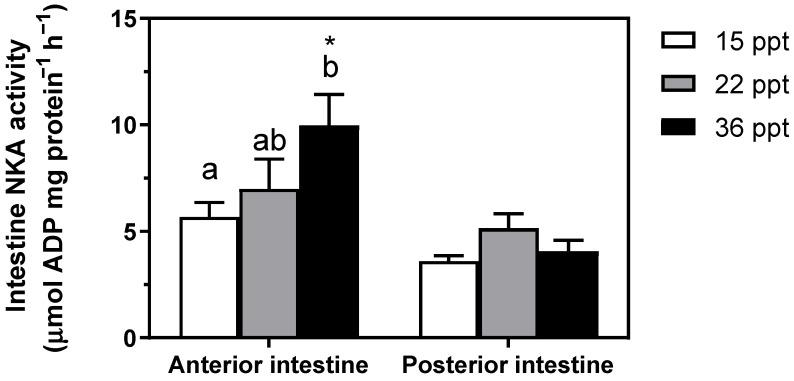
Osmotic costs in teleosts are highly variable, reaching up to 50% of energy expenditure in some. In several species, environmental salinities close to the isosmotic point (~15 psu) minimize energy demand for osmoregulation while enhancing growth. The present study aimed to characterize the physiological status related to osmoregulation in early juveniles of the greater amberjack, acclimated to three salinities (15, 22, and 36 psu). Our results indicate that plasma metabolic substrates were enhanced at the lower salinities, whereas hepatic carbohydrate and energetic lipid substrates decreased. Moreover, osmoregulatory parameters, such as osmolality, muscle water content, gill and intestine Na-K-ATPase activities, suggested a great osmoregulatory capacity in this species. Remarkably, electrophysiological parameters, such as short-circuit current (Isc) and transepithelial electric resistance (TER), were enhanced significantly at the posterior intestine. Concomitantly, Isc and TER anterior-to-posterior intestine differences were intensified with increasing environmental salinity. Furthermore, the expression of several adeno-hypophyseal genes was assessed. Expression of showed an inverse linear relationship with increasing environmental salinity, while mRNA enhanced significantly in the 22 psu-acclimated groups. Overall, these results could explain the better growth observed in juveniles kept at salinities close to isosmotic rather than in seawater.
硬骨鱼的渗透成本变化很大,在某些情况下可达能量消耗的50%。在几个物种中,接近等渗点(约15 psu)的环境盐度可将渗透调节的能量需求降至最低,同时促进生长。本研究旨在描述在三种盐度(15、22和36 psu)下适应环境的大琥珀鲳幼鱼早期与渗透调节相关的生理状态。我们的结果表明,在较低盐度下血浆代谢底物增加,而肝脏碳水化合物和高能脂质底物减少。此外,渗透调节参数,如渗透压、肌肉含水量、鳃和肠道的钠钾ATP酶活性,表明该物种具有很强的渗透调节能力。值得注意的是,后肠的电生理参数,如短路电流(Isc)和跨上皮电阻(TER)显著增强。同时,随着环境盐度的增加,前肠与后肠之间的Isc和TER差异加剧。此外,还评估了几种腺垂体基因的表达。[具体基因名称1]的表达与环境盐度的增加呈反线性关系,而[具体基因名称2]的mRNA在适应22 psu的组中显著增加。总体而言,这些结果可以解释为什么在接近等渗盐度而非海水中饲养的大琥珀鲳幼鱼生长更好。



 Zotero 插件