Lanouzière Morgane, Varbédian Olivier, Chevallier Olivier, Griviau Loïc, Guillen Kévin, Popoff Romain, Aho-Glélé Serge-Ludwig, Loffroy Romaric
Image-Guided Therapy Center, Department of Vascular and Interventional Radiology, François-Mitterrand University Hospital, 14 Rue Paul Gaffarel, BP 77908, 21079 Dijon, France.
Georges-François Leclerc Cancer Center, Department of Radiology, 1 Rue du Professeur Marion, 21000 Dijon, France.
Diagnostics (Basel). 2021 Aug 25;11(9):1532. doi: 10.3390/diagnostics11091532.
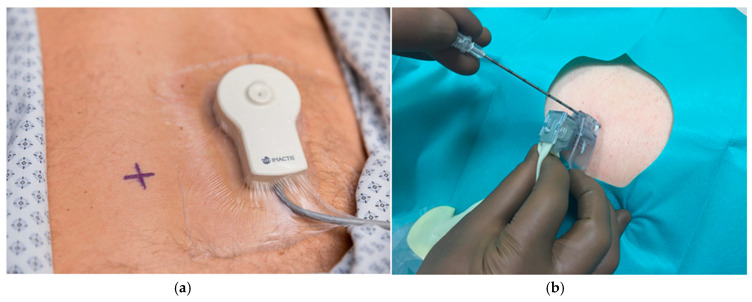
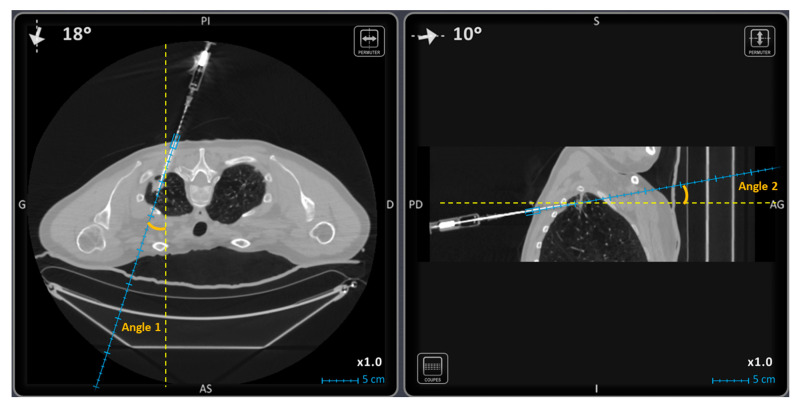
The aim of our study was to assess the efficacy of a computed tomography (CT)-Navigation™ electromagnetic system compared to conventional CT methods for percutaneous lung biopsies (PLB). In this single-center retrospective study, data of a CT-Navigation™ system guided PLB (NAV-group) and conventional CT PLB (CT-group) performed between January 2017 and February 2020 were reviewed. The primary endpoint was the diagnostic success. Secondary endpoints were technical success, total procedure duration, number of CT acquisitions and the dose length product (DLP) during step ∆1 (from planning to initial needle placement), step ∆2 (progression to target), and the entire intervention (from planning to final control) and complications. Additional parameters were recorded, such as the lesion's size and trajectory angles. Sixty patients were included in each group. The lesions median size and median values of the two trajectory angles were significantly lower (20 vs. 29.5 mm, = 0.006) and higher in the NAV-group (15.5° and 10° vs. 6° and 1°; < 0.01), respectively. Technical and diagnostic success rates were similar in both groups, respectively 95% and 93.3% in the NAV-group, and 93.3% and 91.6% in the CT-group. There was no significant difference in total procedure duration ( = 0.487) and total number of CT acquisitions ( = 0.066), but the DLP was significantly lower in the NAV-group ( < 0.01). There was no significant difference in complication rate. For PLB, CT-Navigation™ system is efficient and safe as compared to the conventional CT method.
我们研究的目的是评估计算机断层扫描(CT)导航电磁系统与传统CT方法相比在经皮肺活检(PLB)中的疗效。在这项单中心回顾性研究中,我们回顾了2017年1月至2020年2月期间使用CT导航系统引导的PLB(导航组)和传统CT引导的PLB(CT组)的数据。主要终点是诊断成功率。次要终点包括技术成功率、总操作时间、CT采集次数以及在步骤∆1(从规划到初始针放置)、步骤∆2(推进到目标)和整个干预过程(从规划到最终控制)中的剂量长度乘积(DLP)以及并发症。还记录了其他参数,如病变大小和轨迹角度。每组纳入60例患者。导航组的病变中位大小和两个轨迹角度的中位值分别显著低于CT组(20 vs. 29.5 mm,P = 0.006)和高于CT组(15.5°和10° vs. 6°和1°;P < 0.01)。两组的技术成功率和诊断成功率相似,导航组分别为95%和93.3%,CT组分别为93.3%和91.6%。总操作时间(P = 0.487)和CT采集总数(P = 0.066)无显著差异,但导航组的DLP显著更低(P < 0.01)。并发症发生率无显著差异。对于PLB,与传统CT方法相比,CT导航系统高效且安全。