Tomita Tadakimi, Guevara Rebekah B, Shah Lamisha M, Afrifa Andrews Y, Weiss Louis M
Department of Pathology, Albert Einstein College of Medicine, Bronx, NY 10461, USA.
Department of Biological Science, Lehman College of the City University of New York, Bronx, NY 10468, USA.
Life (Basel). 2021 Sep 20;11(9):988. doi: 10.3390/life11090988.
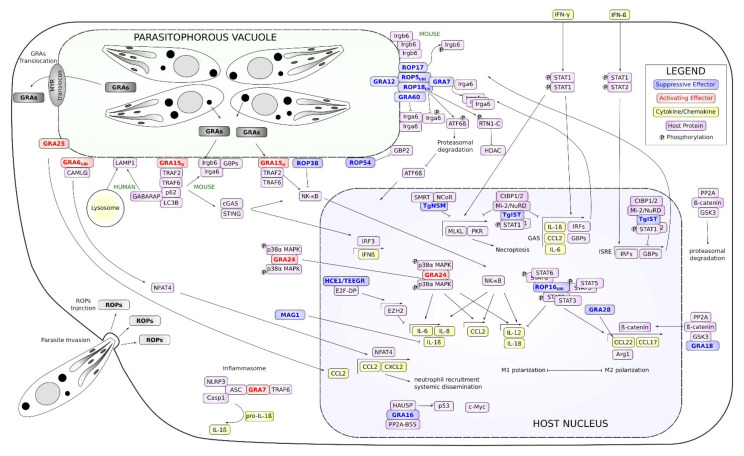
is an obligate intracellular parasite that chronically infects a third of humans. It can cause life-threatening encephalitis in immune-compromised individuals. Congenital infection also results in blindness and intellectual disabilities. In the intracellular milieu, parasites encounter various immunological effectors that have been shaped to limit parasite infection. Parasites not only have to suppress these anti-parasitic inflammatory responses but also ensure the host organism's survival until their subsequent transmission. Recent advancements in research have revealed a plethora of parasite-secreted proteins that suppress as well as activate immune responses. This mini-review will comprehensively examine each secreted immunomodulatory effector based on the location of their actions. The first section is focused on secreted effectors that localize to the parasitophorous vacuole membrane, the interface between the parasites and the host cytoplasm. Murine hosts are equipped with potent IFNγ-induced immune-related GTPases, and various parasite effectors subvert these to prevent parasite elimination. The second section examines several cytoplasmic and ER effectors, including a recently described function for matrix antigen 1 (MAG1) as a secreted effector. The third section covers the repertoire of nuclear effectors that hijack transcription factors and epigenetic repressors that alter gene expression. The last section focuses on the translocation of dense-granule effectors and effectors in the setting of tissue cysts (the bradyzoite parasitophorous vacuole).
是一种专性细胞内寄生虫,慢性感染三分之一的人类。它可在免疫功能低下的个体中引起危及生命的脑炎。先天性感染还会导致失明和智力残疾。在细胞内环境中,寄生虫会遇到各种为限制寄生虫感染而形成的免疫效应物。寄生虫不仅要抑制这些抗寄生虫炎症反应,还要确保宿主生物体在其后续传播之前存活。研究的最新进展揭示了大量抑制和激活免疫反应的寄生虫分泌蛋白。本综述将根据其作用位置全面研究每种分泌的免疫调节效应物。第一部分重点关注定位于寄生泡膜的分泌效应物,寄生泡膜是寄生虫与宿主细胞质之间的界面。小鼠宿主配备有强大的IFNγ诱导的免疫相关GTP酶,各种寄生虫效应物会破坏这些酶以防止寄生虫被清除。第二部分研究几种细胞质和内质网效应物,包括最近描述的基质抗原1(MAG1)作为分泌效应物的功能。第三部分涵盖劫持转录因子和表观遗传阻遏物以改变基因表达的核效应物。最后一部分重点关注致密颗粒效应物和组织囊肿(缓殖子寄生泡)环境中的效应物的转运。