• 文献检索
  • 文档翻译
  • 深度研究
  • 学术资讯
  • Suppr Zotero 插件Zotero 插件
  • 邀请有礼
  • 套餐&价格
  • 历史记录
应用&插件
Suppr Zotero 插件Zotero 插件浏览器插件Mac 客户端Windows 客户端微信小程序
定价
高级版会员购买积分包购买API积分包
服务
文献检索文档翻译深度研究API 文档MCP 服务
关于我们
关于 Suppr公司介绍联系我们用户协议隐私条款
关注我们

Suppr 超能文献

核心技术专利:CN118964589B侵权必究
粤ICP备2023148730 号-1Suppr @ 2026

文献检索

告别复杂PubMed语法,用中文像聊天一样搜索,搜遍4000万医学文献。AI智能推荐,让科研检索更轻松。

立即免费搜索

文件翻译

保留排版,准确专业,支持PDF/Word/PPT等文件格式,支持 12+语言互译。

免费翻译文档

深度研究

AI帮你快速写综述,25分钟生成高质量综述,智能提取关键信息,辅助科研写作。

立即免费体验

脑性瘫痪中马蹄足的患病率是否被高估?对4814只脚的荟萃分析结果

Is the Prevalence of Equinus Foot in Cerebral Palsy Overestimated? Results from a Meta-Analysis of 4814 Feet.

作者信息

Horsch Axel, Klotz Matthias C M, Platzer Hadrian, Seide Svenja, Zeaiter Nancy, Ghandour Maher

机构信息

Department of Orthopedics and Trauma Surgery, Heidelberg University Hospital, 69118 Heidelberg, Germany.

Marienkrankenhaus Soest, Orthopedics and Trauma Surgery, 59494 Soest, Germany.

出版信息

J Clin Med. 2021 Sep 13;10(18):4128. doi: 10.3390/jcm10184128.

DOI:10.3390/jcm10184128
PMID:34575239
原文链接:https://pmc.ncbi.nlm.nih.gov/articles/PMC8465417/
Abstract

BACKGROUND

Equinus is a common foot deformity in patients with cerebral palsy (CP). However, its prevalence is scarcely reported in the literature. Therefore, we conducted this review to estimate the prevalence of equinus foot in CP.

METHODS

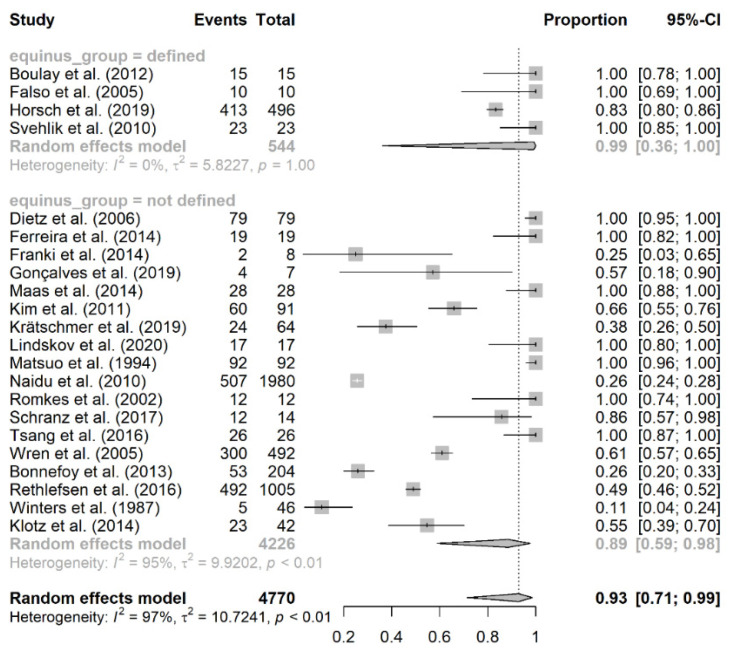
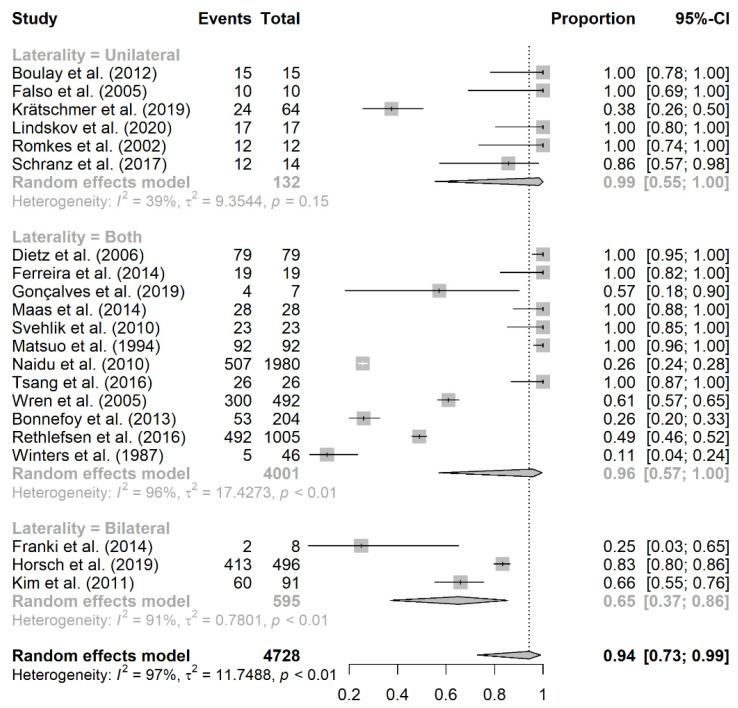
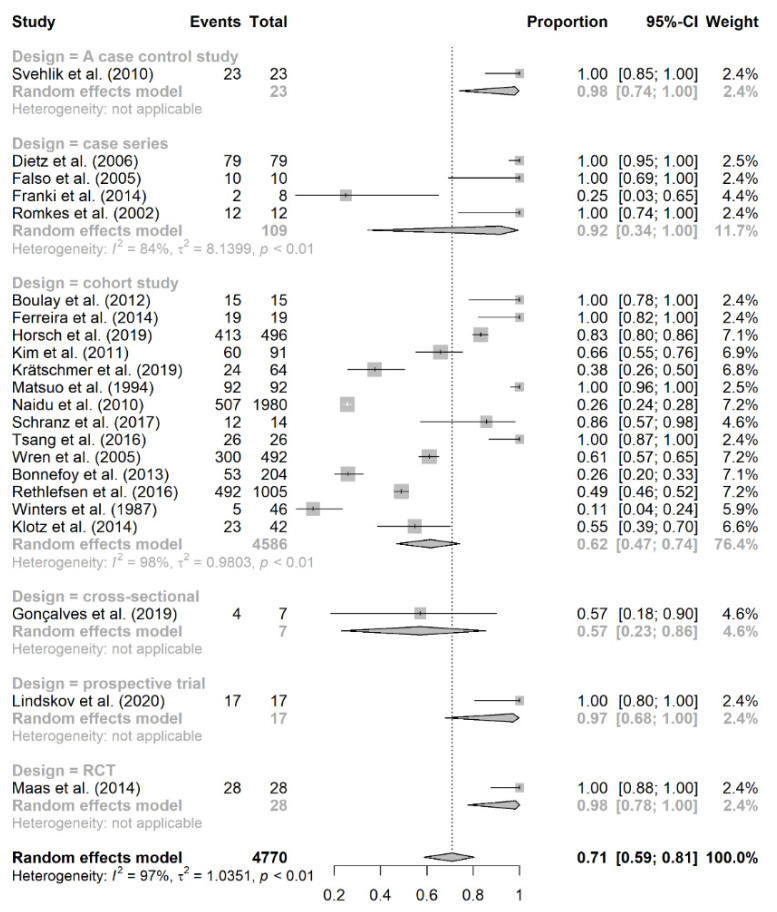
Eight databases were searched. Our primary outcome was the prevalence of equinus foot in CP patients. Subgroup analysis was conducted based on study design, the laterality of CP, and whether equinus foot was defined or not.

RESULTS

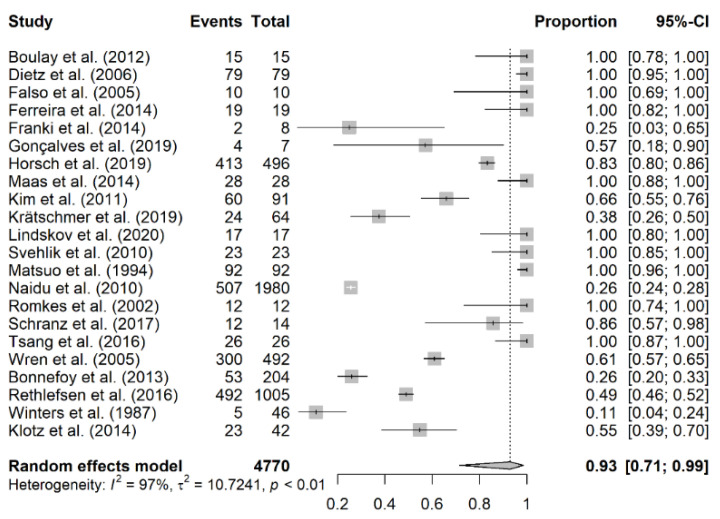
The prevalence of equinus foot in CP was 93% (95% CI: 71-99). The prevalence was 99% (95% CI: 55-100), 96% (95% CI: 57-100), and 65% (95% CI: 37-86) in unilateral, both, and bilateral CP, respectively. Based on study design, equinus foot prevalence was 92% (95% CI: 34-100) in case series and 62% (95% CI: 47-74) in cohort studies. Four studies reported definition criteria for equinus foot, with a pooled prevalence rate of equinus foot of 99% (95% CI: 36-100) compared to a rate of 89% (95% CI: 59-98) among studies that lacked a definition criterion.

CONCLUSIONS

This is the first meta-analysis to address the prevalence of equinus foot in CP patients. Although its prevalence is very high, our findings should be interpreted with caution due to the presence of multiple limitations, such as the lack of standardized definition criteria for equinus foot, the inappropriate study design, the wide confidence interval of equinus foot rate, and the small number of studies investigating it as a primary outcome.

摘要

背景

马蹄足是脑瘫(CP)患者常见的足部畸形。然而,其患病率在文献中鲜有报道。因此,我们进行了这项综述以估计CP患者中马蹄足的患病率。

方法

检索了八个数据库。我们的主要结局是CP患者中马蹄足的患病率。基于研究设计、CP的患侧以及是否定义了马蹄足进行亚组分析。

结果

CP患者中马蹄足的患病率为93%(95%置信区间:71 - 99)。单侧、双侧和双侧CP中马蹄足的患病率分别为99%(95%置信区间:55 - 100)、96%(95%置信区间:57 - 100)和65%(95%置信区间:37 - 86)。基于研究设计,病例系列中马蹄足患病率为92%(95%置信区间:34 - 100),队列研究中为62%(95%置信区间:47 - 74)。四项研究报告了马蹄足的定义标准,定义了马蹄足的研究中其合并患病率为99%(95%置信区间:36 - 100),而缺乏定义标准的研究中该患病率为89%(95%置信区间:59 - 98)。

结论

这是第一项针对CP患者中马蹄足患病率的荟萃分析。尽管其患病率非常高,但由于存在多种局限性,如缺乏马蹄足的标准化定义标准、研究设计不当、马蹄足患病率的置信区间较宽以及将其作为主要结局进行研究的数量较少,我们的研究结果应谨慎解读。
https://cdn.ncbi.nlm.nih.gov/pmc/blobs/a4e2/8465417/06c2f37edde9/jcm-10-04128-g005.jpg
https://cdn.ncbi.nlm.nih.gov/pmc/blobs/a4e2/8465417/83b57e101a8e/jcm-10-04128-g001.jpg
https://cdn.ncbi.nlm.nih.gov/pmc/blobs/a4e2/8465417/83d6438dc05a/jcm-10-04128-g002.jpg
https://cdn.ncbi.nlm.nih.gov/pmc/blobs/a4e2/8465417/63725448f74d/jcm-10-04128-g003.jpg
https://cdn.ncbi.nlm.nih.gov/pmc/blobs/a4e2/8465417/9a7725c5fb16/jcm-10-04128-g004.jpg
https://cdn.ncbi.nlm.nih.gov/pmc/blobs/a4e2/8465417/06c2f37edde9/jcm-10-04128-g005.jpg
https://cdn.ncbi.nlm.nih.gov/pmc/blobs/a4e2/8465417/83b57e101a8e/jcm-10-04128-g001.jpg
https://cdn.ncbi.nlm.nih.gov/pmc/blobs/a4e2/8465417/83d6438dc05a/jcm-10-04128-g002.jpg
https://cdn.ncbi.nlm.nih.gov/pmc/blobs/a4e2/8465417/63725448f74d/jcm-10-04128-g003.jpg
https://cdn.ncbi.nlm.nih.gov/pmc/blobs/a4e2/8465417/9a7725c5fb16/jcm-10-04128-g004.jpg
https://cdn.ncbi.nlm.nih.gov/pmc/blobs/a4e2/8465417/06c2f37edde9/jcm-10-04128-g005.jpg

相似文献

1
Is the Prevalence of Equinus Foot in Cerebral Palsy Overestimated? Results from a Meta-Analysis of 4814 Feet.脑性瘫痪中马蹄足的患病率是否被高估?对4814只脚的荟萃分析结果
J Clin Med. 2021 Sep 13;10(18):4128. doi: 10.3390/jcm10184128.
2
Recurrence of Equinus Foot in Cerebral Palsy following Its Correction-A Meta-Analysis.脑性瘫痪马蹄足矫正术后复发的荟萃分析
Children (Basel). 2022 Mar 2;9(3):339. doi: 10.3390/children9030339.
3
Is shortening of Tibialis Anterior in addition to calf muscle lengthening required to improve the active dorsal extension of the ankle joint in patients with Cerebral Palsy?在脑瘫患者中,除了腓肠肌延长术之外,还需要缩短胫骨前肌以改善踝关节的主动背伸吗?
Gait Posture. 2021 Jan;83:210-216. doi: 10.1016/j.gaitpost.2020.10.019. Epub 2020 Oct 23.
4
Recurrence after surgery for equinus foot deformity in children with cerebral palsy: assessment of predisposing factors for recurrence in a long-term follow-up study.脑瘫患儿马蹄足畸形手术后的复发情况:一项长期随访研究中复发易感因素的评估
J Child Orthop. 2011 Aug;5(4):289-96. doi: 10.1007/s11832-011-0352-4. Epub 2011 Jun 24.
5
Defining Equinus Foot in Cerebral Palsy.脑性瘫痪中马蹄足的定义
Children (Basel). 2022 Jun 25;9(7):956. doi: 10.3390/children9070956.
6
Equinus foot classification in cerebral palsy: an agreement study between clinical and gait analysis assessment.脑性瘫痪患者马蹄足分类:临床与步态分析评估之间的一致性研究。
Eur J Phys Rehabil Med. 2011 Jun;47(2):213-21. Epub 2011 Apr 20.
7
Effect of Botulinum Toxin on Equinus Foot Deformity in Cerebral Palsy Patients: A Systematic Review and Network Meta-analysis.肉毒毒素治疗脑瘫患者马蹄内翻足畸形的疗效:系统评价和网络荟萃分析。
Curr Pharm Des. 2020;26(37):4796-4807. doi: 10.2174/1381612826666200518105633.
8
Prevalence and classification of equinus foot in bilateral spastic cerebral palsy.双侧痉挛性脑瘫患者马蹄足的患病率和分类。
World J Pediatr. 2019 Jun;15(3):276-280. doi: 10.1007/s12519-019-00238-2. Epub 2019 Mar 4.
9
A Critical Evaluation of the Updated Evidence for Casting for Equinus Deformity in Children with Cerebral Palsy.对脑瘫儿童马蹄足畸形石膏固定最新证据的批判性评估
Physiother Res Int. 2017 Jan;22(1). doi: 10.1002/pri.1646. Epub 2015 Sep 9.
10
Recurrence of equinus foot deformity after tendo-achilles lengthening in patients with cerebral palsy.脑瘫患者跟腱延长术后马蹄足畸形复发
J Pediatr Orthop. 2015 Jun;35(4):419-25. doi: 10.1097/BPO.0000000000000278.

引用本文的文献

1
Prevalence of valgus and varus foot deformities in 2784 children with cerebral palsy, a register-based cross-sectional study.2784 例脑瘫儿童的足内翻和足外翻畸形患病率:基于登记的横断面研究。
BMC Musculoskelet Disord. 2024 Nov 19;25(1):930. doi: 10.1186/s12891-024-08029-1.
2
Research Toward Understanding the Benefits and Limitations of Orthotic Use To Improve Mobility and Balance for Individuals With Neuropathic Conditions.研究理解矫形器使用的益处和局限性,以提高神经病变患者的活动能力和平衡能力。
Iowa Orthop J. 2024;44(1):37-45.
3
A bibliometric analysis of cerebral palsy from 2003 to 2022.

本文引用的文献

1
Muscle activity in children with spastic unilateral cerebral palsy when walking with ankle-foot orthoses: an explorative study.痉挛型单侧脑瘫儿童穿戴踝足矫形器行走时的肌肉活动:一项探索性研究。
Gait Posture. 2020 Jul;80:31-36. doi: 10.1016/j.gaitpost.2020.05.011. Epub 2020 May 23.
2
Therapeutic efficacy of hepatitis B virus vaccine in treatment of chronic HBV infections: A systematic review and meta-analysis.乙型肝炎病毒疫苗治疗慢性 HBV 感染的疗效:系统评价和荟萃分析。
Rev Med Virol. 2020 May;30(3):e2089. doi: 10.1002/rmv.2089. Epub 2019 Dec 6.
3
How to perform a meta-analysis with R: a practical tutorial.
2003年至2022年脑瘫的文献计量分析。
Front Neurol. 2024 Apr 2;15:1292587. doi: 10.3389/fneur.2024.1292587. eCollection 2024.
4
Reconsidering the Gold Standard for the Assessment of Spastic Equinus Foot.重新考虑痉挛性马蹄内翻足评估的金标准。
J Am Acad Orthop Surg Glob Res Rev. 2024 Mar 25;8(4). doi: 10.5435/JAAOSGlobal-D-24-00039. eCollection 2024 Apr 1.
5
Research trends in the orthopedic surgical management of cerebral palsy: a cross-analytical study of publications in the past decade.脑瘫骨科手术治疗的研究趋势:过去十年出版物的交叉分析研究
Front Neurol. 2023 Aug 22;14:1200893. doi: 10.3389/fneur.2023.1200893. eCollection 2023.
6
Orthopedics and Trauma in Children: Key Problems and Future Insights.儿童骨科与创伤:关键问题与未来展望
Children (Basel). 2023 Jan 6;10(1):119. doi: 10.3390/children10010119.
7
Efficacy of conservative treatment for spastic cerebral palsy children with equinus gait: a systematic review and meta-analysis.痉挛型脑瘫患儿马蹄内翻足保守治疗效果的系统评价和 Meta 分析。
J Orthop Surg Res. 2022 Sep 8;17(1):411. doi: 10.1186/s13018-022-03301-3.
8
Management of arthrofibrosis in neuromuscular disorders: a review.神经肌肉疾病性关节挛缩的治疗:综述。
BMC Musculoskelet Disord. 2022 Jul 29;23(1):725. doi: 10.1186/s12891-022-05677-z.
9
Defining Equinus Foot in Cerebral Palsy.脑性瘫痪中马蹄足的定义
Children (Basel). 2022 Jun 25;9(7):956. doi: 10.3390/children9070956.
10
Combination taping technique versus ankle foot orthosis on improving gait parameters in spastic cerebral palsy: A controlled randomized study.联合贴扎技术与踝足矫形器对改善痉挛型脑瘫患者步态参数的影响:一项对照随机研究
J Rehabil Med. 2021 Nov 30;53(11):jrm00240. doi: 10.2340/jrm.v53.900.
如何使用 R 进行荟萃分析:实用教程。
Evid Based Ment Health. 2019 Nov;22(4):153-160. doi: 10.1136/ebmental-2019-300117. Epub 2019 Sep 28.
4
Identification of gait events in children with spastic cerebral palsy: comparison between the force plate and algorithms.痉挛型脑瘫儿童步态事件的识别:测力板与算法的比较。
Braz J Phys Ther. 2020 Sep-Oct;24(5):392-398. doi: 10.1016/j.bjpt.2019.05.007. Epub 2019 Jun 12.
5
Prevalence and classification of equinus foot in bilateral spastic cerebral palsy.双侧痉挛性脑瘫患者马蹄足的患病率和分类。
World J Pediatr. 2019 Jun;15(3):276-280. doi: 10.1007/s12519-019-00238-2. Epub 2019 Mar 4.
6
Kinematic adaptation and changes in gait classification in running compared to walking in children with unilateral spastic cerebral palsy.与行走相比,单侧痉挛性脑瘫儿童跑步时的运动适应及步态分类变化。
Gait Posture. 2019 Jan;67:104-111. doi: 10.1016/j.gaitpost.2018.09.031. Epub 2018 Oct 3.
7
Does unilateral single-event multilevel surgery improve gait in children with spastic hemiplegia? A retrospective analysis of a long-term follow-up.单侧单节段多水平手术能否改善痉挛性偏瘫儿童的步态?一项长期随访的回顾性分析。
Gait Posture. 2017 Feb;52:135-139. doi: 10.1016/j.gaitpost.2016.11.018. Epub 2016 Nov 15.
8
Manual search approaches used by systematic reviewers in dermatology.皮肤科系统评价者使用的手动检索方法。
J Med Libr Assoc. 2016 Oct;104(4):302-304. doi: 10.3163/1536-5050.104.4.009.
9
A cohort study of tibialis anterior tendon shortening in combination with calf muscle lengthening in spastic equinus in cerebral palsy.一项关于脑瘫痉挛性马蹄足中胫骨前肌腱缩短联合小腿肌肉延长的队列研究。
Gait Posture. 2016 Oct;50:23-27. doi: 10.1016/j.gaitpost.2016.08.015. Epub 2016 Aug 17.
10
Prevalence of specific gait abnormalities in children with cerebral palsy revisited: influence of age, prior surgery, and Gross Motor Function Classification System level.重新审视脑性瘫痪患儿特定步态异常的患病率:年龄、既往手术及粗大运动功能分类系统水平的影响
Dev Med Child Neurol. 2017 Jan;59(1):79-88. doi: 10.1111/dmcn.13205. Epub 2016 Jul 15.