Department of Orthopaedics, Faculty of Medicine Ramathibodi Hospital, Mahidol University, Bangkok, 10400, Thailand.
Department of Preventive and Social Medicine, Faculty of Medicine, Chulalongkorn University, Bangkok, 10330, Thailand.
J Orthop Surg Res. 2022 Sep 8;17(1):411. doi: 10.1186/s13018-022-03301-3.
Comparisons between various conservative managements of spastic equinus deformity in cerebral palsy demonstrated limited evidences, to evaluate the efficacy of conservative treatment among cerebral palsy children with spastic equinus foot regarding gait and ankle motion.
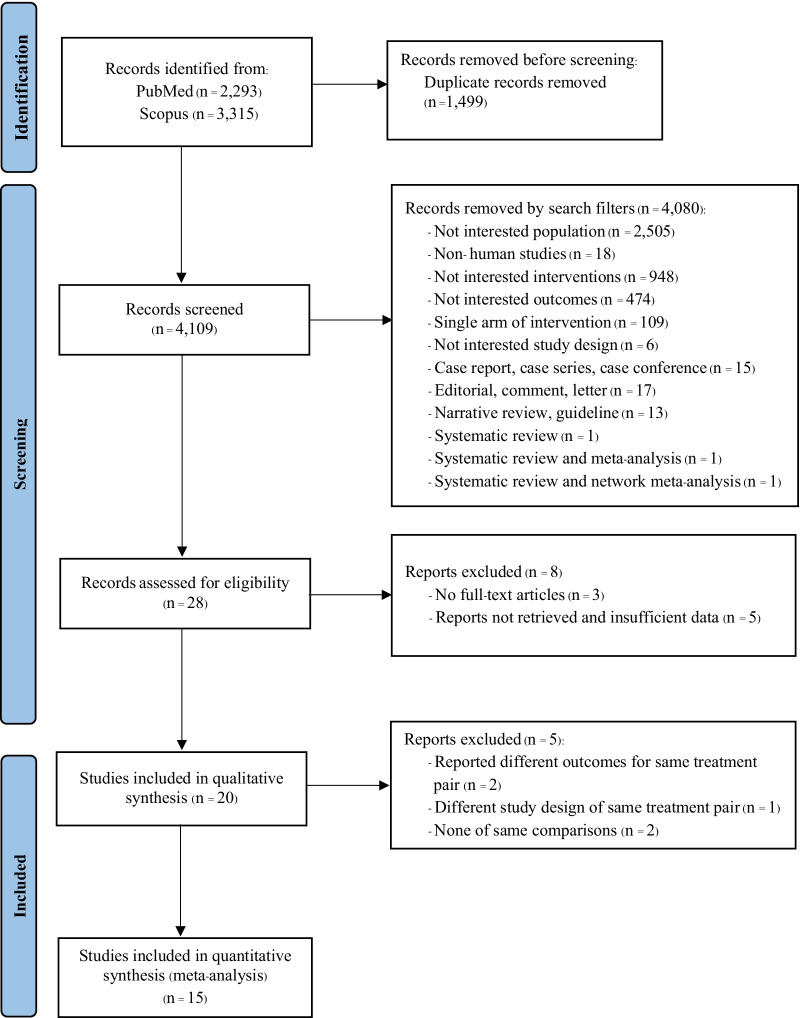
Studies were identified from PubMed and Scopus up to February 2022. Inclusion criteria were randomized controlled trial (RCT), conducted in spastic cerebral palsy children with equinus deformity, aged less than 18 years, compared any conservative treatments (Botulinum toxin A; BoNT-A, casting, physical therapy, and orthosis), and evaluated gait improvement (Physician Rating Scale or Video Gait Analysis), Observational Gait Scale, Clinical Gait Assessment Score, ankle dorsiflexion (ankle dorsiflexion at initial contact, and passive ankle dorsiflexion), or Gross Motor Function Measure. Any study with the participants who recently underwent surgery or received BoNT-A or insufficient data was excluded. Two authors were independently selected and extracted data. Risk of bias was assessed using a revised Cochrane risk-of-bias tool for randomized trials. I was performed to evaluate heterogeneity. Risk ratio (RR), the unstandardized mean difference (USMD), and the standardized mean difference were used to estimate treatment effects with 95% confidence interval (CI).
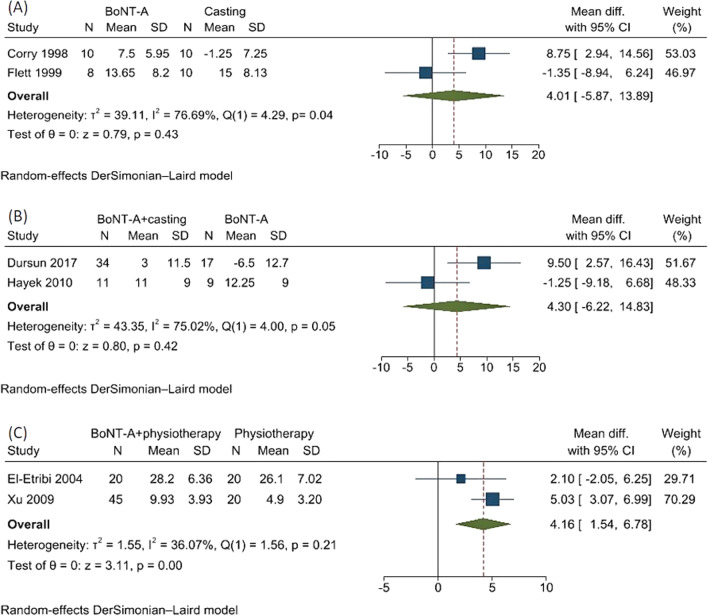
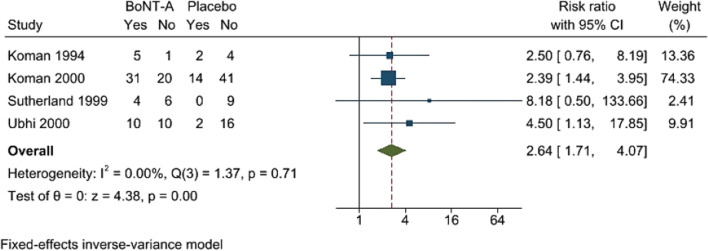
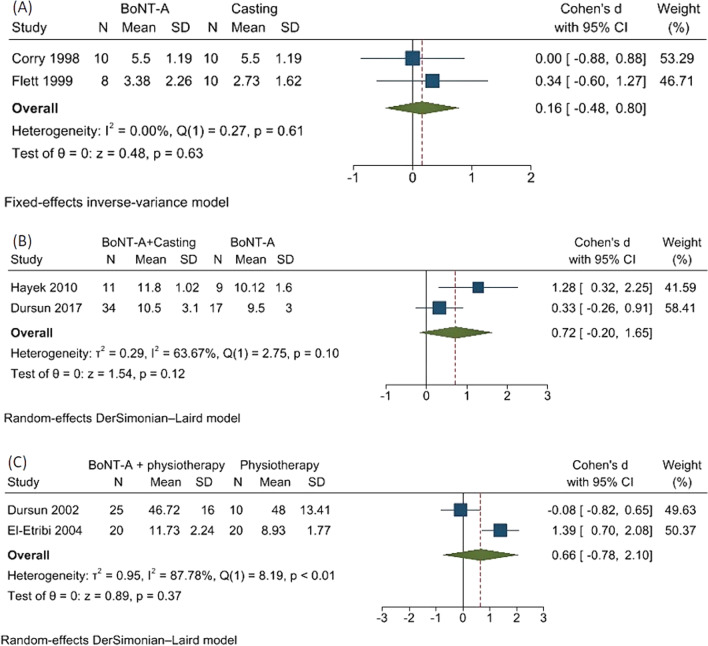
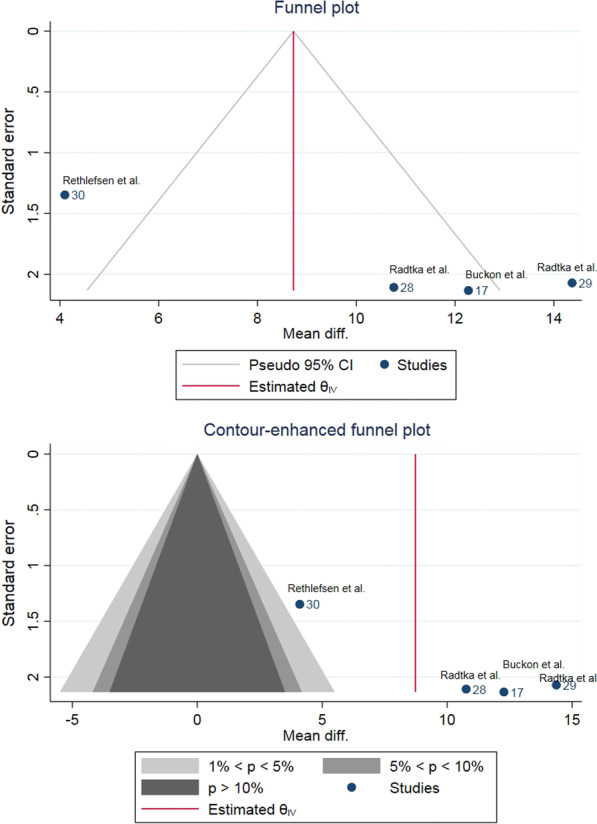
From 20 included studies (716 children), 15 RCTs were eligible for meta-analysis (35% had low risk of bias). BoNT-A had higher number of gait improvements than placebo (RR 2.64, 95% CI 1.71, 4.07, I = 0). Its combination with physical therapy yielded better passive ankle dorsiflexion at knee extension than physical therapy alone (USMD = 4.16 degrees; 95% CI 1.54, 6.78, I = 36%). Casting with or without BoNT-A had no different gait improvement and ankle dorsiflexion at knee extension when compared to BoNT-A. Orthosis significantly increased ankle dorsiflexion at initial contact comparing to control (USMD 10.22 degrees, 95 CI% 5.13, 15.31, I = 87%).
BoNT-A and casting contribute to gait improvement and ankle dorsiflexion at knee extension. BoNT-A specifically provided gait improvement over the placebo and additive effect to physical therapy for passive ankle dorsiflexion. Orthosis would be useful for ankle dorsiflexion at initial contact. Trial registration PROSPERO number CRD42019146373.
比较各种脑瘫痉挛性马蹄内翻足的保守治疗方法,显示出有限的证据,以评估脑瘫儿童痉挛性马蹄内翻足的保守治疗方法对步态和踝关节运动的疗效。
研究人员从 PubMed 和 Scopus 数据库中检索了截至 2022 年 2 月的相关文献。纳入标准为随机对照试验(RCT),研究对象为痉挛性脑瘫伴马蹄内翻足畸形、年龄小于 18 岁的儿童,比较了任何保守治疗方法(肉毒毒素 A;BoNT-A、石膏固定、物理治疗和矫形器),并评估了步态改善(医生评分量表或视频步态分析)、观察步态量表、临床步态评估评分、踝关节背屈(初始接触时的踝关节背屈和被动踝关节背屈)或粗大运动功能测量。任何最近接受过手术或接受过 BoNT-A 治疗或数据不足的研究均被排除在外。两名作者独立选择并提取数据。使用修订后的 Cochrane 随机试验偏倚风险工具评估偏倚风险。使用 I ² 评估异质性。使用风险比(RR)、未标准化均数差(USMD)和标准化均数差来估计治疗效果,并使用 95%置信区间(CI)。
从 20 项纳入的研究(716 名儿童)中,有 15 项 RCT 符合荟萃分析标准(35%的研究具有低偏倚风险)。BoNT-A 治疗组的步态改善数量高于安慰剂组(RR 2.64,95%CI 1.71,4.07,I=0)。BoNT-A 联合物理治疗组的膝关节伸展时被动踝关节背屈优于单纯物理治疗组(USMD=4.16°;95%CI 1.54,6.78,I=36%)。与 BoNT-A 相比,石膏固定加或不加 BoNT-A 对步态改善和膝关节伸展时的踝关节背屈无影响。矫形器与对照组相比,初始接触时的踝关节背屈明显增加(USMD 10.22°;95%CI 5.13,15.31,I=87%)。
BoNT-A 和石膏固定有助于改善步态和膝关节伸展时的踝关节背屈。BoNT-A 特别能改善安慰剂组的步态,对物理治疗的被动踝关节背屈有附加作用。矫形器对初始接触时的踝关节背屈有用。试验注册 PROSPERO 编号 CRD42019146373。