Patil Shankargouda, Reda Rodolfo, Boreak Nezar, Taher Hasan Ahmad, Melha Abdulaziz Abu, Albrakati Ashraf, Vinothkumar Thilla Sekar, Mustafa Mohammed, Robaian Ali, Alroomy Riyadh, Kharaf Rawabi Jaber Ahmed, Kameli Taif Sharafuddin, Alkahtani Ahmed, Baeshen Hosam Ali, Patil Vikrant R, Testarelli Luca
Department of Maxillofacial Surgery and Diagnostic Sciences, Division of Oral Pathology, College of Dentistry, Jazan University, Jazan 45142, Saudi Arabia.
Department of Oral and Maxillo Facial Sciences, University of Rome La Sapienza, 00161 Rome, Italy.
J Pers Med. 2021 Sep 14;11(9):915. doi: 10.3390/jpm11090915.
dental pulp-derived stem cells are easy to access and collect and are an excellent source of stem cells for regenerative therapy. These cells can interact with many biomolecules and scaffolds and can pass on the instructive signals to the sites of regeneration where they are used. In this regard cordycepin, a potential biomolecule derived from medicinal mushrooms with a spectrum of bioactive properties such as antioxidant, anti-inflammatory, and anticancer has not yet been tested for its effect on human dental pulp stem cells.
the objective of the present study was to assess the in vitro adipogenic and osteogenic differentiation potential of human dental pulp stem cells with or without induction after administration of cordycepin.
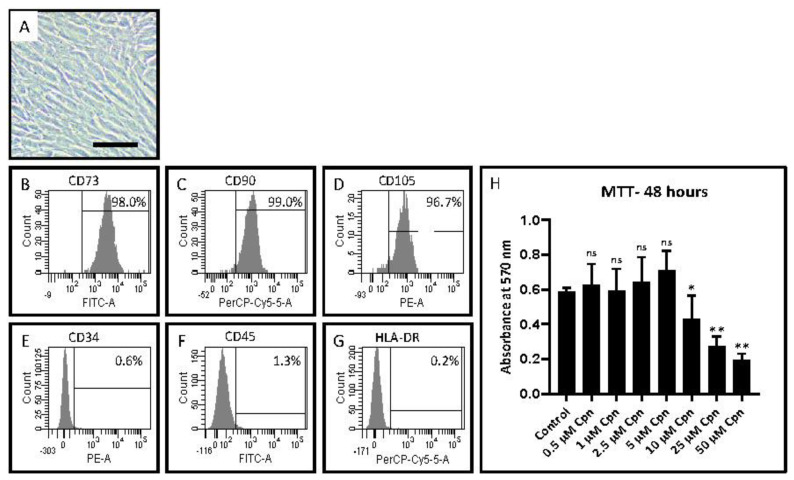
human dental pulp stem cells DPSCs were isolated from a healthy permanent tooth extracted for orthodontic purposes after obtaining informed consent. Flow cytometry technique was used to assess the surface markers of these cells such as CD73, CD90, and CD105, CD34, CD45, and HLA-DR. Further, an MTT assay was performed on the cells after subjecting them to various concentrations of cordycepin. Following this, the adipogenic and osteogenic potential of the dental pulp stem cells was assessed with or without induction under the influence/absence of 5 µM of cordycepin. The results obtained were statistically analyzed and documented.
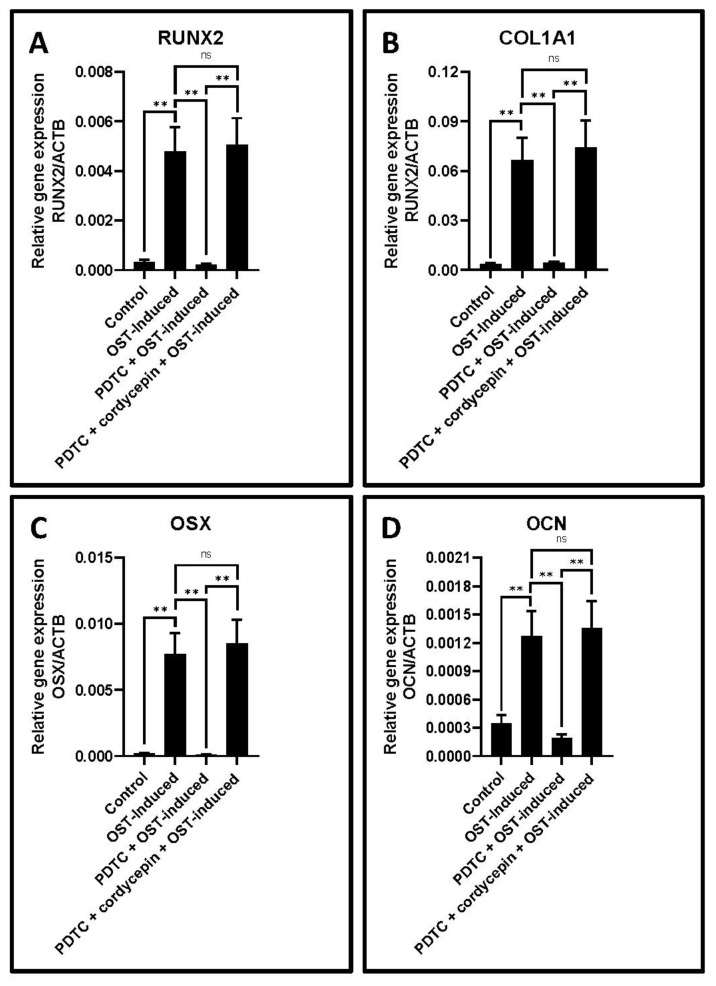
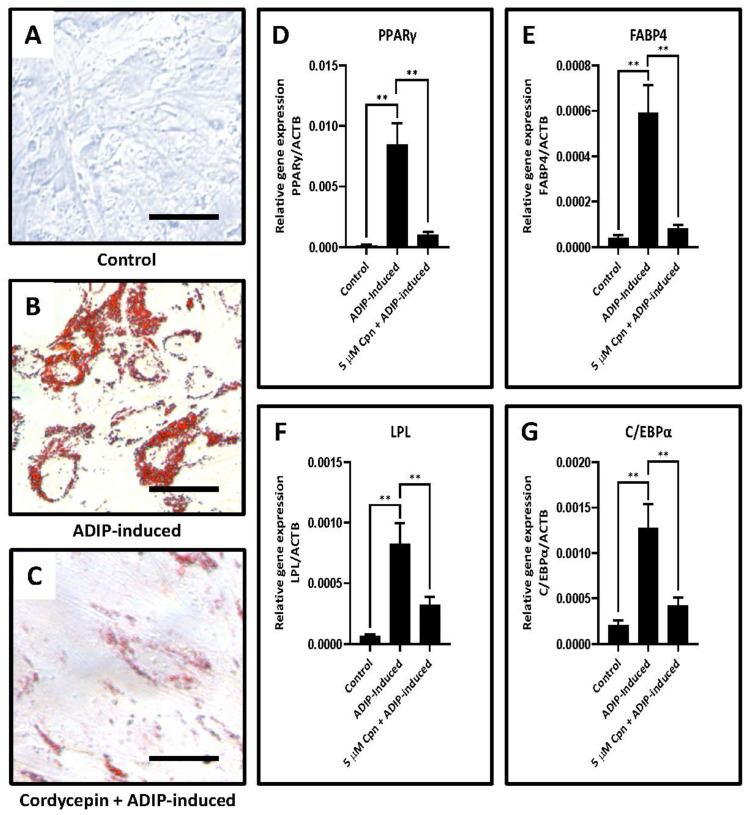
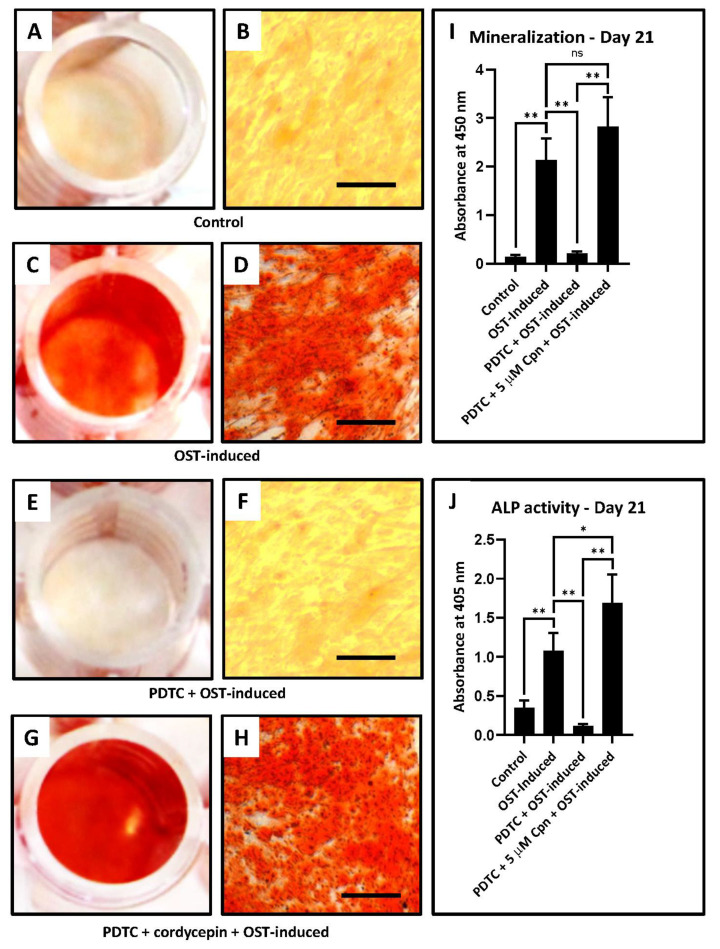
it was found that the dental pulp stem cells showed strong positive expression for CD73, CD90, and CD105 and faint expression of CD34, CD45, and HLA-DR. MTT assay revealed that 5 µM was the optimum concentration of cordycepin for all the assays. Concerning adipogenesis experiments, there was a statistically significant lowering of all the 4 adipogenesis-related genes PPARγ, FABP4, LPL, and C/EBPα following cordycepin treatment in the presence of induction compared to the only induction group and untreated control cells ( < 0.05). In connection with osteogenesis, was found that there was a statistically significant increase in the expression of RUNX2, COL1A1, OSX and OCN genes along with the increase in alkaline phosphatase and alizarin red staining in the DPSC treated with cordycepin along with the presence of induction and simultaneous addition of PDTC compared to the control untreated cells and cells treated with induction and simultaneous addition of PDTC ( < 0.05).
cordycepin can be exploited for its osteopromotive properties and can be used as a bioactive molecule alongside the administration of dental pulp stem cells in the area of regenerative biology and medicine.
牙髓来源的干细胞易于获取和收集,是再生治疗中干细胞的优质来源。这些细胞可与许多生物分子和支架相互作用,并能将指导信号传递至其应用的再生部位。在这方面,虫草素作为一种源自药用蘑菇的潜在生物分子,具有抗氧化、抗炎和抗癌等一系列生物活性特性,但尚未对其对人牙髓干细胞的作用进行测试。
本研究的目的是评估给予虫草素后,人牙髓干细胞在诱导或未诱导情况下的体外成脂和成骨分化潜能。
在获得知情同意后,从因正畸目的拔除的健康恒牙中分离出人牙髓干细胞(DPSCs)。采用流式细胞术技术评估这些细胞的表面标志物,如CD73、CD90和CD105、CD34、CD45和HLA - DR。此外,在用不同浓度的虫草素处理细胞后进行MTT试验。在此之后,在有或无5 μM虫草素存在的情况下,评估牙髓干细胞在诱导或未诱导情况下的成脂和成骨潜能。对获得的结果进行统计分析并记录。
发现牙髓干细胞对CD73、CD90和CD105呈强阳性表达,对CD34、CD45和HLA - DR呈弱阳性表达。MTT试验表明,5 μM是所有试验中虫草素的最佳浓度。关于成脂实验,与仅诱导组和未处理的对照细胞相比,在有诱导的情况下,虫草素处理后所有4个成脂相关基因PPARγ、FABP4、LPL和C/EBPα均有统计学意义的降低(P < 0.05)。关于成骨,发现与未处理的对照细胞以及诱导并同时添加PDTC处理的细胞相比,在有诱导且同时添加PDTC的情况下,用虫草素处理的DPSC中RUNX2、COL1A1、OSX和OCN基因的表达有统计学意义的增加,同时碱性磷酸酶和茜素红染色也增加(P < 0.05)。
虫草素可因其促进成骨的特性而被开发利用,并可在再生生物学和医学领域中作为生物活性分子与牙髓干细胞联合应用。