Institute of Functional Genomics, University of Montpellier, CNRS, Inserm, 34094 Montpellier, France.
Department of Organic Chemistry, Jagiellonian University Medical College, 9 Medyczna Street, 30-688 Kraków, Poland.
Int J Mol Sci. 2021 Sep 21;22(18):10178. doi: 10.3390/ijms221810178.
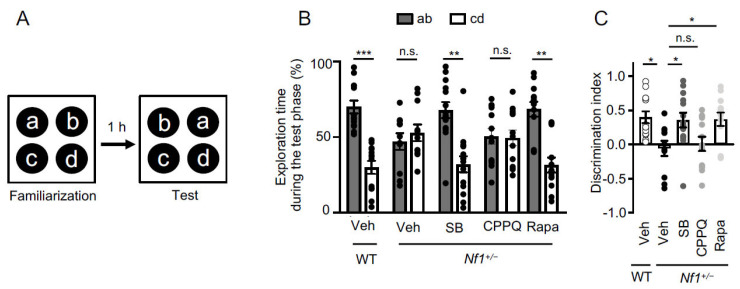
Neurofibromatosis type 1 (NF1) is a common inherited disorder caused by mutations of the gene that encodes the Ras-GTPase activating protein neurofibromin, leading to overactivation of Ras-dependent signaling pathways such as the mTOR pathway. It is often characterized by a broad range of cognitive symptoms that are currently untreated. The serotonin 5-HT receptor is a potentially relevant target in view of its ability to associate with neurofibromin and to engage the mTOR pathway to compromise cognition in several cognitive impairment paradigms. Here, we show that constitutively active 5-HT receptors contribute to increased mTOR activity in the brain of mice, a preclinical model recapitulating some behavioral alterations of NF1. Correspondingly, peripheral administration of SB258585, a 5-HT receptor inverse agonist, or rapamycin, abolished deficits in long-term social and associative memories in mice, whereas administration of CPPQ, a neutral antagonist, did not produce cognitive improvement. These results show a key influence of mTOR activation by constitutively active 5-HT receptors in NF1 cognitive symptoms. They provide a proof of concept that 5-HT receptor inverse agonists already in clinical development as symptomatic treatments to reduce cognitive decline in dementia and psychoses, might be repurposed as therapies alleviating cognitive deficits in NF1 patients.
神经纤维瘤病 1 型(NF1)是一种常见的遗传性疾病,由编码 Ras-GTP 酶激活蛋白神经纤维瘤素的基因突变引起,导致 Ras 依赖性信号通路(如 mTOR 通路)过度激活。它通常表现为广泛的认知症状,目前尚无治疗方法。鉴于 5-羟色胺 5-HT 受体能够与神经纤维瘤素结合,并通过 mTOR 通路参与认知障碍的几个认知障碍模型,它是一个潜在的相关靶点。在这里,我们表明,在一种模拟 NF1 某些行为改变的临床前模型中,持续激活的 5-HT 受体导致大脑中 mTOR 活性增加。相应地,外周给予 5-HT 受体反向激动剂 SB258585 或雷帕霉素可消除 NF1 小鼠的长期社交和联想记忆缺陷,而给予中性拮抗剂 CPPQ 则不会产生认知改善。这些结果表明,持续激活的 5-HT 受体通过 mTOR 激活对 NF1 的认知症状有重要影响。它们提供了一个概念验证,即已经在临床开发中作为治疗痴呆和精神病认知下降的症状治疗药物的 5-HT 受体反向激动剂,可能被重新用作缓解 NF1 患者认知缺陷的治疗方法。