Hachaichi Amina, Kouini Benalia, Kian Lau Kia, Asim Mohammad, Fouad Hassan, Jawaid Mohammad, Sain Mohini
Research Unit Materials, Processes and Environment (URMPE), Faculty of Technology, M'hamed Bougara University, Boumerdes 35000, Algeria.
Laboratory of Coatings, Materials and Environment, M'hamed Bougara University, Boumerdes 35000, Algeria.
Materials (Basel). 2021 Sep 15;14(18):5313. doi: 10.3390/ma14185313.
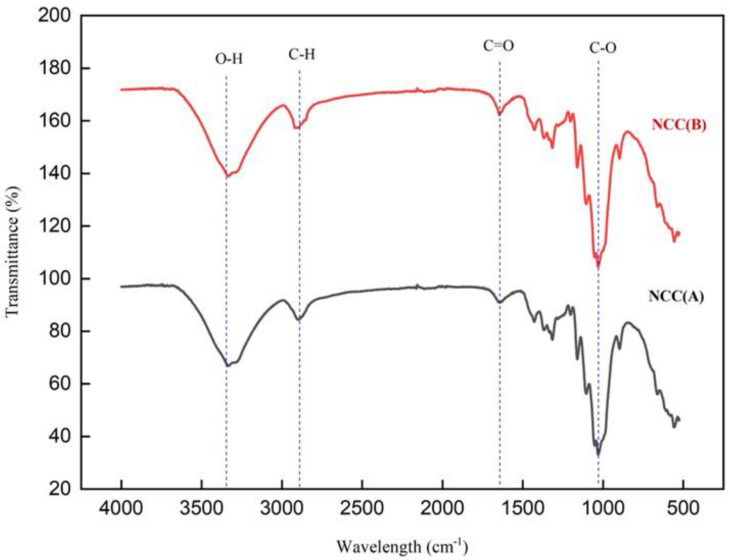
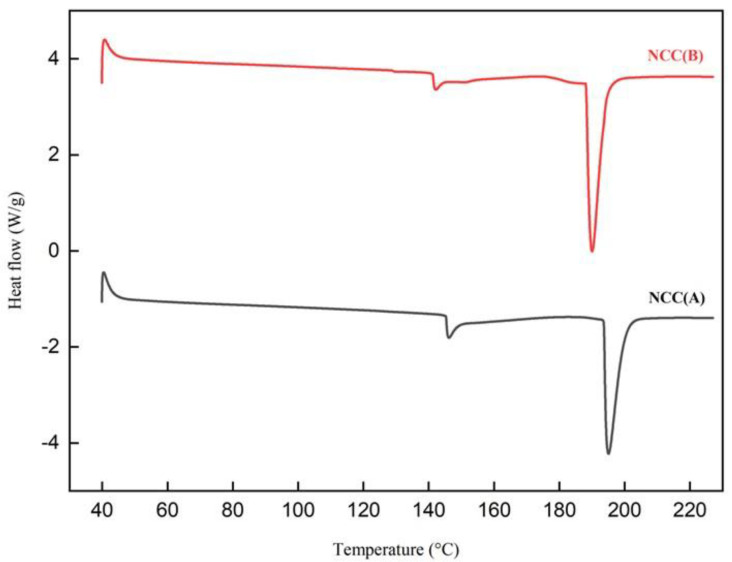
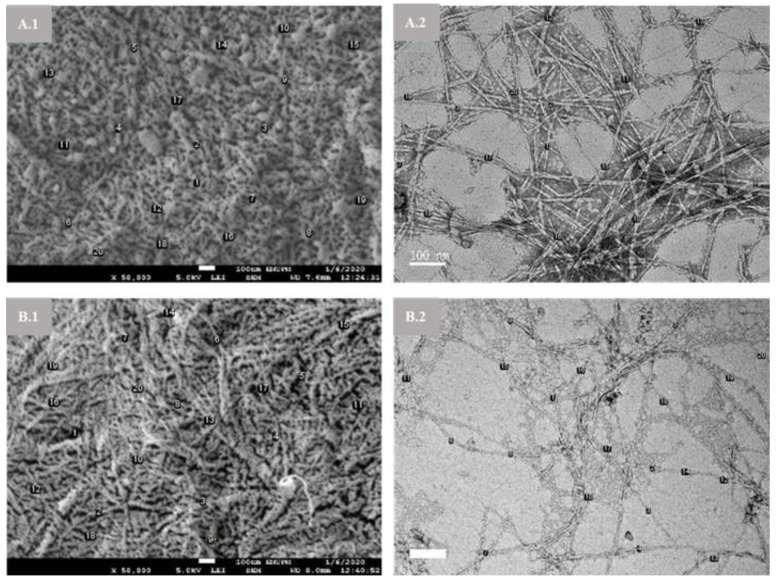
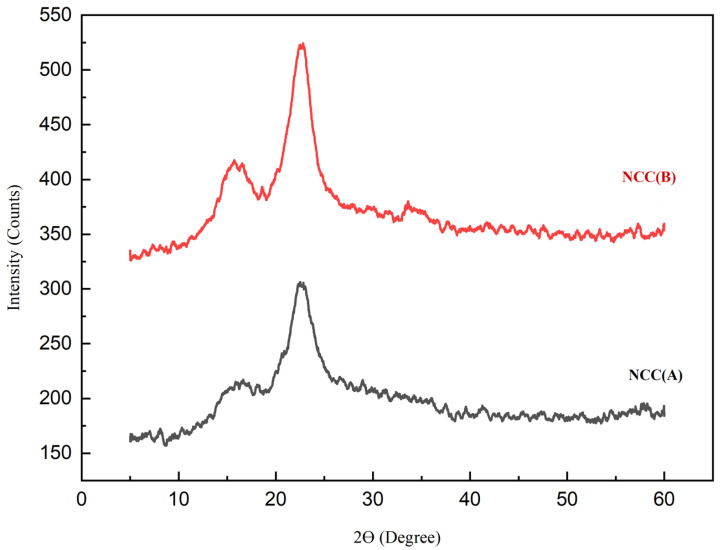
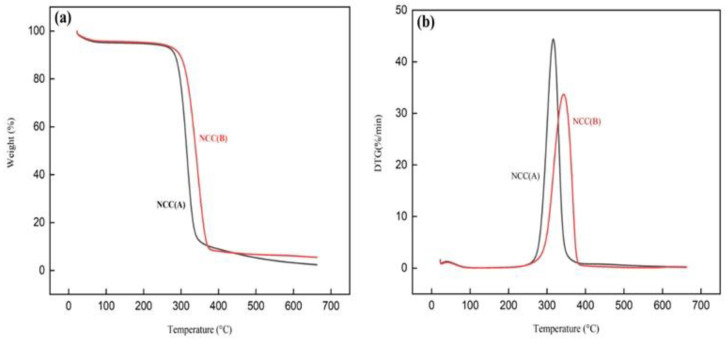
Date palm fiber ( L.) is a natural biopolymer rich in lignocellulosic components. Its high cellulose content lends them to the extraction of tiny particles like microcrystalline cellulose (MCC) and nanocrystalline cellulose (NCC). These cellulose-derived small size particles can be used as an alternative biomaterial in wide fields of application due to their renewability and sustainability. In the present work, NCC (A) and NCC (B) were isolated from date palm MCC at 60 min and 90 min hydrolysis times, respectively. The isolated NCC product was subjected to characterization to study their properties differences. With the hydrolysis treatment, the yields of produced NCC could be attained at between 22% and 25%. The infrared-ray functional analysis also revealed the isolated NCC possessed a highly exposed cellulose compartment with minimized lignoresidues of lignin and hemicellulose. From morphology evaluation, the nanoparticles' size was decreased gradually from NCC (A) (7.51 nm width, 139.91 nm length) to NCC (B) (4.34 nm width, 111.51 nm length) as a result of fragmentation into cellulose fibrils. The crystallinity index was found increasing from NCC (A) to NCC (B). With 90 min hydrolysis time, NCC (B) showed the highest crystallinity index of 71% due to its great cellulose rigidity. For thermal analysis, NCC (B) also exhibited stable heat resistance, in associating with its highly crystalline cellulose structure. In conclusion, the NCC isolated from date palm MCC would be a promising biomaterial for various applications such as biomedical and food packaging applications.
椰枣纤维(L.)是一种富含木质纤维素成分的天然生物聚合物。其高纤维素含量使其适合提取微晶纤维素(MCC)和纳米晶纤维素(NCC)等微小颗粒。这些源自纤维素的小尺寸颗粒因其可再生性和可持续性,可在广泛的应用领域用作替代生物材料。在本研究中,分别在水解60分钟和90分钟时从椰枣MCC中分离出NCC(A)和NCC(B)。对分离出的NCC产物进行表征以研究它们的性能差异。通过水解处理,所生产的NCC产率可达22%至25%。红外功能分析还表明,分离出的NCC具有高度暴露的纤维素部分,木质素和半纤维素的木质残余物最少。从形态学评估来看,由于破碎成纤维素原纤维,纳米颗粒的尺寸从NCC(A)(宽度7.51纳米,长度139.91纳米)逐渐减小到NCC(B)(宽度4.34纳米,长度111.51纳米)。结晶度指数从NCC(A)到NCC(B)呈上升趋势。水解90分钟时,NCC(B)由于其较高的纤维素刚性,显示出最高的结晶度指数71%。对于热分析,NCC(B)由于其高度结晶的纤维素结构,也表现出稳定的耐热性。总之,从椰枣MCC中分离出的NCC有望成为用于生物医学和食品包装等各种应用的生物材料。