Miyanishi Hajime, Nitta Atsumi
Department of Pharmaceutical Therapy and Neuropharmacology, Faculty of Pharmaceutical Sciences, University of Toyama, 2630 Sugitani, Toyama-shi, Toyama 930-0194, Japan.
Pharmaceuticals (Basel). 2021 Sep 1;14(9):889. doi: 10.3390/ph14090889.
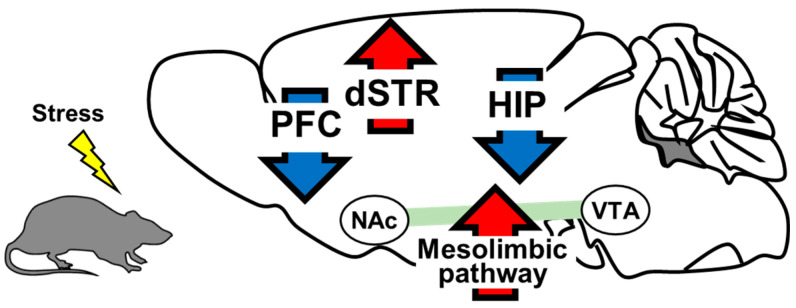
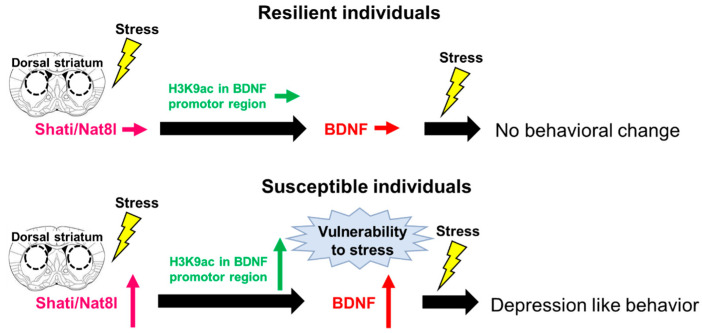
Depression is one of the most common mental diseases, with increasing numbers of patients globally each year. In addition, approximately 30% of patients with depression are resistant to any treatment and do not show an expected response to first-line antidepressant drugs. Therefore, novel antidepressant agents and strategies are required. Although depression is triggered by post-birth stress, while some individuals show the pathology of depression, others remain resilient. The molecular mechanisms underlying stress sensitivity remain unknown. Brain-derived neurotrophic factor (BDNF) has both pro- and anti-depressant effects, dependent on brain region. Considering the strong region-specific contribution of BDNF to depression pathogenesis, the regulation of BDNF in the whole brain is not a beneficial strategy for the treatment of depression. We reviewed a novel finding of BDNF function in the dorsal striatum, which induces vulnerability to social stress, in addition to recent research progress regarding the brain regional functions of BDNF, including the prefrontal cortex, hippocampus, and nucleus accumbens. Striatal BDNF is regulated by Shati/Nat8l, an -acetyltransferase through epigenetic regulation. Targeting of Shati/Nat8l would allow BDNF to be striatum-specifically regulated, and the striatal Shati/Nat8l-BDNF pathway could be a promising novel therapeutic agent for the treatment of depression by modulating sensitivity to stress.
抑郁症是最常见的精神疾病之一,全球每年患者数量都在增加。此外,约30%的抑郁症患者对任何治疗都有抵抗性,对一线抗抑郁药物未表现出预期反应。因此,需要新型抗抑郁药物和策略。虽然抑郁症由产后应激引发,但一些人出现抑郁症病理症状,而另一些人仍具有恢复力。应激敏感性的分子机制尚不清楚。脑源性神经营养因子(BDNF)根据脑区不同具有促抑郁和抗抑郁作用。考虑到BDNF对抑郁症发病机制具有很强的区域特异性作用,对全脑BDNF进行调节并非治疗抑郁症的有效策略。我们综述了BDNF在背侧纹状体中功能的新发现,其除了诱导对社会应激的易感性外,还包括近期关于BDNF在脑区功能方面的研究进展,如前额叶皮质、海马体和伏隔核。纹状体BDNF受Shati/Nat8l(一种通过表观遗传调控的N - 乙酰转移酶)调节。靶向Shati/Nat8l可使BDNF在纹状体中受到特异性调节,且纹状体Shati/Nat8l - BDNF通路可能是一种通过调节对应激的敏感性来治疗抑郁症的有前景的新型治疗药物。