Lim An Eng, Lam Yee Cheong
School of Mechanical and Aerospace Engineering, Nanyang Technological University, 50 Nanyang Avenue, Singapore 639798, Singapore.
Micromachines (Basel). 2021 Aug 28;12(9):1031. doi: 10.3390/mi12091031.
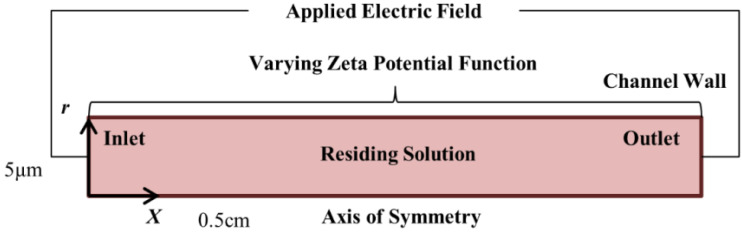
Electroosmotic flow (EOF) involving displacement of multiple fluids is employed in micro-/nanofluidic applications. There are existing investigations on EOF hysteresis, i.e., flow direction-dependent behavior. However, none so far have studied the solution pair system of dissimilar ionic species with substantial pH difference. They exhibit complicated hysteretic phenomena. In this study, we investigate the EOF of sodium bicarbonate (NaHCO, alkaline) and sodium chloride (NaCl, slightly acidic) solution pair via current monitoring technique. A developed slip velocity model with a modified wall condition is implemented with finite element simulations. Quantitative agreements between experimental and simulation results are obtained. Concentration evolutions of NaHCO-NaCl follow the dissimilar anion species system. When NaCl displaces NaHCO, EOF reduces due to the displacement of NaHCO with high pH (high absolute zeta potential). Consequently, NaCl is not fully displaced into the microchannel. When NaHCO displaces NaCl, NaHCO cannot displace into the microchannel as NaCl with low pH (low absolute zeta potential) produces slow EOF. These behaviors are independent of the applied electric field. However, complete displacement tends to be achieved by lowering the NaCl concentration, i.e., increasing its zeta potential. In contrast, the NaHCO concentration has little impact on the displacement process. These findings enhance the understanding of EOF involving solutions with dissimilar pH and ion species.
涉及多种流体位移的电渗流(EOF)被应用于微纳流体领域。已有关于EOF滞后现象的研究,即与流动方向相关的行为。然而,目前尚无研究针对具有显著pH差异的不同离子种类的溶液对系统。它们呈现出复杂的滞后现象。在本研究中,我们通过电流监测技术研究碳酸氢钠(NaHCO₃,碱性)和氯化钠(NaCl,微酸性)溶液对的EOF。采用有限元模拟实现了一个具有修正壁面条件的滑移速度模型。实验结果与模拟结果取得了定量的一致性。NaHCO₃-NaCl的浓度演变遵循不同阴离子种类系统。当NaCl取代NaHCO₃时,由于高pH值(高绝对zeta电位)的NaHCO₃被取代,EOF降低。因此,NaCl不能完全被置换到微通道中。当NaHCO₃取代NaCl时,由于低pH值(低绝对zeta电位)的NaCl产生缓慢的EOF,NaHCO₃无法置换到微通道中。这些行为与所施加的电场无关。然而,通过降低NaCl浓度,即增加其zeta电位,倾向于实现完全置换。相比之下,NaHCO₃浓度对置换过程影响很小。这些发现增进了对涉及具有不同pH值和离子种类溶液的EOF的理解。