Kang Jung-Mi, Lê Hương Giang, Na Byoung-Kuk, Yoo Won Gi
Department of Parasitology and Tropical Medicine, Institute of Health Sciences, Gyeongsang National University College of Medicine, Jinju 52727, Korea.
Department of Convergence Medical Science, Gyeongsang National University, Jinju 52727, Korea.
Pathogens. 2021 Sep 2;10(9):1128. doi: 10.3390/pathogens10091128.
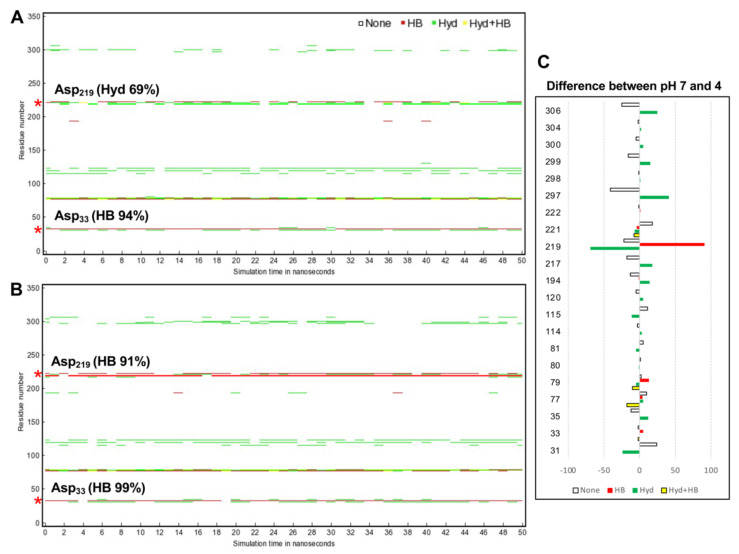
Cathepsin D (CatD; EC 3.4.23.5) family peptidases of parasitic organisms are regarded as potential drug targets as they play critical roles in the physiology and pathobiology of parasites. Previously, we characterized the biochemical features of cathepsin D isozyme 2 (CatD2) in the carcinogenic liver fluke (CsCatD2). In this study, we performed all-atomic molecular dynamics simulations by applying different systems for the ligand-free/bound forms under neutral and acidic conditions to investigate the pH-dependent structural alterations and associated functional changes in CsCatD2. CsCatD2 showed several distinctive characteristics as follows: (1) acidic pH caused major conformational transitions from open to closed state in this enzyme; (2) during 30-36-ns simulations, acidic pH contributed significantly to the formation of rigid β-sheets around the catalytic residue Asp, higher occupancy (0% to 99%) of hydrogen bond than that of Asp, and enhanced stabilization of the CsCatD2-inhibtor complex; (3) neutral pH-induced displacement of the N-terminal part to hinder the accessibility of the active site and open allosteric site of this enzyme; and (4) the flap dynamics metrics, including distance (), TriCα angles ( and ), and dihedral angle (ϕ), account for the asymmetrical twisting motion of the active site of this enzyme. These findings provide an in-depth understanding of the pH-dependent structural dynamics of free and bound forms of CsCatD2 and basic information for the rational design of an inhibitor as a drug targeting parasitic CatD.
寄生生物的组织蛋白酶D(CatD;EC 3.4.23.5)家族肽酶被视为潜在的药物靶点,因为它们在寄生虫的生理学和病理生物学中发挥着关键作用。此前,我们对致癌肝吸虫中的组织蛋白酶D同工酶2(CsCatD2)的生化特性进行了表征。在本研究中,我们通过在中性和酸性条件下对无配体/结合形式应用不同系统进行全原子分子动力学模拟,以研究CsCatD2中pH依赖性的结构改变和相关的功能变化。CsCatD2表现出以下几个显著特征:(1)酸性pH导致该酶从开放状态到封闭状态的主要构象转变;(2)在30 - 36纳秒的模拟过程中,酸性pH显著促进了催化残基天冬氨酸周围刚性β折叠片的形成、氢键占有率(从0%到99%)高于天冬氨酸以及CsCatD2 - 抑制剂复合物稳定性的增强;(3)中性pH诱导N端部分的位移,从而阻碍该酶活性位点和开放变构位点的可及性;(4)包括距离()、TriCα角(和)以及二面角(ϕ)在内的瓣片动力学指标解释了该酶活性位点的不对称扭曲运动。这些发现为深入了解CsCatD2游离和结合形式的pH依赖性结构动力学以及作为靶向寄生性CatD药物的抑制剂的合理设计提供了基础信息。