Koju R K, Mishin Y
Department of Physics and Astronomy, George Mason University, MSN 3F3, Fairfax, VA 22030, USA.
Nanomaterials (Basel). 2021 Sep 10;11(9):2348. doi: 10.3390/nano11092348.
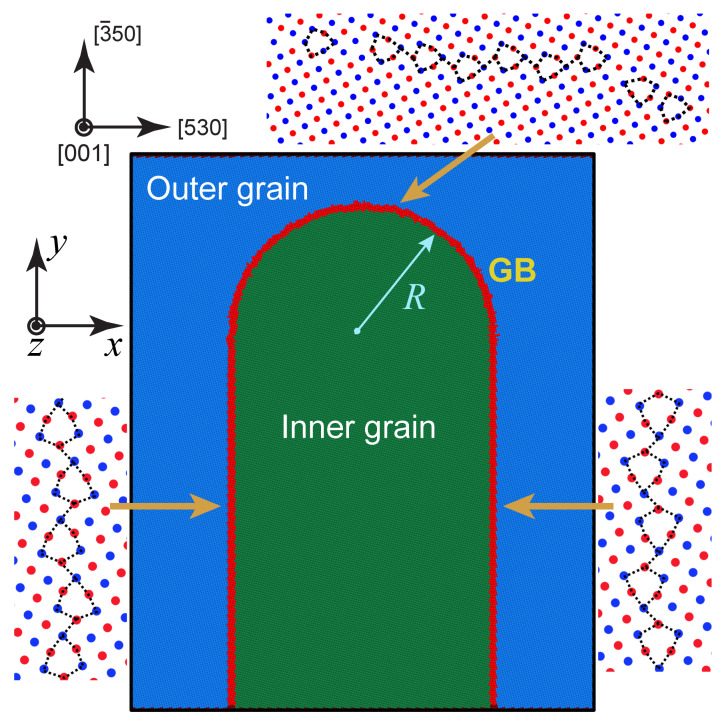
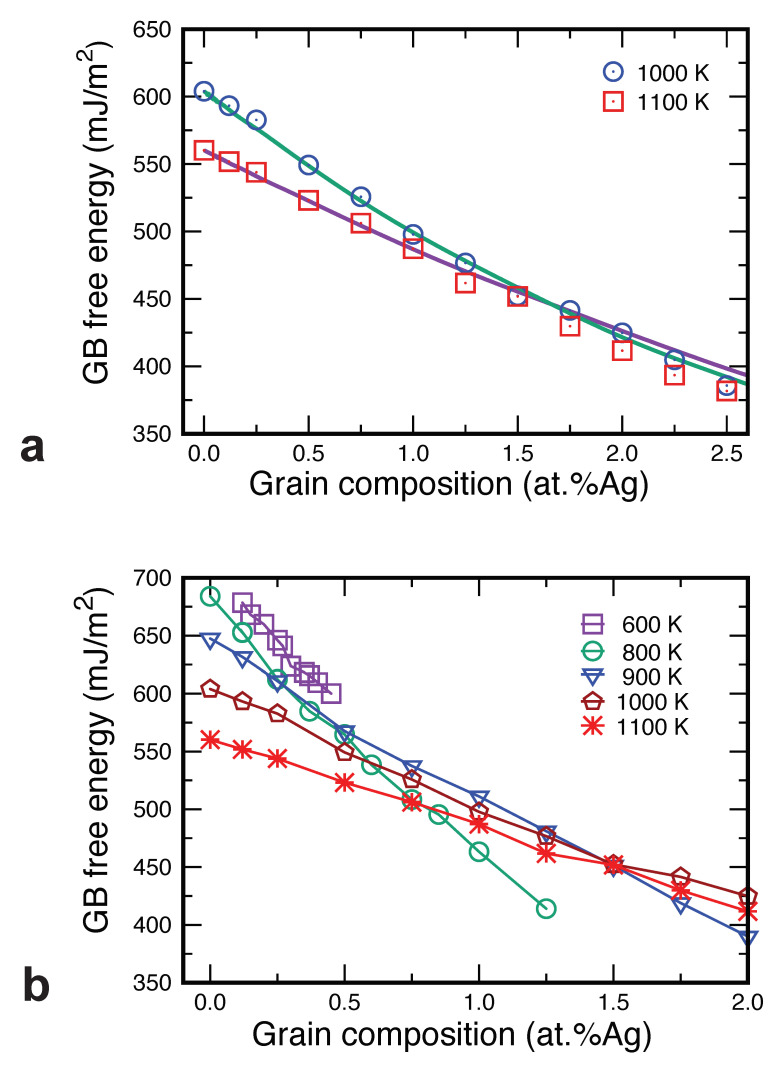
Molecular dynamics (MD) simulations are applied to study solute drag by curvature-driven grain boundaries (GBs) in Cu-Ag solid solution. Although lattice diffusion is frozen on the MD timescale, the GB significantly accelerates the solute diffusion and alters the state of short-range order in lattice regions swept by its motion. The accelerated diffusion produces a nonuniform redistribution of the solute atoms in the form of GB clusters enhancing the solute drag by the Zener pinning mechanism. This finding points to an important role of lateral GB diffusion in the solute drag effect. A 1.5 at.%Ag alloying reduces the GB free energy by 10-20% while reducing the GB mobility coefficients by more than an order of magnitude. Given the greater impact of alloying on the GB mobility than on the capillary driving force, kinetic stabilization of nanomaterials against grain growth is likely to be more effective than thermodynamic stabilization aiming to reduce the GB free energy.
应用分子动力学(MD)模拟研究了Cu-Ag固溶体中曲率驱动晶界(GBs)引起的溶质拖拽现象。尽管在MD时间尺度上晶格扩散被冻结,但晶界显著加速了溶质扩散,并改变了其运动扫过的晶格区域中的短程有序状态。加速扩散以晶界团簇的形式产生溶质原子的不均匀再分布,通过齐纳钉扎机制增强了溶质拖拽。这一发现表明横向晶界扩散在溶质拖拽效应中起着重要作用。1.5原子百分比的Ag合金化使晶界自由能降低了10%-20%,同时使晶界迁移率系数降低了一个多数量级。鉴于合金化对晶界迁移率的影响大于对毛细驱动力的影响,纳米材料抵抗晶粒生长的动力学稳定可能比旨在降低晶界自由能的热力学稳定更有效。