Özpolat B Duygu, Randel Nadine, Williams Elizabeth A, Bezares-Calderón Luis Alberto, Andreatta Gabriele, Balavoine Guillaume, Bertucci Paola Y, Ferrier David E K, Gambi Maria Cristina, Gazave Eve, Handberg-Thorsager Mette, Hardege Jörg, Hird Cameron, Hsieh Yu-Wen, Hui Jerome, Mutemi Kevin Nzumbi, Schneider Stephan Q, Simakov Oleg, Vergara Hernando M, Vervoort Michel, Jékely Gáspár, Tessmar-Raible Kristin, Raible Florian, Arendt Detlev
Eugene Bell Center for Regenerative Biology and Tissue Engineering, Marine Biological Laboratory, Woods Hole, MA, 02543, USA.
Department of Zoology, University of Cambridge, Downing Street, Cambridge, CB2 3EJ, UK.
Evodevo. 2021 Sep 27;12(1):10. doi: 10.1186/s13227-021-00180-3.
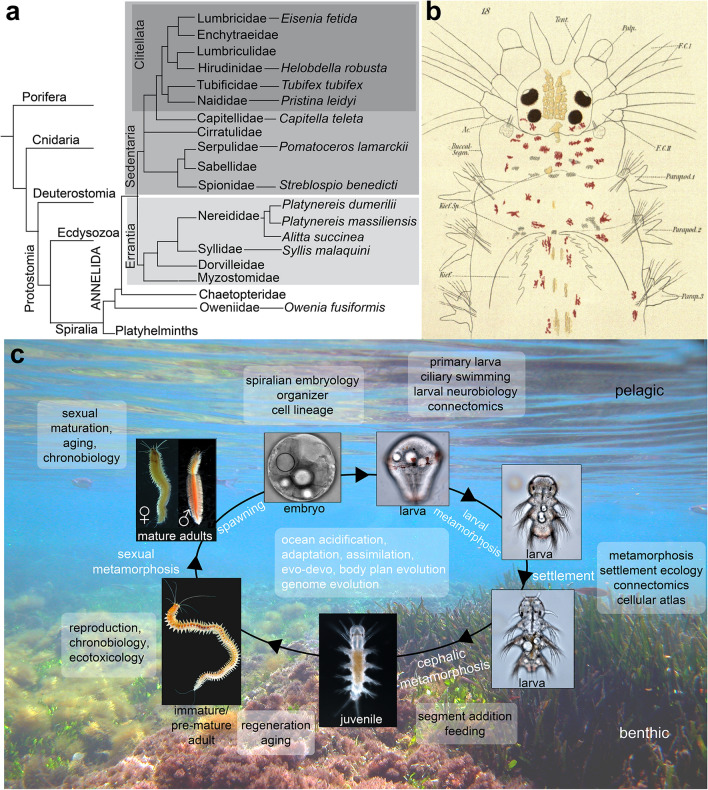
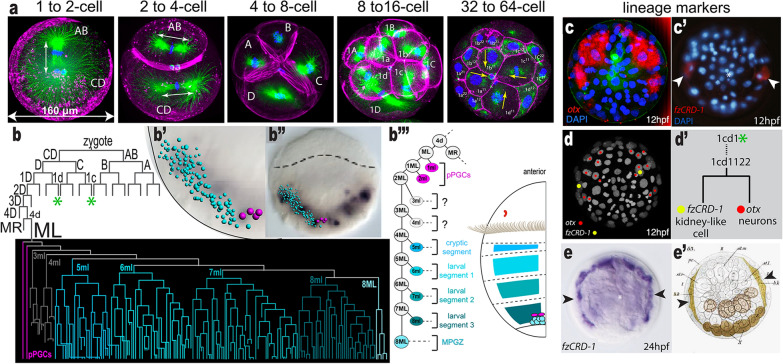
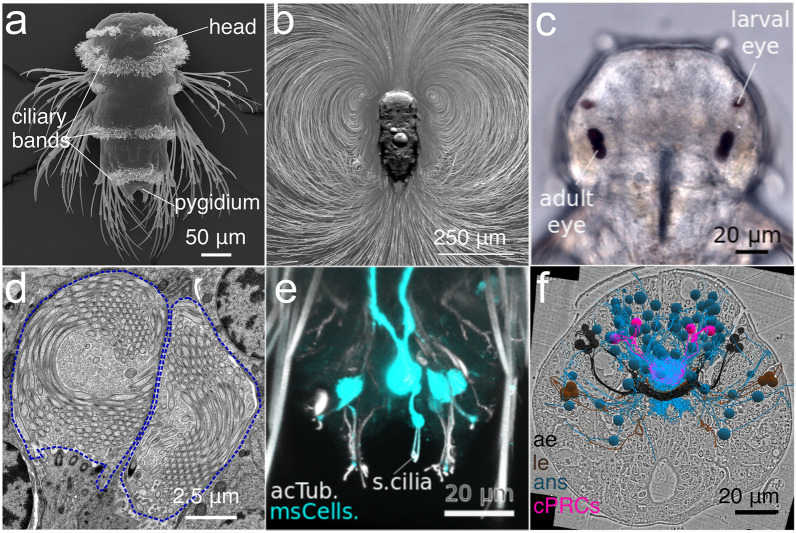
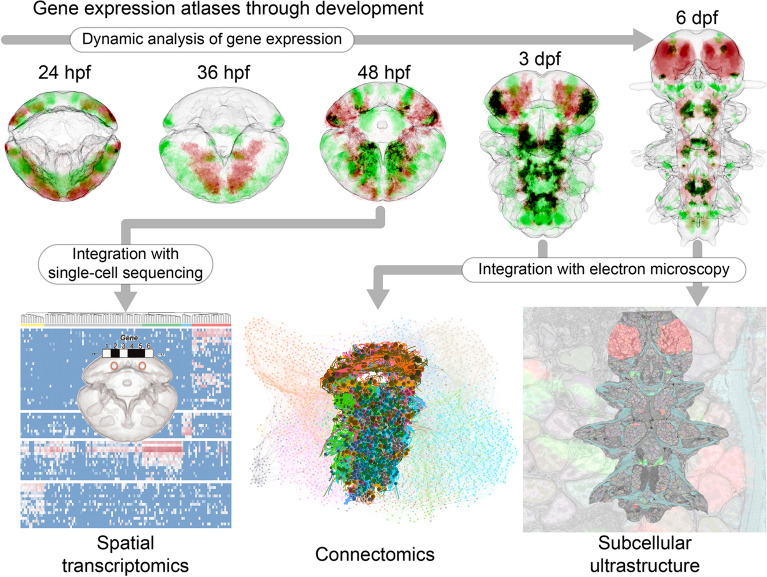
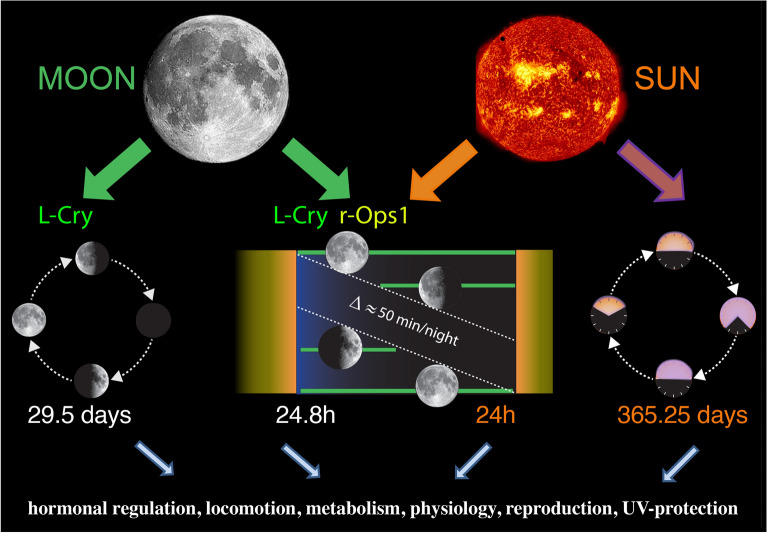
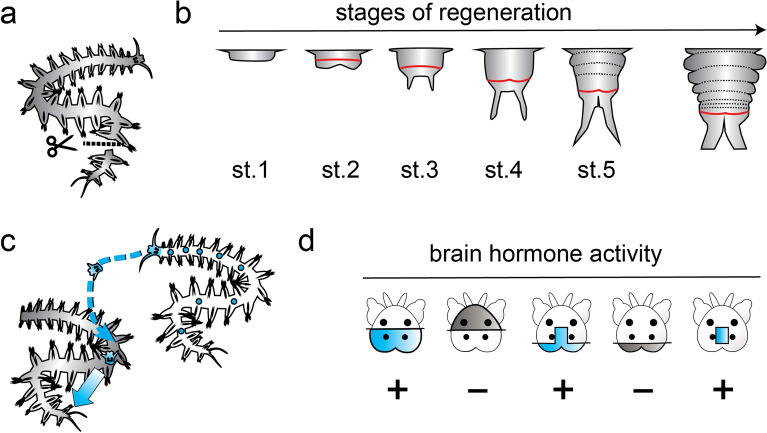
The Nereid Platynereis dumerilii (Audouin and Milne Edwards (Annales des Sciences Naturelles 1:195-269, 1833) is a marine annelid that belongs to the Nereididae, a family of errant polychaete worms. The Nereid shows a pelago-benthic life cycle: as a general characteristic for the superphylum of Lophotrochozoa/Spiralia, it has spirally cleaving embryos developing into swimming trochophore larvae. The larvae then metamorphose into benthic worms living in self-spun tubes on macroalgae. Platynereis is used as a model for genetics, regeneration, reproduction biology, development, evolution, chronobiology, neurobiology, ecology, ecotoxicology, and most recently also for connectomics and single-cell genomics. Research on the Nereid started with studies on eye development and spiralian embryogenesis in the nineteenth and early twentieth centuries. Transitioning into the molecular era, Platynereis research focused on posterior growth and regeneration, neuroendocrinology, circadian and lunar cycles, fertilization, and oocyte maturation. Other work covered segmentation, photoreceptors and other sensory cells, nephridia, and population dynamics. Most recently, the unique advantages of the Nereid young worm for whole-body volume electron microscopy and single-cell sequencing became apparent, enabling the tracing of all neurons in its rope-ladder-like central nervous system, and the construction of multimodal cellular atlases. Here, we provide an overview of current topics and methodologies for P. dumerilii, with the aim of stimulating further interest into our unique model and expanding the active and vibrant Platynereis community.
多毛纲沙蚕目多毛类动物杜氏阔沙蚕(Audouin和Milne Edwards,《自然科学年鉴》1:195 - 269,1833年)是一种海洋环节动物,属于游走多毛类蠕虫的沙蚕科。杜氏阔沙蚕呈现出浮游 - 底栖的生命周期:作为触手冠动物/螺旋动物总门的一个普遍特征,它具有螺旋分裂的胚胎,发育成游动的担轮幼虫。幼虫随后变态为底栖蠕虫,生活在大型藻类上自行纺丝形成的管中。阔沙蚕被用作遗传学、再生、生殖生物学、发育、进化、生物钟学、神经生物学、生态学、生态毒理学的模型,最近还用于连接组学和单细胞基因组学。对杜氏阔沙蚕的研究始于19世纪和20世纪初对眼睛发育和螺旋动物胚胎发生的研究。进入分子时代后,阔沙蚕的研究重点转向后部生长与再生、神经内分泌学、昼夜节律和月周期、受精以及卵母细胞成熟。其他工作涵盖了体节形成、光感受器和其他感觉细胞、肾管以及种群动态。最近,杜氏阔沙蚕幼体在全身体积电子显微镜和单细胞测序方面的独特优势变得明显,能够追踪其绳梯状中枢神经系统中的所有神经元,并构建多模式细胞图谱。在这里,我们概述了杜氏阔沙蚕当前的研究主题和方法,旨在激发对我们独特模型的进一步兴趣,并扩大活跃且充满活力的阔沙蚕研究群体。