Department of Global Health, University of Washington, Seattle, USA.
Division of Allergy and Infectious Diseases, University of Washington, Seattle, USA.
Trials. 2021 Sep 27;22(1):661. doi: 10.1186/s13063-021-05608-8.
HPV infection is the primary cause of cervical cancer, a leading cause of cancer among women in Kenya and many sub-Saharan African countries. High coverage of HPV vaccination is a World Health Organization priority to eliminate cervical cancer globally, but vaccine supply and logistics limit widespread implementation of the current two or three dose HPV vaccine schedule.
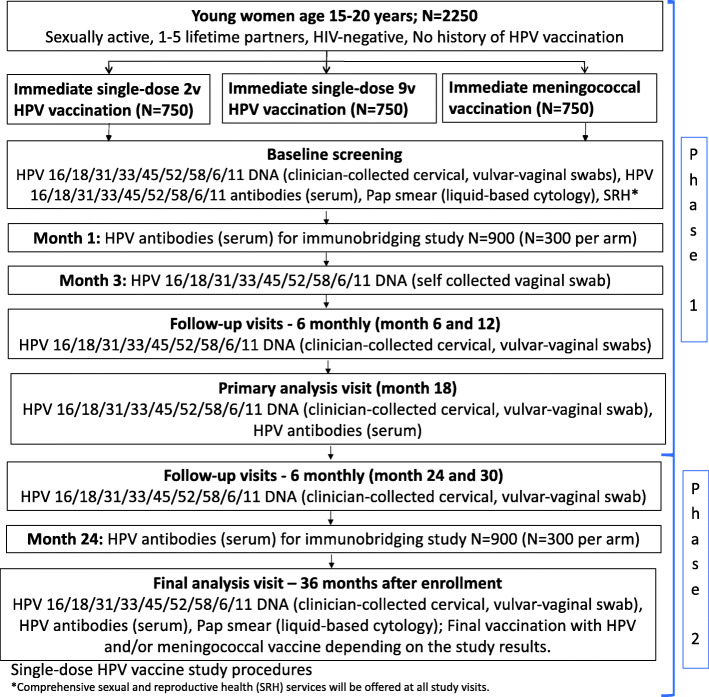
We are conducting an individual randomized controlled trial to evaluate whether a single dose of the bivalent (HPV 16/18) or nonavalent (HPV 16/18/31/33/45/52/58/6/11) HPV vaccine prevents persistent HPV infection, a surrogate marker for precancerous lesions and cervical cancer. The primary objective is to compare the efficacy of immediate, single-dose bivalent or nonavalent vaccination with delayed HPV vaccination. Kenyan women age 15-20 years old are randomized to immediate bivalent HPV and delayed meningococcal vaccine (group 1), immediate nonavalent HPV vaccine and delayed meningococcal vaccine (group 2), or immediate meningococcal vaccine and delayed HPV vaccine (group 3) with 36 months of follow-up. The primary outcome is persistent vaccine-type HPV infection by month 18 and by month 36 for the final durability outcome. The secondary objectives include to (1) evaluate non-inferiority of antibody titers among girls and adolescents (age 9 to 14 years) from another Tanzanian study, the DoRIS Study (NCT02834637), compared to KEN SHE Study participants; (2) assess the memory B cell immune response at months 36 and 37; and (3) estimate cost-effectiveness using the trial results and health economic models.
This study will evaluate single-dose HPV vaccine efficacy in Africa and has the potential to guide public health policy and increase HPV vaccine coverage. The secondary aims will assess generalizability of the trial results by evaluating immunobridging from younger ages, durability of the immune response, and the long-term health benefits and cost of single-dose HPV vaccine delivery.
ClinicalTrials.gov NCT03675256 . Registered on September 18, 2018.
HPV 感染是宫颈癌的主要病因,也是肯尼亚和撒哈拉以南非洲国家许多国家女性癌症死亡的主要原因。高覆盖率的 HPV 疫苗接种是世界卫生组织消除全球宫颈癌的优先事项,但疫苗供应和物流限制了当前两剂或三剂 HPV 疫苗接种计划的广泛实施。
我们正在进行一项个体随机对照试验,以评估单剂二价(HPV 16/18)或九价(HPV 16/18/31/33/45/52/58/6/11)HPV 疫苗是否可预防持续性 HPV 感染,这是癌前病变和宫颈癌的替代标志物。主要目的是比较即时接种单剂二价或九价 HPV 疫苗与延迟接种 HPV 疫苗的效果。肯尼亚年龄在 15-20 岁的女性被随机分为即时接种二价 HPV 疫苗和延迟接种脑膜炎球菌疫苗组(第 1 组)、即时接种九价 HPV 疫苗和延迟接种脑膜炎球菌疫苗组(第 2 组)或即时接种脑膜炎球菌疫苗和延迟接种 HPV 疫苗组(第 3 组),随访 36 个月。主要结局是第 18 个月和第 36 个月时持续性疫苗型 HPV 感染。次要目标包括:(1)通过另一个坦桑尼亚研究(DoRIS 研究,NCT02834637)评估来自 9-14 岁女孩和青少年的抗体滴度,与 KEN SHE 研究参与者相比是否不劣效;(2)评估第 36 个月和第 37 个月时记忆 B 细胞免疫应答;(3)利用试验结果和健康经济模型评估成本效益。
本研究将评估非洲单剂 HPV 疫苗的效果,有潜力指导公共卫生政策并提高 HPV 疫苗覆盖率。次要目标将通过评估来自较年轻年龄的免疫桥接、免疫应答的持久性以及单剂 HPV 疫苗接种的长期健康效益和成本,评估试验结果的普遍性。
ClinicalTrials.gov NCT03675256。于 2018 年 9 月 18 日注册。