Department of Neural and Behavioral Sciences, Penn State College of Medicine, Hershey, PA
Department of Neural and Behavioral Sciences, Penn State College of Medicine, Hershey, PA.
Diabetes. 2021 Dec;70(12):2903-2916. doi: 10.2337/db21-0385. Epub 2021 Sep 27.
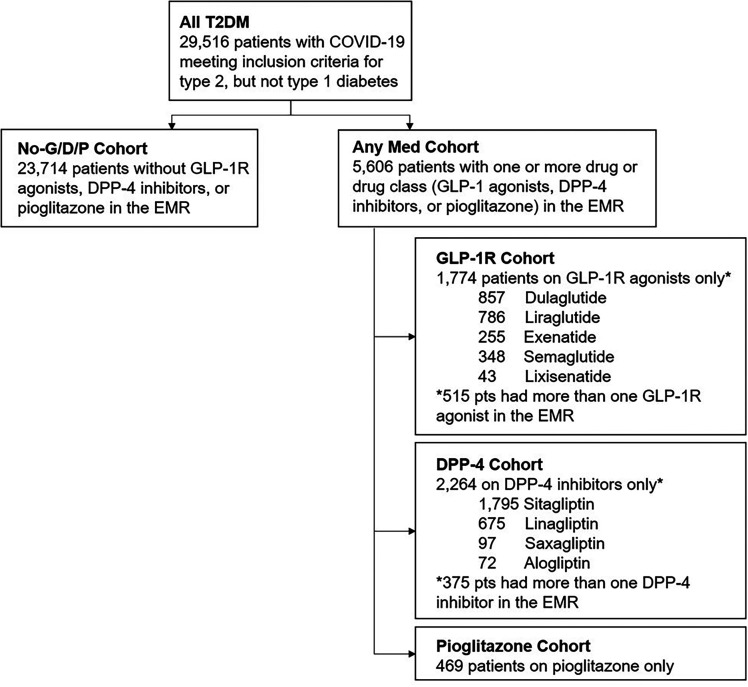
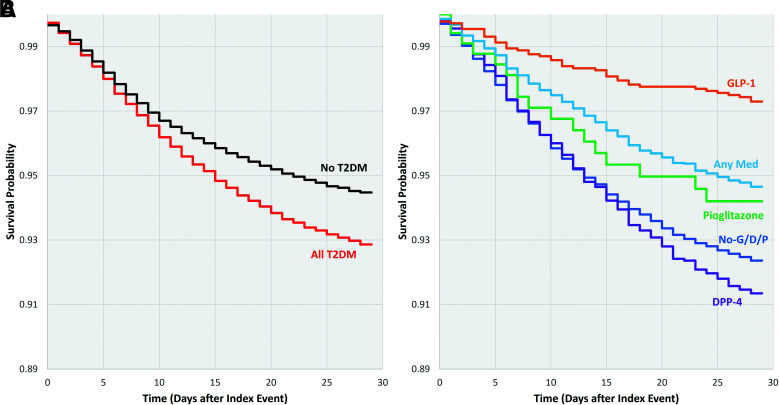
Patients with type 2 diabetes mellitus (T2DM) are at increased risk of severe coronavirus disease 2019 (COVID-19) outcomes possibly because of dysregulated inflammatory responses. Glucose-regulating medications, such as glucagon-like peptide 1 receptor (GLP-1R) agonists, dipeptidyl peptidase 4 (DPP-4) inhibitors, and pioglitazone, are known to have anti-inflammatory effects that may improve outcomes in patients with severe acute respiratory syndrome coronavirus 2 (SARS-CoV-2) infection. In a multinational retrospective cohort study, we used the TriNetX COVID-19 Research Network of 56 large health care organizations to examine these medications in relation to the incidence of hospital admissions, respiratory complications, and mortality within 28 days after a COVID-19 diagnosis. After matching for age, sex, race, ethnicity, BMI, and significant comorbidities, use of GLP-1R agonists and/or pioglitazone was associated with significant reductions in hospital admissions (GLP-1R: 15.7% vs. 23.5%, risk ratio [RR] 0.67 [95% CI 0.57-0.79; < 0.001]; pioglitazone: 20.0% vs. 28.2%; RR 0.71 [95% CI 0.54-0.93; = 0.01]). Use of GLP-1R agonists was also associated with reductions in respiratory complications (15.3% vs. 24.9%, RR 0.62 [95% CI 0.52-0.73]; < 0.001) and incidence of mortality (1.9% vs. 3.3%, RR 0.58 [95% CI 0.35-0.97]; = 0.04). Use of DPP-4 inhibitors was associated with a reduction in respiratory complications (24.0% vs. 29.2%, RR 0.82 [95% CI 0.74-0.90]; < 0.001), and continued use of DPP-4 inhibitors after hospitalization was associated with a decrease in mortality compared with those who discontinued use (9% vs. 19%, RR 0.45 [95% CI 0.28-0.72]; < 0.001). In conclusion, use of glucose-regulating medications, such as GLP-1R agonists, DPP-4 inhibitors, or pioglitazone, may improve COVID-19 outcomes for patients with T2DM; randomized clinical trials are needed to further investigate this possibility.
患有 2 型糖尿病(T2DM)的患者患严重 2019 年冠状病毒病(COVID-19)的风险增加,这可能是由于炎症反应失调所致。人们已知葡萄糖调节药物,如胰高血糖素样肽 1 受体(GLP-1R)激动剂、二肽基肽酶 4(DPP-4)抑制剂和吡格列酮具有抗炎作用,可改善严重急性呼吸综合征冠状病毒 2(SARS-CoV-2)感染患者的结局。在一项多中心回顾性队列研究中,我们使用 TriNetX COVID-19 研究网络中的 56 个大型医疗保健组织,研究这些药物与 COVID-19 诊断后 28 天内住院、呼吸并发症和死亡率的发生之间的关系。在匹配年龄、性别、种族、民族、BMI 和显著合并症后,GLP-1R 激动剂和/或吡格列酮的使用与住院率显著降低相关(GLP-1R:15.7%对 23.5%,风险比[RR]0.67[95%CI 0.57-0.79;<0.001];吡格列酮:20.0%对 28.2%;RR 0.71[95%CI 0.54-0.93;=0.01])。GLP-1R 激动剂的使用还与呼吸并发症的减少相关(15.3%对 24.9%,RR 0.62[95%CI 0.52-0.73];<0.001)和死亡率的降低相关(1.9%对 3.3%,RR 0.58[95%CI 0.35-0.97];=0.04)。DPP-4 抑制剂的使用与呼吸并发症减少相关(24.0%对 29.2%,RR 0.82[95%CI 0.74-0.90];<0.001),与停止使用相比,住院后继续使用 DPP-4 抑制剂与死亡率降低相关(9%对 19%,RR 0.45[95%CI 0.28-0.72];<0.001)。总之,使用葡萄糖调节药物,如 GLP-1R 激动剂、DPP-4 抑制剂或吡格列酮,可能改善 T2DM 患者的 COVID-19 结局;需要进行随机临床试验来进一步研究这种可能性。