
生物信息学分析结合实验鉴定百草枯诱导人胚肺成纤维细胞纤维化的关键基因及通路
Identification of hub genes and key pathways of paraquat-induced human embryonic pulmonary fibrosis by bioinformatics analysis and studies.
机构信息
Department of Respiration, First Affiliated Hospital of Guangzhou Medical University, Guangzhou 510120, Guangdong, China.
Department of General Medicine, The First People's Hospital of Foshan, The Affiliated Foshan Hospital of Sun Yat-Sen University, Foshan 528000, Guangdong, China.
出版信息
Aging (Albany NY). 2021 Sep 27;13(19):22792-22801. doi: 10.18632/aging.203570.
OBJECTIVE
Paraquat (N,N0-dimethyl-4,40-bipyridinium dichloride;PQ) is a highly toxic pesticide, which usually leads to acute lung injury and subsequent development of pulmonary fibrosis. The exact mechanism underlying PQ-induced lung fibrosis remain largely unclear and as yet, no specific treatment drugs have been approved. Our study aimed to identify its potential mechanisms of PQ-induced fibrosis through a modeling study studies and bioinformatics analysis.
METHODS
Gene expression datasets associated with PQ-induced lung fibrosis were obtained from the Gene Expression Omnibus, wherefrom differentially expressed genes (DEGs) were identified using GEO2R. Functional enrichment analyses were performed using the Database for Annotation Visualization and Integrated Discovery. The DEGs analyzed by a protein-protein interaction network was constructed with the Search Tool for the Retrieval of Interacting Genes database. MCODE, a Cytoscape plugin, was subsequently used to identify the most significant modules. The expression of the key genes in PQ-induced pulmonary fibrotic tissues was verified by reverse transcription-quantitative PCR (RT-qPCR).
RESULTS
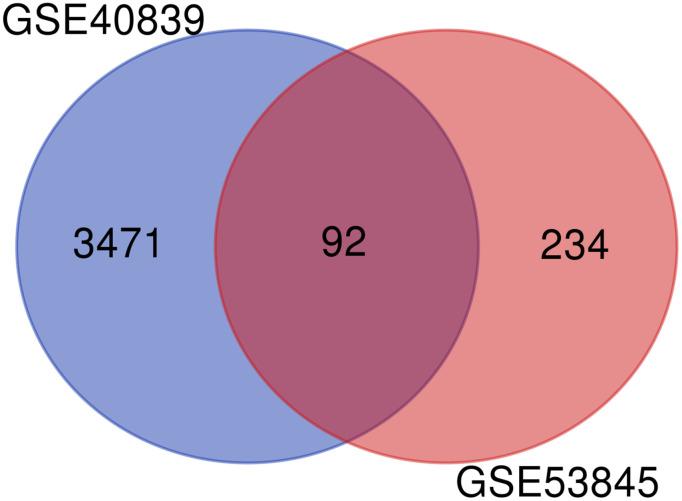
Two datasets were analyzed and revealed 92 overlapping DEGs. Functional analysis demonstrated that these 92 DEGs were enriched in the 'TNF signaling pathway', 'CXCR chemokine receptor binding', and 'core promoter binding'. Moreover, nine hub genes were identified from the protein-protein interaction network formed from the DEGs. These results suggested that the TNF signaling pathway and nine hub genes are possibly involved in PQ-induced lung fibrosis progression.
CONCLUSIONS
This integrative analysis identified candidate genes and pathways potentially involved in PQ-induced lung fibrosis, and could benefit future development of novel approaches for controlling and treating this disease.
目的
百草枯(N,N0-二甲基-4,40-联吡啶二氯化物;PQ)是一种剧毒农药,通常导致急性肺损伤和随后的肺纤维化发展。PQ 诱导肺纤维化的确切机制在很大程度上仍不清楚,迄今为止,尚未批准任何特定的治疗药物。我们的研究旨在通过建模研究和生物信息学分析来确定 PQ 诱导纤维化的潜在机制。
方法
从基因表达综合数据库中获取与 PQ 诱导肺纤维化相关的基因表达数据集,使用 GEO2R 识别差异表达基因(DEGs)。使用数据库注释可视化和综合发现进行功能富集分析。使用 Search Tool for the Retrieval of Interacting Genes 数据库构建 DEGs 分析的蛋白质-蛋白质相互作用网络。随后使用 Cytoscape 插件 MCODE 识别最重要的模块。通过逆转录定量聚合酶链反应(RT-qPCR)验证 PQ 诱导的肺纤维化组织中关键基因的表达。
结果
分析了两个数据集,发现了 92 个重叠的 DEGs。功能分析表明,这些 92 个 DEGs 富集在“TNF 信号通路”、“CXCR 趋化因子受体结合”和“核心启动子结合”中。此外,从 DEGs 形成的蛋白质-蛋白质相互作用网络中鉴定出 9 个枢纽基因。这些结果表明,TNF 信号通路和 9 个枢纽基因可能参与 PQ 诱导的肺纤维化进展。
结论
这项综合分析确定了候选基因和途径,可能参与 PQ 诱导的肺纤维化,有助于未来开发控制和治疗这种疾病的新方法。


 Zotero 插件