Vanderbilt University, Nashville, Tennessee, USA.
Cancer Med. 2021 Nov;10(21):7692-7711. doi: 10.1002/cam4.4285. Epub 2021 Sep 28.
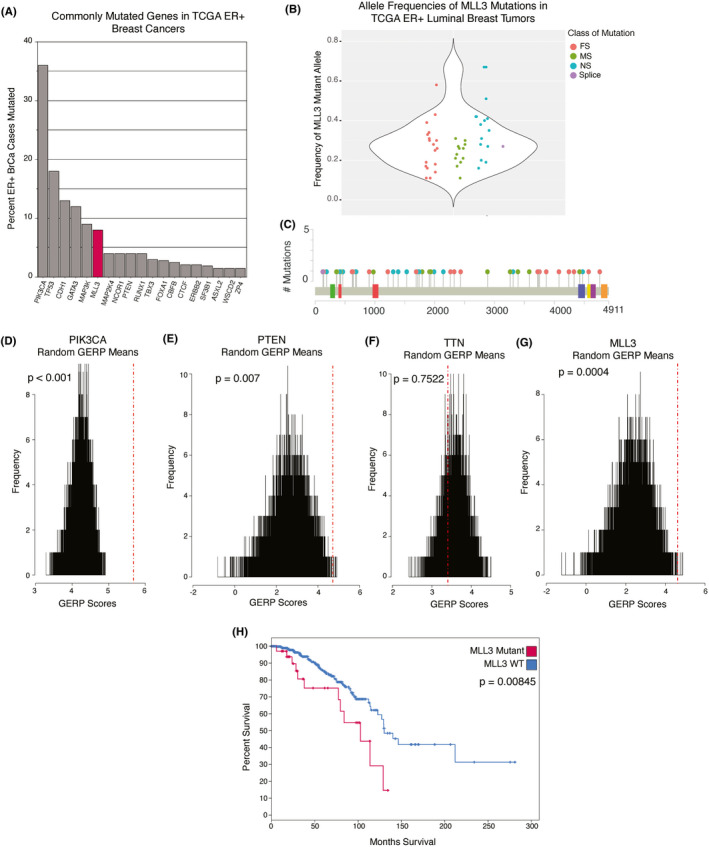
Cancer resequencing studies have revealed epigenetic enzymes as common targets for recurrent mutations. The monomethyltransferase MLL3 is among the most recurrently mutated enzymes in ER+ breast cancer. The H3K4me1 marks created by MLL3 can define enhancers. In ER+ breast cancer, ERα genome-binding sites are primarily distal enhancers. Thus, we hypothesize that mutation of MLL3 will alter the genomic binding and transcriptional regulatory activity of ERα.
We investigated the genomic consequences of knocking down MLL3 in an MLL3/PIK3CA WT ER+ breast cancer cell line.
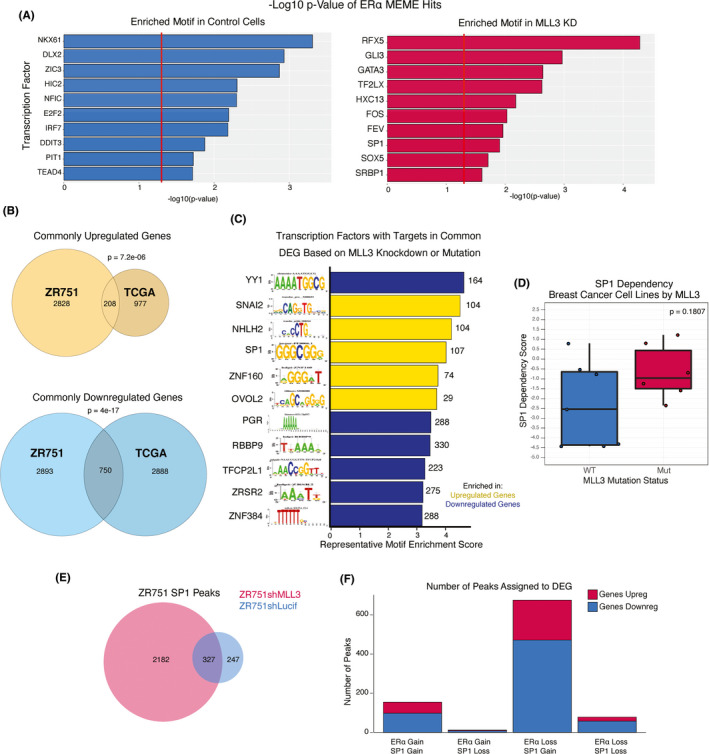
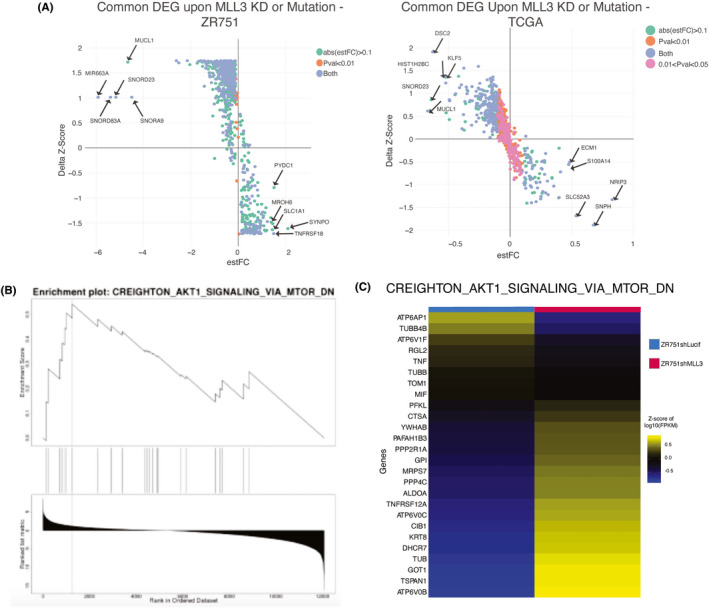
Loss of MLL3 led to a large loss of H3K4me1 across the genome, and a shift in genomic location of ERα-binding sites, which was accompanied by a re-organization of the breast cancer transcriptome. Gene set enrichment analyses of ERα-binding sites in MLL3 KD identified endocrine therapy resistance terms, and we showed that MLL3 KD cells are resistant to tamoxifen and fulvestrant. Many differentially expressed genes are controlled by the small collection of new locations of H3K4me1 deposition and ERα binding, suggesting that loss of functional MLL3 leads to new transcriptional regulation of essential genes. Motif analysis of RNA-seq and ChIP-seq data highlighted SP1 as a critical transcription factor in the MLL3 KD cells. Differentially expressed genes that display a loss of ERα binding upon MLL3 KD also harbor increased SP1 binding.
Our data show that a decrease in functional MLL3 leads to endocrine therapy resistance. This highlights the importance of genotyping patient tumor samples for MLL3 mutation upon initial resection, prior to deciding upon treatment plans.
癌症重测序研究表明,表观遗传酶是复发性突变的常见靶点。在 ER+乳腺癌中,MLL3 是最常发生突变的酶之一。MLL3 形成的 H3K4me1 标记可以定义增强子。在 ER+乳腺癌中,ERα 基因组结合位点主要是远端增强子。因此,我们假设 MLL3 的突变将改变 ERα 的基因组结合和转录调控活性。
我们研究了在 MLL3/PIK3CA WT ER+乳腺癌细胞系中敲低 MLL3 后的基因组后果。
MLL3 的缺失导致整个基因组上的 H3K4me1 大量丢失,以及 ERα 结合位点的基因组位置发生转移,这伴随着乳腺癌转录组的重新组织。MLL3 KD 中 ERα 结合位点的基因集富集分析确定了内分泌治疗抵抗术语,我们表明 MLL3 KD 细胞对他莫昔芬和氟维司群具有抗性。许多差异表达的基因受一小部分新的 H3K4me1 沉积和 ERα 结合位置的控制,这表明功能性 MLL3 的丧失导致了必需基因的新转录调控。RNA-seq 和 ChIP-seq 数据的基序分析强调了 SP1 是 MLL3 KD 细胞中关键的转录因子。在 MLL3 KD 后显示 ERα 结合丢失的差异表达基因也显示出 SP1 结合增加。
我们的数据表明,功能性 MLL3 的减少导致内分泌治疗耐药。这凸显了在决定治疗方案之前,对初始切除的患者肿瘤样本进行 MLL3 突变基因分型的重要性。