College of Pharmacy and Bio-MAX Institute, Research Institute of Pharmaceutical Sciences, Seoul National University, 1 Gwanak-ro, Gwanak-gu, Seoul, 08826, Korea.
Breast Cancer Res Treat. 2020 Feb;180(1):45-54. doi: 10.1007/s10549-019-05517-0. Epub 2020 Jan 2.
Although tamoxifen remains the frontline treatment for ERα-positive breast cancers, resistance to this drug limits its clinical efficacy. Most tamoxifen-resistant patients retain ERα expression which may support growth and progression of breast cancers. Therefore, we investigated epigenetic regulation of ERα that may provide a rationale for targeting ERα in these patients.
Expression levels of the mixed-lineage leukemia (MLL) family of proteins in tamoxifen-resistant breast cancer cells and publicly available breast cancer patient data sets were analyzed. Histone methylation levels in ERα promoter regions were assessed using chromatin immunoprecipitation. Expression levels of ERα and its target gene were analyzed using western blotting and real-time qPCR. Cell-cycle was analyzed by flow cytometry.
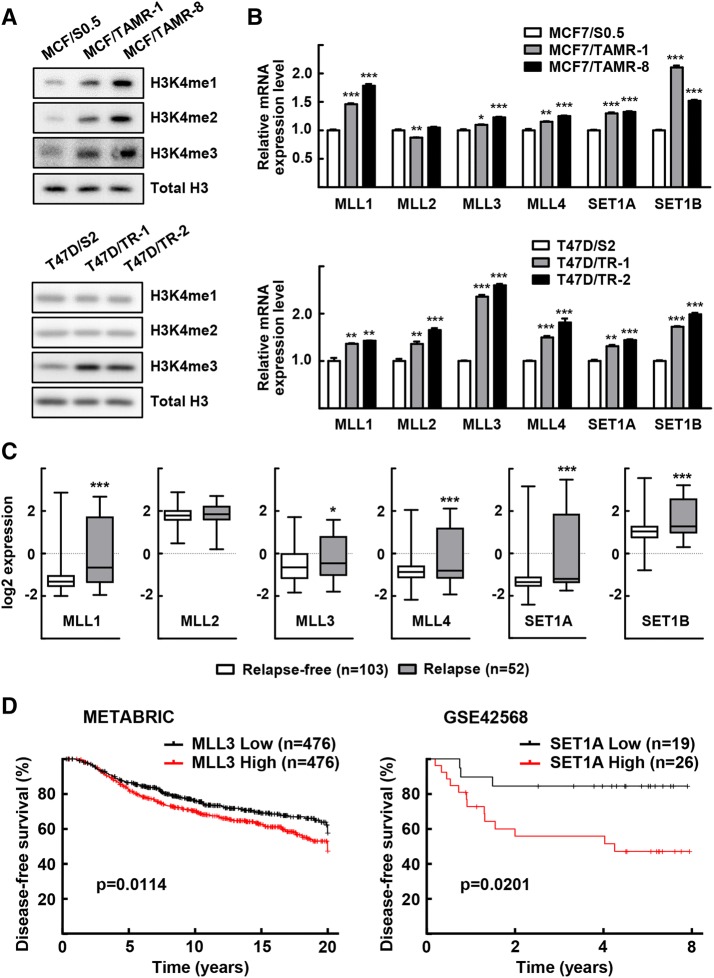
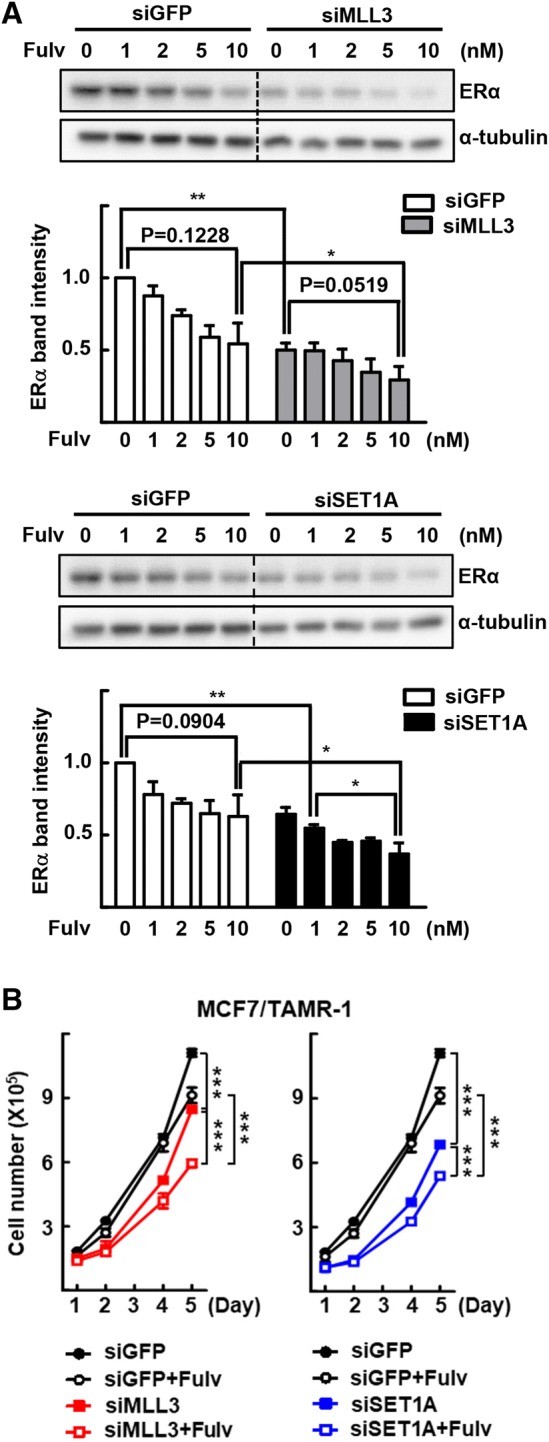
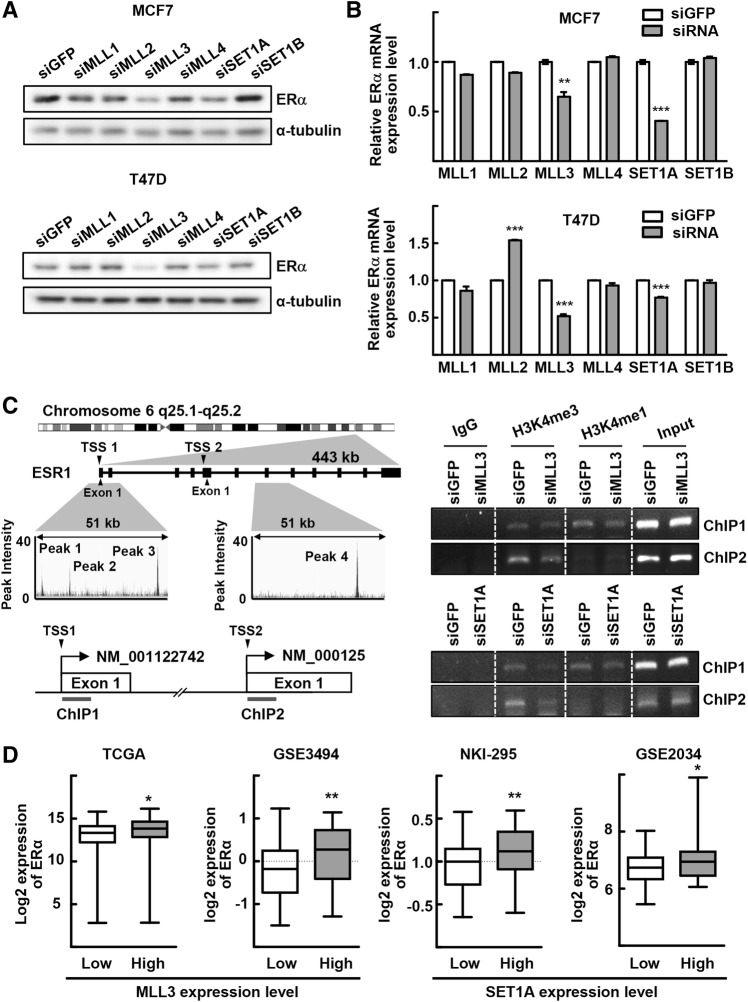
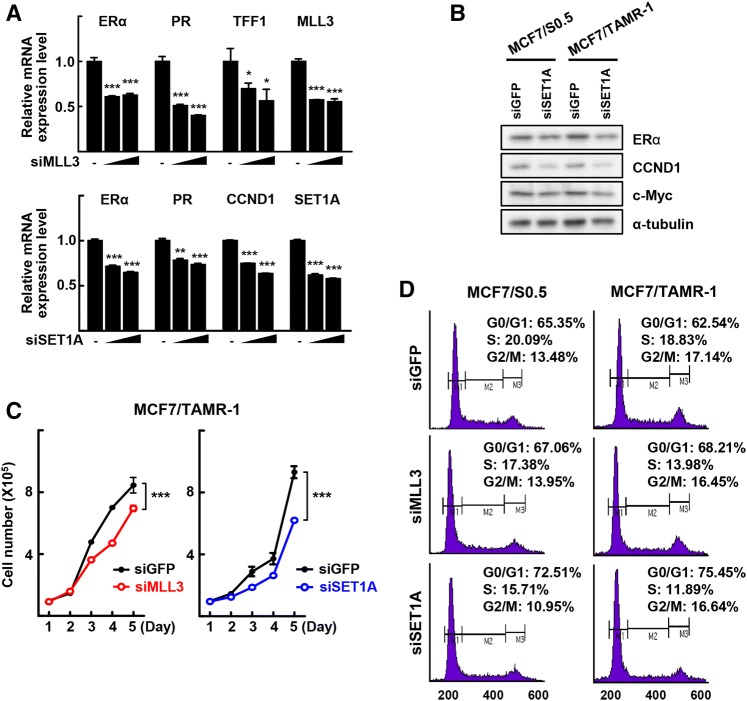
The expression of MLL3 and SET-domain-containing 1A (SET1A) were increased in tamoxifen-resistant breast cancers. An MLL3 chromatin immunoprecipitation-sequencing data analysis and chromatin immunoprecipitation experiments for MLL3 and SET1A suggested that these proteins bound to enhancer or intron regions of the ESR1 gene and regulated histone H3K4 methylation status. Depletion of MLL3 or SET1A downregulated the expression level of ERα and inhibited the growth of tamoxifen-resistant breast cancer cells. Additional treatment with fulvestrant resulted in a synergistic reduction of ERα levels and the growth of the cells.
The enhanced expression of MLL3 and SET1A in tamoxifen-resistant breast cancer cells supported the ERα-dependent growth of these cells by increasing ERα expression. Our results suggest that targeting these histone methyltransferases might provide an attractive strategy to overcome endocrine resistance.
尽管他莫昔芬仍然是 ERα 阳性乳腺癌的一线治疗药物,但对这种药物的耐药性限制了其临床疗效。大多数他莫昔芬耐药的患者仍然表达 ERα,这可能支持乳腺癌的生长和进展。因此,我们研究了 ERα 的表观遗传调控,这可能为这些患者靶向 ERα 提供依据。
分析了他莫昔芬耐药乳腺癌细胞和公开可用的乳腺癌患者数据集中小混合谱系白血病(MLL)家族蛋白的表达水平。使用染色质免疫沉淀检测 ERα 启动子区域的组蛋白甲基化水平。使用 Western blot 和实时 qPCR 分析 ERα 及其靶基因的表达水平。通过流式细胞术分析细胞周期。
MLL3 和 SET 结构域包含 1A(SET1A)在他莫昔芬耐药乳腺癌中的表达增加。MLL3 染色质免疫沉淀测序数据分析和 MLL3 和 SET1A 的染色质免疫沉淀实验表明,这些蛋白结合到 ESR1 基因的增强子或内含子区域,并调节组蛋白 H3K4 甲基化状态。MLL3 或 SET1A 的耗竭下调了 ERα 的表达水平并抑制了他莫昔芬耐药乳腺癌细胞的生长。用氟维司群进行额外治疗导致 ERα 水平和细胞生长的协同降低。
他莫昔芬耐药乳腺癌细胞中 MLL3 和 SET1A 的表达增强通过增加 ERα 的表达支持这些细胞的 ERα 依赖性生长。我们的结果表明,靶向这些组蛋白甲基转移酶可能是克服内分泌耐药的一种有吸引力的策略。