Cornea and Refractive Surgery, Duke University Eye Center, Durham, NC.
Cincinnati Eye Institute, Edgewood, KY.
Cornea. 2022 Apr 1;41(4):417-426. doi: 10.1097/ICO.0000000000002837.
The aim of this study was to demonstrate the safety and effectiveness of a single TearCare procedure compared with a single LipiFlow procedure in treatment of the dry eye disease associated with meibomian gland dysfunction.
In a multicenter, masked, randomized controlled trial, 135 subjects received a single TearCare (TC) treatment (n = 67) or a single LipiFlow (LF) treatment (n = 68) at baseline and were followed up for 1 month posttreatment. Tear film breakup time, meibomian gland function, and corneal and conjunctival staining scores were assessed as dry eye signs at baseline, 2 weeks, and 1 month; dry eye symptoms were assessed using the Ocular Surface Disease Index, Symptom Assessment in Dry Eye, and eye dryness questionnaires at baseline and 1 month.
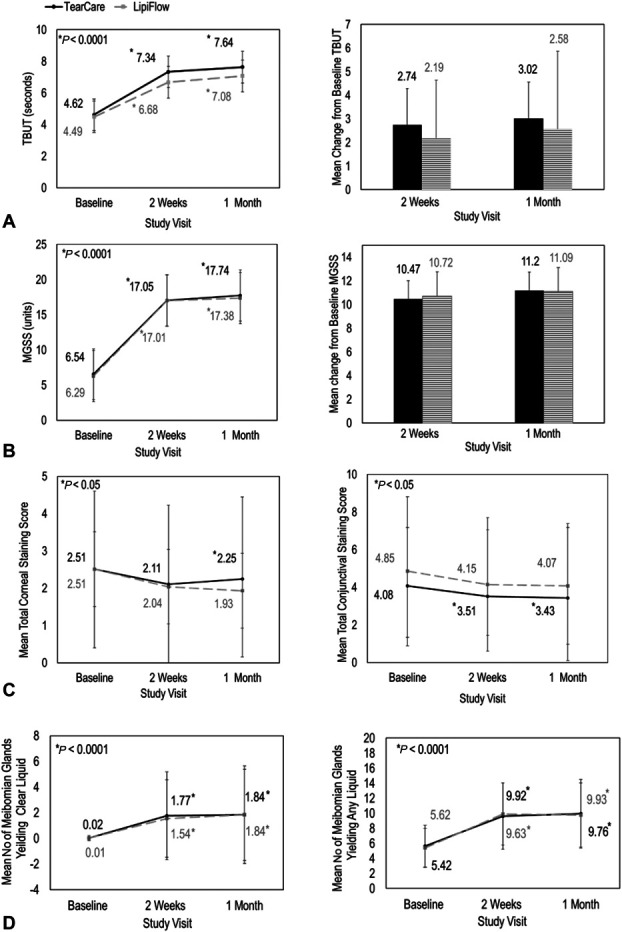
At 1 month posttreatment, both groups demonstrated significant improvements (P < 0.0001) in mean tear film breakup time and meibomian gland secretion score to 3.0 ± 4.4 and 11.2 ± 11.1 in the TC group and 2.6 ± 3.3 and 11.0 ± 10.4 in the LF group, respectively. The mean eye dryness, Symptom Assessment in Dry Eye, and Ocular Surface Disease Index scores were significantly reduced (P < 0.0001) by 35.4 ± 34.1, 38.2 ± 31.0, and 27.9 ± 20.5 in the TC group and 34.9 ± 26.9, 38.0 ± 25.9, and 23.4 ± 17.7 in the LF group, respectively. There were no statistically significant differences for any result between the groups. However, the TC group demonstrated numerically greater improvements consistently in all signs and symptoms. Device-related ocular adverse events were reported in 3 patients in the TC group (superficial punctate keratitis, chalazion, and blepharitis) and 4 patients in the LF group (blepharitis, 2 cases of foreign body sensation, and severe eye dryness).
A single TearCare treatment significantly alleviates the signs and symptoms of dry eye disease in patients with meibomian gland dysfunction and is equivalent in its safety and effectiveness profile to LipiFlow treatment as shown in this 1-month follow-up study.
本研究旨在证明单次 TearCare 治疗与单次 LipiFlow 治疗在治疗与睑板腺功能障碍相关的干眼症方面的安全性和有效性。
在一项多中心、盲法、随机对照试验中,135 名受试者在基线时分别接受单次 TearCare(TC)治疗(n=67)或单次 LipiFlow(LF)治疗(n=68),并在治疗后 1 个月进行随访。在基线、2 周和 1 个月时,使用泪膜破裂时间、睑板腺功能、角膜和结膜染色评分评估干眼症体征;使用眼表疾病指数、干眼症状评估量表和眼干问卷评估干眼症状。
治疗后 1 个月,两组的平均泪膜破裂时间和睑板腺分泌评分均显著改善(P<0.0001),TC 组分别为 3.0±4.4 和 11.2±11.1,LF 组分别为 2.6±3.3 和 11.0±10.4。TC 组的眼干、干眼症状评估量表和眼表疾病指数评分分别显著降低(P<0.0001)35.4±34.1、38.2±31.0 和 27.9±20.5,LF 组分别降低 34.9±26.9、38.0±25.9 和 23.4±17.7。两组间各项结果均无统计学差异。然而,TC 组在所有体征和症状方面的改善程度均高于 LF 组。TC 组有 3 例(浅层点状角膜炎、睑板腺囊肿和睑缘炎)和 LF 组有 4 例(睑缘炎,2 例异物感,1 例严重眼干)患者报告与器械相关的眼部不良事件。
单次 TearCare 治疗可显著缓解睑板腺功能障碍患者的干眼症体征和症状,在本 1 个月随访研究中,其安全性和有效性与 LipiFlow 治疗相当。