Faculty of Pharmacy, Mashhad University of Medical Sciences, Mashhad, Iran.
Faculty of Medicine, Mashhad University of Medical Sciences, Mashhad, Iran.
Eur J Pharmacol. 2021 Nov 15;911:174527. doi: 10.1016/j.ejphar.2021.174527. Epub 2021 Sep 25.
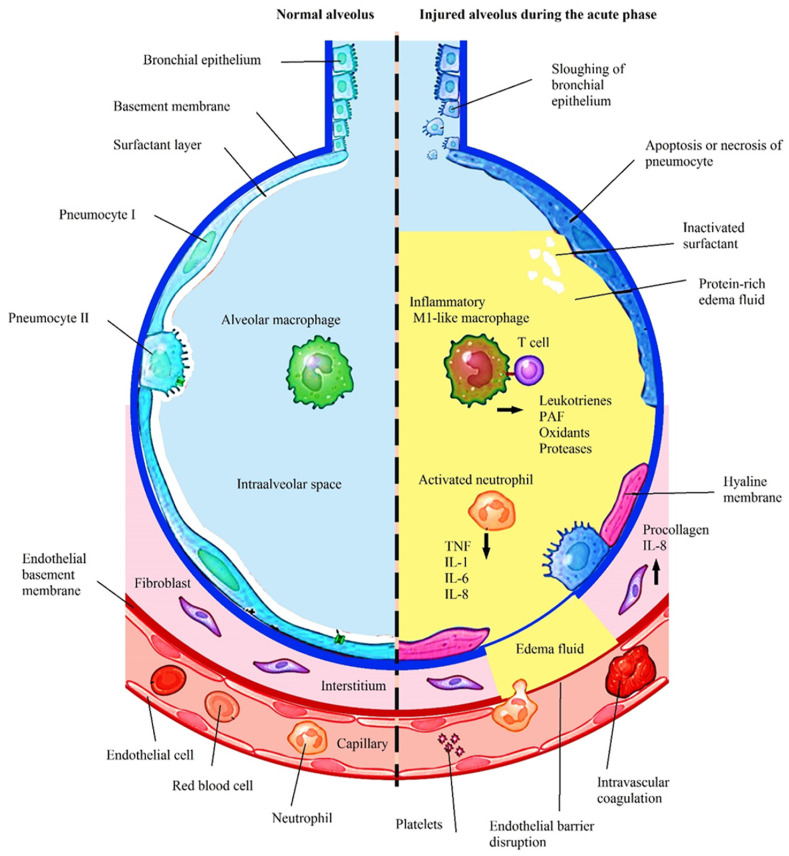
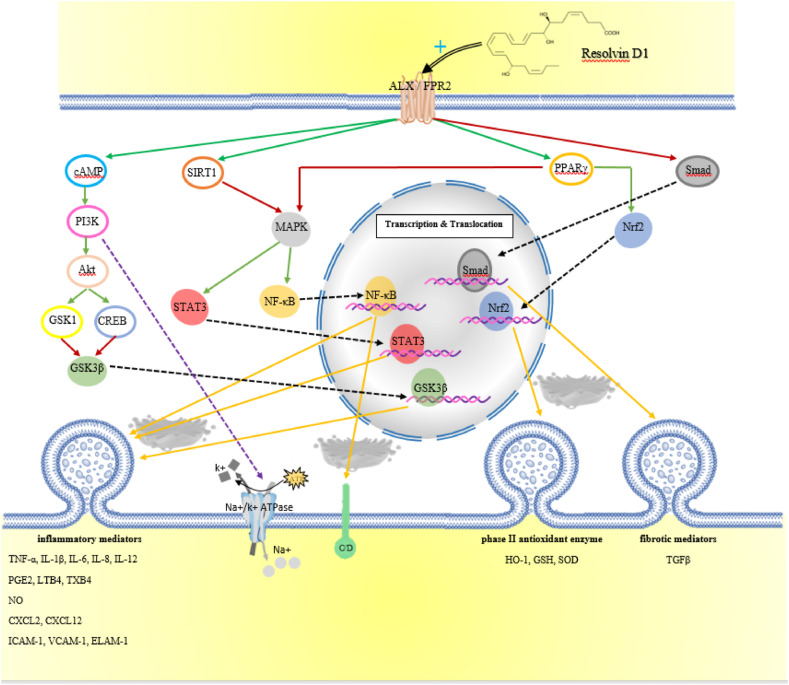
Acute lung injury (ALI), or its more severe form, acute respiratory distress syndrome (ARDS), is a disease with high mortality and is a serious challenge facing the World Health Organization because there is no specific treatment. The excessive and prolonged immune response is the hallmark of this disorder, so modulating and regulating inflammation plays an important role in its prevention and treatment. Resolvin D1 (RvD1) as a specialized pro-resolving mediator has the potential to suppress the expression of inflammatory cytokines and to facilitate the production of antioxidant proteins by stimulating lipoxin A4 receptor/formyl peptide receptor 2 (ALX/FPR2). These changes limit the invasion of immune cells into the lung tissue, inhibit coagulation, and enhance cell protection against oxidative stress (OS). In particular, this biomolecule reduces the generation of reactive oxygen species (ROS) by blocking the activation of inflammatory transcription factors, especially nuclear factor-κB (NF-κB), and accelerating the synthesis of antioxidant compounds such as heme oxygenase 1 (HO-1) and superoxide dismutase (SOD). Therefore, the destruction and dysfunction of important cell components such as cytoplasmic membrane, mitochondria, Na+/k + adenosine triphosphatase (ATPase) and proteins involved in the phagocytic activity of scavenger macrophages are attenuated. Numerous studies on the effect of RvD1 over inflammation using animal models revealed that Rvs have both anti-inflammatory and pro-resolving capabilities and therefore, might have potential therapeutic value in treating ALI. Here, we review the current knowledge on the classification, biosynthesis, receptors, mechanisms of action, and role of Rvs in ALI/ARDS.
急性肺损伤(ALI),或其更严重的形式,急性呼吸窘迫综合征(ARDS),是一种死亡率高的疾病,是世界卫生组织面临的严重挑战,因为目前没有特定的治疗方法。过度和持久的免疫反应是这种疾病的标志,因此调节和控制炎症在其预防和治疗中起着重要作用。解析素 D1(RvD1)作为一种专门的促解决介质,具有抑制炎症细胞因子表达和通过刺激脂氧素 A4 受体/甲酰肽受体 2(ALX/FPR2)促进抗氧化蛋白产生的潜力。这些变化限制了免疫细胞侵入肺组织,抑制了凝血,并增强了细胞对氧化应激(OS)的保护作用。特别是,这种生物分子通过阻断炎症转录因子(特别是核因子-κB(NF-κB)的激活)来减少活性氧物种(ROS)的产生,并加速血红素加氧酶 1(HO-1)和超氧化物歧化酶(SOD)等抗氧化化合物的合成。因此,细胞质膜、线粒体、Na+/k+三磷酸腺苷酶(ATPase)和参与吞噬作用的巨噬细胞清道夫的蛋白质等重要细胞成分的破坏和功能障碍得到减弱。大量使用动物模型研究 RvD1 对炎症的影响的研究表明,Rv 具有抗炎和促解决能力,因此,在治疗 ALI 方面可能具有潜在的治疗价值。在这里,我们综述了 Rv 在 ALI/ARDS 中的分类、生物合成、受体、作用机制和作用的最新知识。