The Kirby Institute, UNSW Sydney, Sydney, NSW, Australia.
Centre for Big Data Research in Health, UNSW Sydney, Sydney, NSW, Australia.
HIV Med. 2022 Feb;23(2):134-145. doi: 10.1111/hiv.13179. Epub 2021 Sep 28.
The aim of the study was to describe time trends in cancer incidence in people living with HIV (PLHIV) in Australia between 1982 and 2012.
A population-based prospective study was conducted using data linkage between the national HIV and cancer registries. Invasive cancers identified in PLHIV were grouped into AIDS-defining cancers (ADCs), infection-related non-ADCs (NADCs), and non-infection-related NADCs. Crude and age-standardized incidence rates of cancers were calculated and compared over five time periods: 1982-1995, 1996-1999, 2000-2004, 2005-2008 and 2009-2012, roughly reflecting advances in HIV antiretroviral therapy. Standardized incidence ratios (SIRs) compared with the Australian general population were calculated for each time period. Generalized linear models were developed to assess time trends in crude and age-standardized incidences.
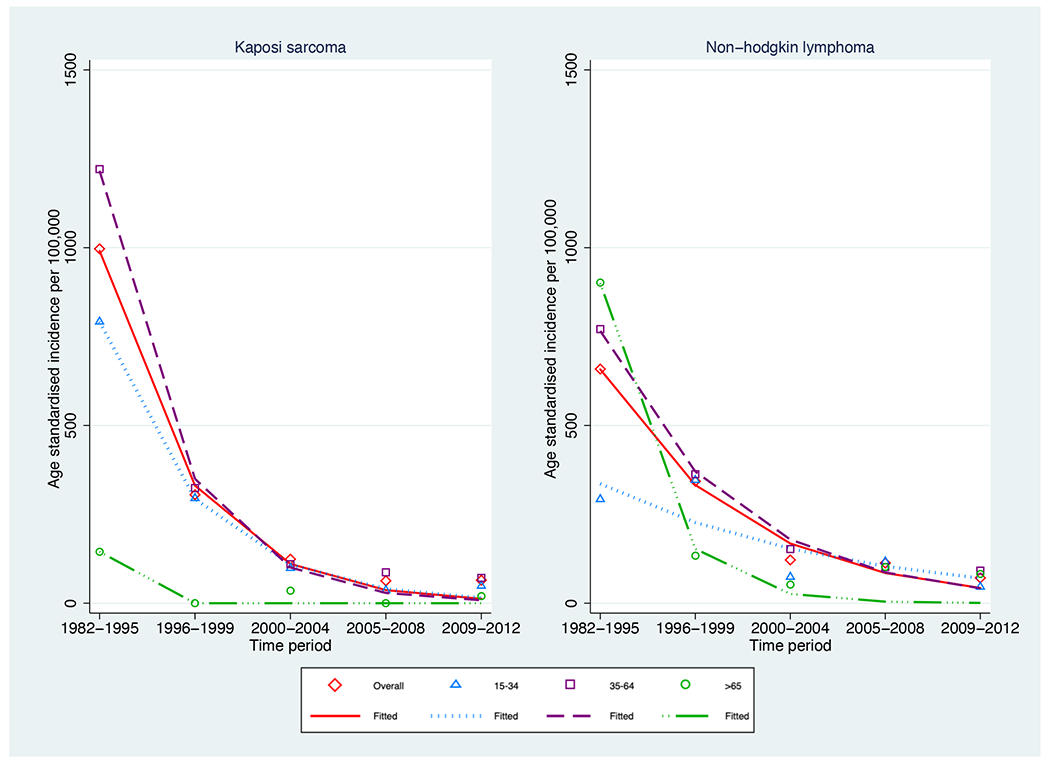
For ADCs, the crude and age-standardized incidences of Kaposi sarcoma and non-Hodgkin lymphoma substantially declined over time (P-trend < 0.001 for all) but SIRs remained significantly elevated. For infection-related NADCs, there were significant increases in the crude incidences of anal, liver and head and neck cancers. Age-standardized incidences increased for anal cancer (P-trend = 0.002) and liver cancer (P-trend < 0.001). SIRs were significantly elevated for anal cancer, liver cancer and Hodgkin lymphoma. For non-infection-related NADCs, the crude incidence of colorectal, lung and prostate cancers increased over time, but age-standardized incidences remained stable.
Continuous improvements and high coverage of antiretroviral therapy have reduced the incidence of ADCs in PLHIV in Australia. Clinical monitoring of anal and liver cancers in people living with HIV should be performed, given the increasing incidence of these cancers.
本研究旨在描述 1982 年至 2012 年间澳大利亚艾滋病毒感染者(PLHIV)癌症发病率的时间趋势。
本研究采用国家艾滋病毒和癌症登记处的数据链接进行了一项基于人群的前瞻性研究。将 PLHIV 中确定的侵袭性癌症分为艾滋病定义性癌症(ADC)、感染相关非艾滋病定义性癌症(NADC)和非感染相关非艾滋病定义性癌症(NADC)。计算了五个时期的癌症粗发病率和年龄标准化发病率,并进行了比较:1982-1995 年、1996-1999 年、2000-2004 年、2005-2008 年和 2009-2012 年,大致反映了艾滋病毒抗逆转录病毒治疗的进展。为每个时期计算了与澳大利亚普通人群的标准化发病率比值(SIR)。采用广义线性模型评估了粗发病率和年龄标准化发病率的时间趋势。
对于 ADC,卡波西肉瘤和非霍奇金淋巴瘤的粗发病率和年龄标准化发病率随着时间的推移显著下降(所有 P 趋势<0.001),但 SIR 仍然显著升高。对于感染相关的 NADC,肛门癌、肝癌和头颈部癌症的粗发病率显著增加。肛门癌(P 趋势=0.002)和肝癌(P 趋势<0.001)的年龄标准化发病率增加。肛门癌、肝癌和霍奇金淋巴瘤的 SIR 显著升高。对于非感染相关的 NADC,结直肠癌、肺癌和前列腺癌的粗发病率随时间增加,但年龄标准化发病率保持稳定。
在澳大利亚,抗逆转录病毒治疗的不断改进和高覆盖率降低了 PLHIV 的 ADC 发病率。鉴于这些癌症的发病率不断增加,应对 HIV 感染者进行肛门和肝癌的临床监测。