Department of Global Public Health, Karolinska Institutet, Stockholm, Sweden.
Department of Public Health and Nursing, Norwegian University of Science and Technology, Trondheim, Norway.
PLoS Med. 2021 Sep 29;18(9):e1003790. doi: 10.1371/journal.pmed.1003790. eCollection 2021 Sep.
The death of a child is an extreme life event with potentially long-term health consequences. Knowledge about its association with ischemic heart diseases (IHDs) and acute myocardial infarction (AMI), however, is very limited. We investigated whether the death of an offspring is associated with the risk of IHD and AMI.
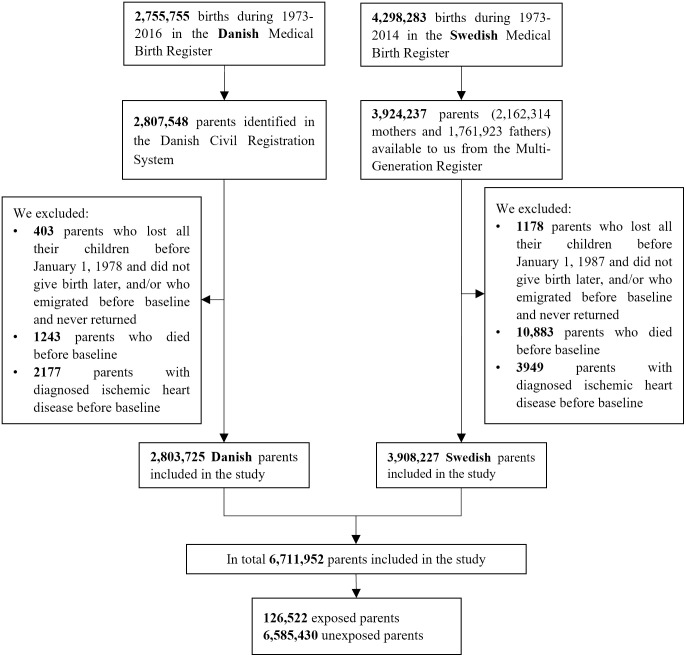
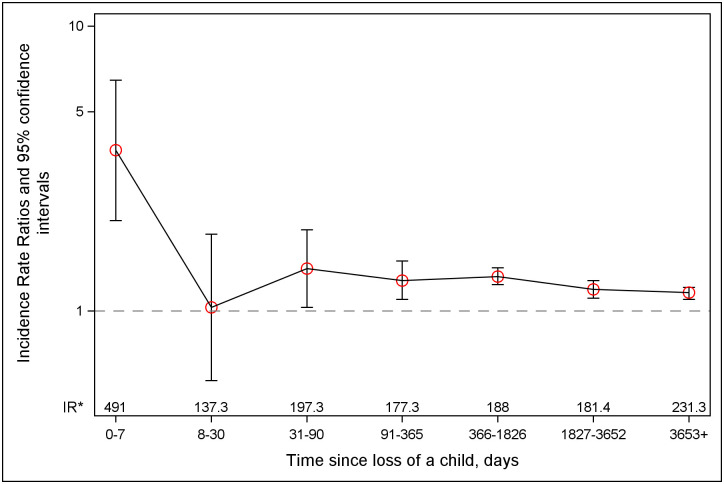
We studied parents of live-born children recorded in the Danish (1973 to 2016) and the Swedish (1973 to 2014) Medical Birth Registers (n = 6,711,952; mean age at baseline 31 years, 53% women). We retrieved information on exposure, outcomes, and covariates by linking individual-level information from several nationwide registers. We analyzed the abovementioned associations using Poisson regression. A total of 126,522 (1.9%) parents lost at least 1 child during the study period. Bereaved parents had a higher risk of IHD and AMI than the nonbereaved [incidence rate ratios (IRRs) (95% confidence intervals (CIs)): 1.20 (1.18 to 1.23), P < 0.001 and 1.21 (1.17 to 1.25), P < 0.001, respectively]. The association was present not only in case of losses due to CVD or other natural causes, but also in case of unnatural deaths. The AMI risk was highest in the first week after the loss [IRR (95% CI): 3.67 (2.08 to 6.46), P < 0.001], but a 20% to 40% increased risk was observed throughout the whole follow-up period. Study limitations include the possibility of residual confounding by socioeconomic, lifestyle, or health-related factors and the potentially limited generalizability of our findings outside Scandinavia.
The death of an offspring was associated with an increased risk of IHD and AMI. The finding that the association was present also in case of losses due to unnatural causes, which are less likely to be confounded by cardiovascular risk factors clustering in families, suggests that stress-related mechanisms may also contribute to the observed associations.
儿童死亡是一种极端的生活事件,可能会带来长期的健康后果。然而,人们对其与缺血性心脏病(IHD)和急性心肌梗死(AMI)的关联知之甚少。我们调查了子女的死亡是否与 IHD 和 AMI 的风险相关。
我们研究了丹麦(1973 年至 2016 年)和瑞典(1973 年至 2014 年)的医疗出生登记处(n=6711952;基线年龄平均为 31 岁,女性占 53%)中活产子女的父母。我们通过链接来自多个全国性登记处的个体水平信息,获取有关暴露、结局和协变量的信息。我们使用泊松回归分析了上述关联。在研究期间,共有 126522(1.9%)名父母至少失去了 1 名子女。丧亲父母患 IHD 和 AMI 的风险高于未丧亲的父母[发病率比(IRR)(95%置信区间(CI)):1.20(1.18 至 1.23),P<0.001 和 1.21(1.17 至 1.25),P<0.001]。这种关联不仅存在于因 CVD 或其他自然原因导致的损失中,也存在于非自然死亡的情况下。在失去子女后的第一周,AMI 风险最高[IRR(95%CI):3.67(2.08 至 6.46),P<0.001],但在整个随访期间,风险仍增加 20%至 40%。研究局限性包括社会经济、生活方式或与健康相关的因素可能存在残余混杂,以及我们的发现可能无法推广到斯堪的纳维亚以外的地区。
子女的死亡与 IHD 和 AMI 的风险增加有关。由于非自然原因导致的死亡不太可能受到心血管危险因素聚集在家庭中引起的混杂,因此发现这种关联也存在于这种情况下,这表明应激相关机制也可能导致观察到的关联。