Unit of Integrative Epidemiology, Institute of Environmental Medicine, Karolinska Institutet, Stockholm, Sweden.
Department of Global Public Health, Karolinska Institutet, Stockholm, Sweden.
JAMA Netw Open. 2023 Jan 3;6(1):e2249560. doi: 10.1001/jamanetworkopen.2022.49560.
There is emerging evidence that spouses of patients with cancer may have a higher prevalence of mental illness, but these studies have been limited by pre-post designs, focus on a single mental illness, and short follow-up periods.
To assess the overall burden of psychiatric disorders among spouses of patients with cancer vs spouses of individuals without cancer and to describe possible changes in this burden over time.
DESIGN, SETTING, AND PARTICIPANTS: This population based cohort study included spouses of patients with cancer (diagnosed 1986-2016 in Denmark and 1973-2014 in Sweden; exposed group) and spouses of individuals without cancer (unexposed group). Members of the unexposed group were individually matched to individuals in the exposed group on the year of birth, sex, and country. Spouses with and without preexisting psychiatric morbidity were analyzed separately. Data analysis was performed between May 2021 and January 2022.
Being spouse to a patient with cancer.
The main outcome was a clinical diagnosis of psychiatric disorders through hospital-based inpatient or outpatient care. Flexible parametric models and Cox models were fitted to estimate hazard ratios (HRs) with 95% CIs, adjusted for sex, age and year at cohort entry, country, household income, and cancer history.
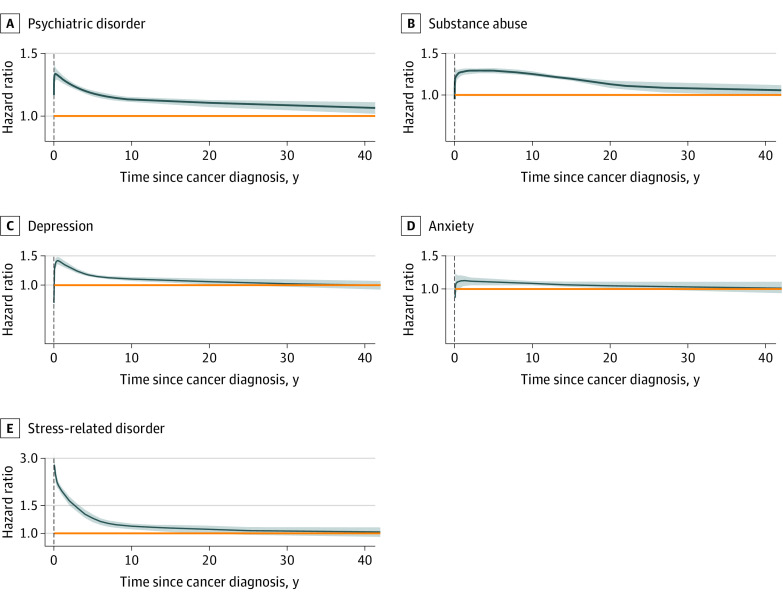
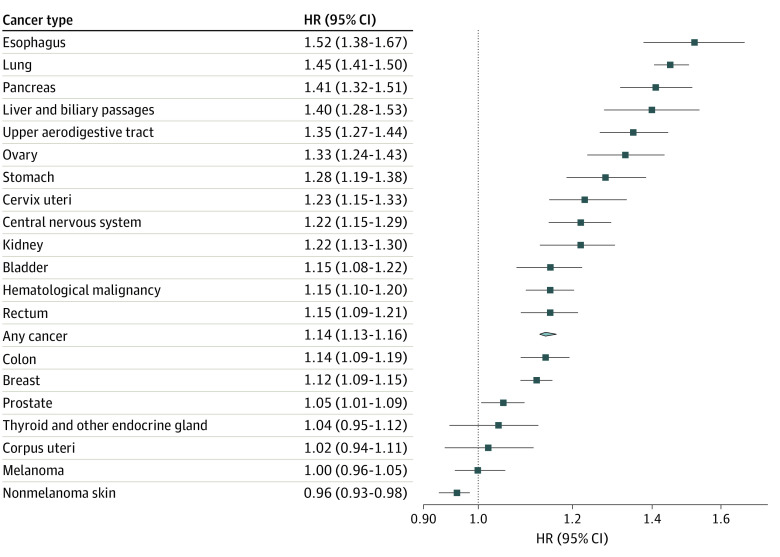
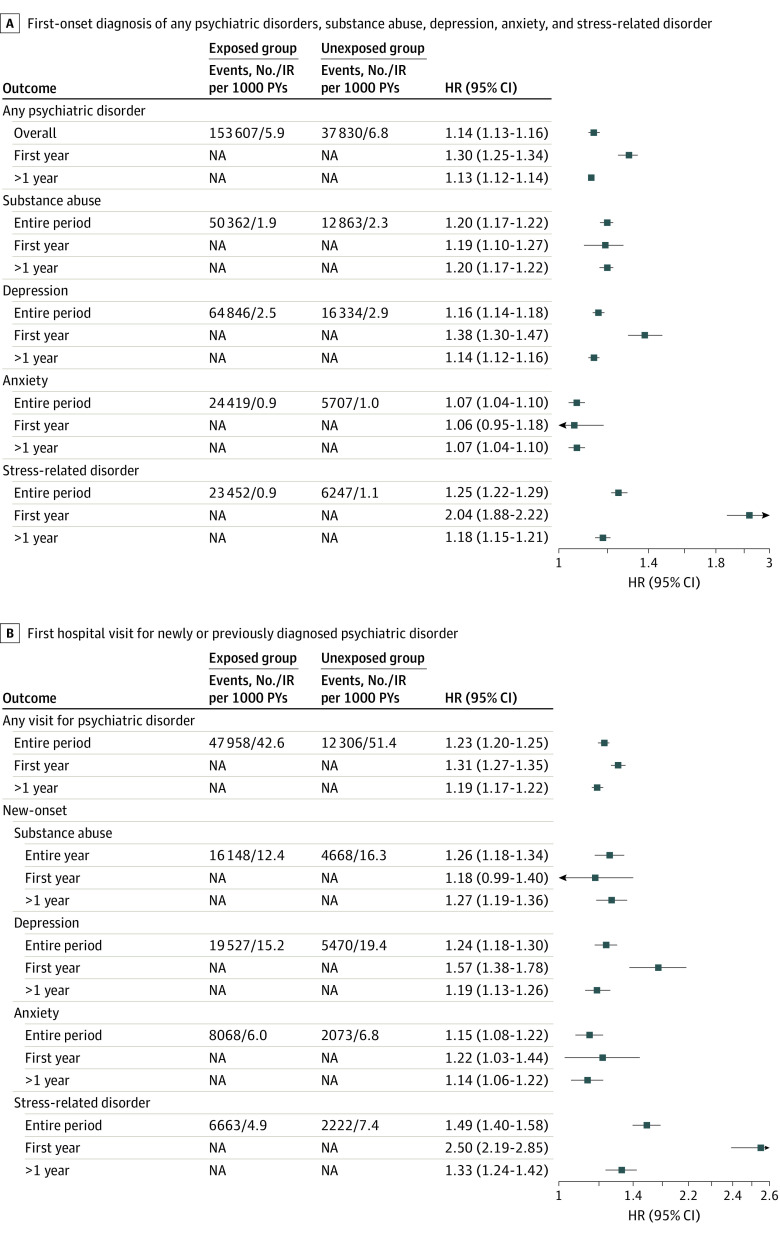
Among 546 321 spouses in the exposed group and 2 731 574 in the unexposed group who had no preexisting psychiatry morbidity, 46.0% were male participants, with a median (IQR) age at cohort entry of 60 (51-68) years. During follow-up (median, 8.4 vs 7.6 years), the incidence rate of first-onset psychiatric disorders was 6.8 and 5.9 per 1000 person-years for the exposed and unexposed groups, respectively (37 830 spouses of patients with cancer [6.9%]; 153 607 of spouses of individuals without cancer [5.6%]). Risk of first-onset psychiatric disorders increased by 30% (adjusted HR, 1.30; 95% CI, 1.25-1.34) during the first year after cancer diagnosis, especially for depression (adjusted HR, 1.38; 95% CI, 1.30-1.47) and stress-related disorders (adjusted HR, 2.04; 95% CI, 1.88-2.22). Risk of first-onset psychiatric disorders increased by 14% (adjusted HR, 1.14; 95% CI, 1.13-1.16) during the entire follow-up, which was similar for substance abuse, depression, and stress-related disorders. The risk increase was more prominent among spouses of patients diagnosed with a cancer with poor prognosis (eg, pancreatic cancer: adjusted HR, 1.41; 95% CI, 1.32-1.51) or at an advanced stage (adjusted HR, 1.31; 95% CI, 1.26-1.36) and when the patient died during follow-up (adjusted HR, 1.29; 95% CI, 1.27-1.31). Among spouses with preexisting psychiatric morbidity, the risk of psychiatric disorders (first-onset or recurrent) increased by 23% during the entire follow-up (adjusted HR, 1.23; 95% CI, 1.20-1.25).
In this cohort study of 2 populations in Denmark and Sweden, spouses of patients with cancer experienced increased risk of several psychiatric disorders that required hospital-based specialist care. Our results support the need for clinical awareness to prevent potential mental illness among the spouses of patients with cancer.
有越来越多的证据表明,癌症患者的配偶可能患有更高的精神疾病患病率,但这些研究受到了前后设计、关注单一精神疾病和随访时间短的限制。
评估癌症患者配偶与无癌症个体配偶之间精神疾病总体负担,并描述随着时间的推移这种负担的可能变化。
设计、设置和参与者:这项基于人群的队列研究包括丹麦(1986-2016 年)和瑞典(1973-2014 年)癌症患者的配偶(暴露组)和无癌症个体的配偶(非暴露组)。非暴露组的成员根据出生年份、性别和国家与暴露组的个体进行单独匹配。分析了有和没有预先存在的精神疾病发病率的配偶。数据分析于 2021 年 5 月至 2022 年 1 月进行。
配偶是癌症患者。
主要结果是通过医院住院或门诊治疗诊断为精神疾病。采用灵活参数模型和 Cox 模型来估计风险比(HR)及其 95%置信区间(CI),并调整了性别、年龄和队列进入年份、国家、家庭收入和癌症史。
在暴露组的 546321 名配偶和非暴露组的 2731574 名无预先存在的精神疾病发病率的配偶中,46.0%为男性参与者,队列进入时的中位(IQR)年龄为 60(51-68)岁。在随访期间(中位数 8.4 与 7.6 年),首次出现精神疾病的发病率分别为暴露组和非暴露组每 1000 人年 6.8 和 5.9 例(37830 名癌症患者的配偶[6.9%];153607 名无癌症个体的配偶[5.6%])。在癌症诊断后的第一年,首次出现精神疾病的风险增加了 30%(调整后的 HR,1.30;95%CI,1.25-1.34),尤其是抑郁症(调整后的 HR,1.38;95%CI,1.30-1.47)和应激相关障碍(调整后的 HR,2.04;95%CI,1.88-2.22)。在整个随访期间,首次出现精神疾病的风险增加了 14%(调整后的 HR,1.14;95%CI,1.13-1.16),这与物质滥用、抑郁症和应激相关障碍相似。在预后较差的癌症患者(例如胰腺癌:调整后的 HR,1.41;95%CI,1.32-1.51)或晚期癌症患者(调整后的 HR,1.31;95%CI,1.26-1.36)以及在随访期间患者死亡的情况下,风险增加更为明显(调整后的 HR,1.29;95%CI,1.27-1.31)。在有预先存在的精神疾病发病率的配偶中,整个随访期间精神疾病(首次发作或复发)的风险增加了 23%(调整后的 HR,1.23;95%CI,1.20-1.25)。
在这项丹麦和瑞典的 2 个人群队列研究中,癌症患者的配偶患有几种需要医院专科治疗的精神疾病的风险增加。我们的研究结果支持临床意识的需要,以预防癌症患者配偶潜在的精神疾病。