Department of Internal Medicine and Clinical Nutrition, Institute of Medicine, Sahlgrenska Academy, University of Gothenburg, Gothenburg, Sweden.
Department of Rheumatology and Inflammation Research, Institute of Medicine, Sahlgrenska Academy, University of Gothenburg, Gothenburg, Sweden.
J Nutr. 2021 Dec 3;151(12):3856-3864. doi: 10.1093/jn/nxab313.
It is unclear to what extent adjuvant dietary intervention can influence inflammation in rheumatoid arthritis (RA).
The objective was to assess the effects of dietary manipulation on inflammation in patients with RA.
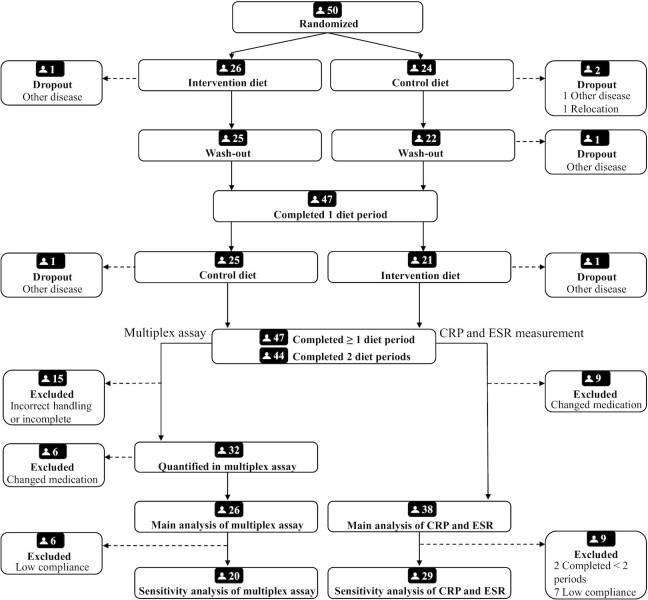
In a crossover design, participants [n = 50, 78% females, median BMI (in kg/m2) 27, median age 63 y] were randomly assigned to begin with either a 10-wk portfolio diet of proposed anti-inflammatory foods (i.e., a high intake of fatty fish, whole grains, fruits, nuts, and berries) or a control diet resembling a Western diet with a 4-mo washout in between. This report evaluates the secondary outcome markers of inflammation among participants with stable medication. Analyses were performed using a linear mixed ANCOVA model.
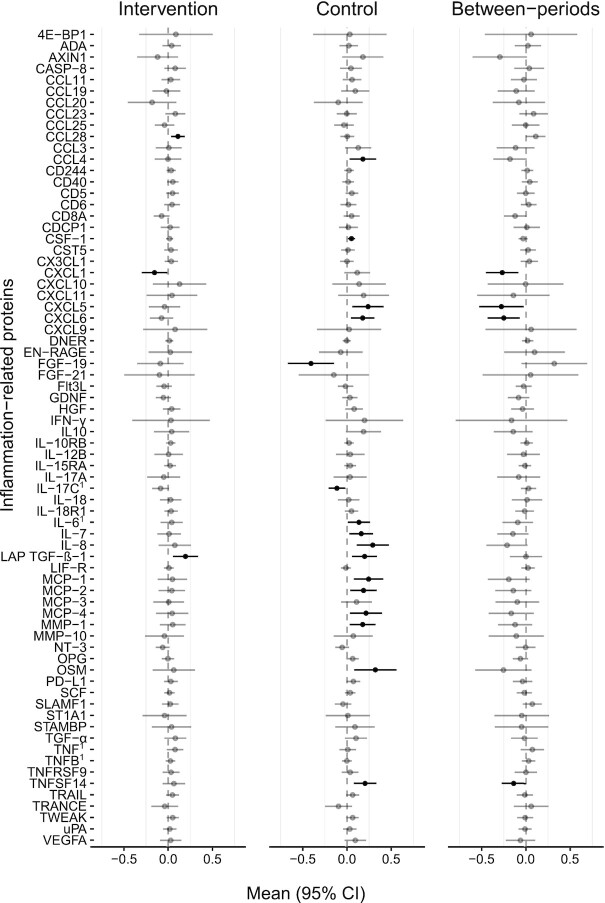
There were no significant effects on CRP or ESR in the group as a whole. In those with high compliance (n = 29), changes in ESR within the intervention diet period differed significantly compared with changes within the control diet period (mean: -5.490; 95% CI: -10.310, -0.669; P = 0.027). During the intervention diet period, there were lowered serum concentrations of C-X-C motif ligand 1 (CXCL1) (mean: -0.268; 95% CI: -0.452, -0.084;P = 0.006), CXCL5 (mean: -0.278; 95% CI: -0.530, -0.026 P = 0.031), CXCL6 (mean: -0.251; 95% CI: -0.433, -0.069; P = 0.009), and tumor necrosis factor ligand superfamily member 14 (TNFSF14) (mean: -0.139; 95% CI: -0.275, -0.002; P = 0.047) compared with changes within the control diet period.
A proposed anti-inflammatory diet likely reduced systemic inflammation, as indicated by a decreased ESR in those who completed the study with high compliance (n = 29). These findings warrant further studies to validate our results, and to evaluate the clinical relevance of changes in CXCL1, CXCL5, CXCL6, and TNFSF14 in patients with RA.
尚不清楚辅助饮食干预能在多大程度上影响类风湿关节炎(RA)的炎症。
评估饮食干预对 RA 患者炎症的影响。
采用交叉设计,将[ n = 50,78%女性,中位数 BMI(kg/m2)27,中位数年龄 63 岁]参与者随机分为 Portfolio 饮食组(10 周,富含抗炎食物,如多脂鱼、全谷物、水果、坚果和浆果)或对照组(4 个月洗脱期,饮食类似于西方饮食)。本报告评估了稳定药物治疗的参与者中炎症的次要结局标志物。使用线性混合方差分析模型进行分析。
总体而言,CRP 或 ESR 无显著影响。在高依从性(n = 29)的人群中,干预饮食期间 ESR 的变化与对照饮食期间的变化有显著差异(平均变化:-5.490;95%CI:-10.310,-0.669;P = 0.027)。在干预饮食期间,血清中 C-X-C 基序配体 1(CXCL1)(平均变化:-0.268;95%CI:-0.452,-0.084;P = 0.006)、CXCL5(平均变化:-0.278;95%CI:-0.530,-0.026;P = 0.031)、CXCL6(平均变化:-0.251;95%CI:-0.433,-0.069;P = 0.009)和肿瘤坏死因子配体超家族成员 14(TNFSF14)(平均变化:-0.139;95%CI:-0.275,-0.002;P = 0.047)的浓度降低。
一项抗炎饮食方案可能通过降低高依从性(n = 29)参与者的 ESR 来降低系统性炎症。这些发现需要进一步的研究来验证我们的结果,并评估 RA 患者中 CXCL1、CXCL5、CXCL6 和 TNFSF14 变化的临床意义。