College of Veterinary Medicine, Shanxi Agricultural University, Taiyuan, Shanxi, 030000, P.R. China.
Laboratory Animal Center, Shanxi Agricultural University, Taiyuan, Shanxi, 030000, P.R. China.
BMC Vet Res. 2021 Sep 30;17(1):318. doi: 10.1186/s12917-021-03015-4.
Encephalomyocarditis virus (EMCV) infection can cause reproductive failure in sows and acute myocarditis and sudden death in piglets. It has caused huge economic losses to the global pig industry and that is why it is necessary to develop effective new treatment compounds. Zedoary turmeric oil has been used for treating myocarditis. Curcumol extracted from the roots of curcuma is one of the main active ingredient of zedoary turmeric oil. The anti-EMCV activity of curcumol along with the molecular mechanisms involved with a focus on IFN-β signaling pathway was investigated in this study.
3-(4,5-dimethyithiazol-2-yl)-2,5-diphenyltetrazolium bromide (MTT) assay was used to determine the maximum non-toxic concentration (MNTC), 50% cytotoxic concentration (CC), maximum inhibition rate (MIR) and 50% effective concentration (EC) against EMCV. Through EMCV load, the anti-viral effect of curcumol was quantitatively determined using real-time quantitative PCR (qPCR). The effect of curcumol on the expression of IFN-β was investigated using real-time quantitative PCR and ELISA. Western blot was used to determine the amounts of MDA5, MAVS, TANK, IRF3 and P-IRF3 proteins in human embryonic kidney 293 T (HEK-293 T) cells infected with EMCV.
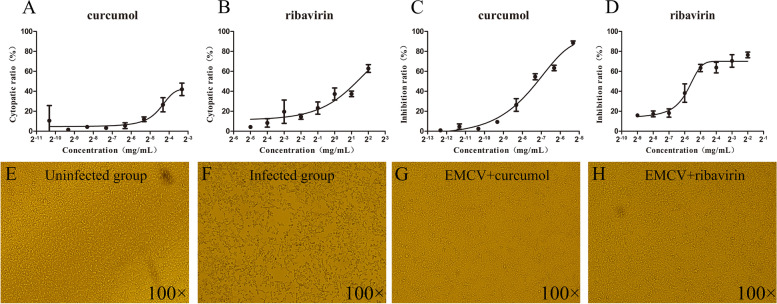
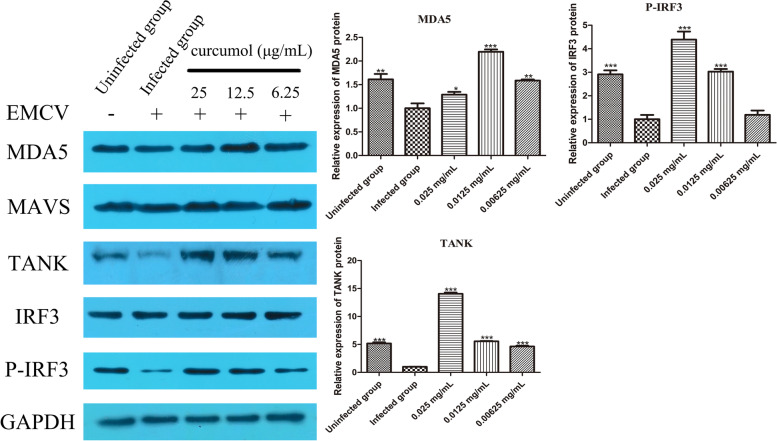
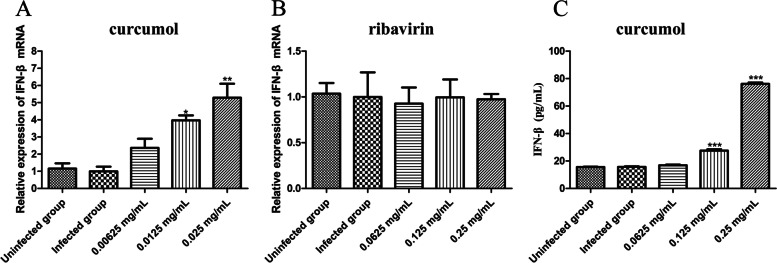
The results of MTT showed that compared with the ribavirin positive control group, the maximum inhibition ratio (MIR) of curcumol was greater but the selection index (SI) value was much smaller than that of ribavirin. The results of qPCR showed that curcumol and ribavirin significantly reduced the replication of EMCV in HEK-293 T cells. The curcumol (0.025 mg/mL) treatment has significantly increased IFN-β mRNA expression in the EMCV-infected HEK-293 T cells while ribavirin treatment did not. The results of ELISA showed that curcumol (0.025 mg/mL and 0.0125 mg/mL) has significantly increased the expression of IFN-β protein in EMCV-infected HEK-293 T cells. The results of Western blot showed that curcumol can inhibit the degradation of TANK protein mediated by EMCV and promote the expression of MDA5 and P-IRF3, while the protein expression level of MAVS and IRF3 remain unchanged.
Curcumol has biological activity against EMCV which we suggest that IFN-β signaling pathway is one of its mechanisms.
脑心肌炎病毒(EMCV)感染可导致母猪繁殖失败和仔猪急性心肌炎和突然死亡。它给全球养猪业造成了巨大的经济损失,因此有必要开发有效的新型治疗化合物。莪术油已用于治疗心肌炎。姜黄中的姜黄素是莪术油的主要活性成分之一。本研究旨在探讨姜黄素对 EMCV 的抗活性及其涉及干扰素-β信号通路的分子机制。
采用 3-(4,5-二甲基噻唑-2-基)-2,5-二苯基四氮唑溴盐(MTT)法测定最大无毒浓度(MNTC)、50%细胞毒性浓度(CC)、最大抑制率(MIR)和对 EMCV 的 50%有效浓度(EC)。通过 EMCV 载量,用实时定量 PCR(qPCR)定量测定姜黄素的抗病毒作用。用实时定量 PCR 和 ELISA 法研究姜黄素对 IFN-β表达的影响。用 Western blot 法测定 EMCV 感染人胚肾 293T(HEK-293T)细胞中 MDA5、MAVS、TANK、IRF3 和 P-IRF3 蛋白的含量。
MTT 结果表明,与利巴韦林阳性对照组相比,姜黄素的最大抑制率(MIR)较大,但选择指数(SI)值远小于利巴韦林。qPCR 结果表明,姜黄素和利巴韦林均能显著降低 EMCV 在 HEK-293T 细胞中的复制。姜黄素(0.025mg/ml)处理可显著增加 EMCV 感染的 HEK-293T 细胞中 IFN-βmRNA 的表达,而利巴韦林处理则不能。ELISA 结果表明,姜黄素(0.025mg/ml 和 0.0125mg/ml)能显著增加 EMCV 感染的 HEK-293T 细胞中 IFN-β 蛋白的表达。Western blot 结果表明,姜黄素能抑制 EMCV 介导的 TANK 蛋白降解,促进 MDA5 和 P-IRF3 的表达,而 MAVS 和 IRF3 的蛋白表达水平保持不变。
姜黄素对 EMCV 具有生物活性,我们认为干扰素-β信号通路是其机制之一。