Department of Palliative Care, Japanese Red Cross Medical Center, 4-1-22 Hiroo, Shibuya-ku, Tokyo, 150-8935, Japan.
Department of Palliative Medicine and Advanced Clinical Oncology, IMSUT Hospital, The Institute of Medical Science, The University of Tokyo, Tokyo, Japan.
Sci Rep. 2021 Sep 29;11(1):19321. doi: 10.1038/s41598-021-97143-4.
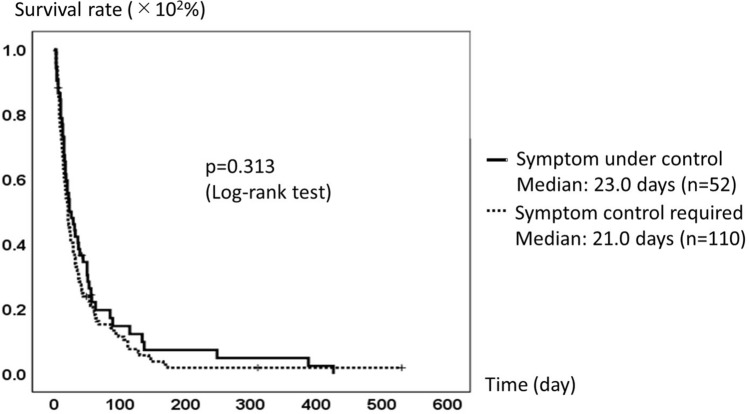
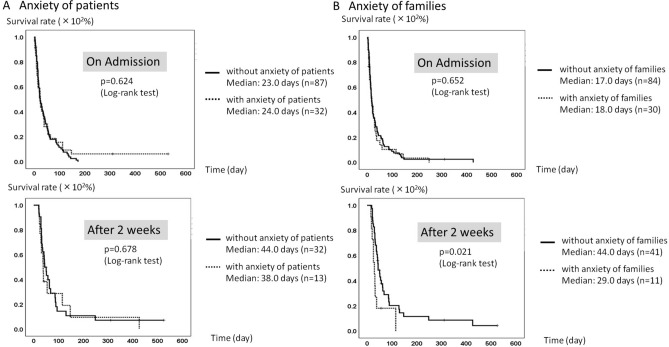
Various physical and psychosocial difficulties including anxiety affect cancer patients. Patient surroundings also have psychological effects on caregiving. Assessing the current status of palliative care intervention, specifically examining anxiety and its associated factors, is important to improve palliative care unit (PCU) patient quality of life (QOL). This study retrospectively assessed 199 patients admitted to a PCU during August 2018-June 2019. Data for symptom control, anxiety level, disease insight, and communication level obtained using Support Team Assessment Schedule Japanese version (STAS-J) were evaluated on admission and after 2 weeks. Palliative Prognostic Index (PPI) and laboratory data were collected at admission. Patient anxiety was significantly severer and more frequent in groups with severer functional impairment (p = 0.003) and those requiring symptom control (p = 0.006). Nevertheless, no relation was found between dyspnea and anxiety (p = 0.135). Patients with edema more frequently experienced anxiety (p = 0.068). Patient survival was significantly shorter when family anxiety was higher after 2 weeks (p = 0.021). Symptoms, edema, and disabilities in daily living correlate with patient anxiety. Dyspnea is associated with anxiety, but its emergence might be attributable mainly to physical factors in this population. Family members might sensitize changes reflecting worsened general conditions earlier than the patients.
各种身体和心理社会困难,包括焦虑,影响癌症患者。患者环境也对护理产生心理影响。评估姑息治疗干预的现状,特别是检查焦虑及其相关因素,对于提高姑息治疗病房(PCU)患者的生活质量(QOL)非常重要。本研究回顾性评估了 2018 年 8 月至 2019 年 6 月期间入住 PCU 的 199 名患者。使用支持团队评估计划日本版(STAS-J)在入院时和 2 周后评估症状控制、焦虑水平、疾病洞察力和沟通水平的数据。入院时收集姑息预后指数(PPI)和实验室数据。在功能障碍更严重(p=0.003)和需要症状控制的患者(p=0.006)中,患者的焦虑明显更严重和更频繁。然而,呼吸困难与焦虑之间没有关系(p=0.135)。有水肿的患者更频繁地出现焦虑(p=0.068)。在 2 周后,家属焦虑程度较高时,患者的生存率显著缩短(p=0.021)。症状、水肿和日常生活中的残疾与患者的焦虑相关。呼吸困难与焦虑相关,但在该人群中,其出现可能主要归因于身体因素。与患者相比,家属可能更早地察觉到反映一般状况恶化的变化。