Wambui Joseph, Cernela Nicole, Stevens Marc J A, Stephan Roger
Institute for Food Safety and Hygiene, Vetsuisse Faculty, University of Zurich, Zurich, Switzerland.
Front Microbiol. 2021 Sep 13;12:727022. doi: 10.3389/fmicb.2021.727022. eCollection 2021.
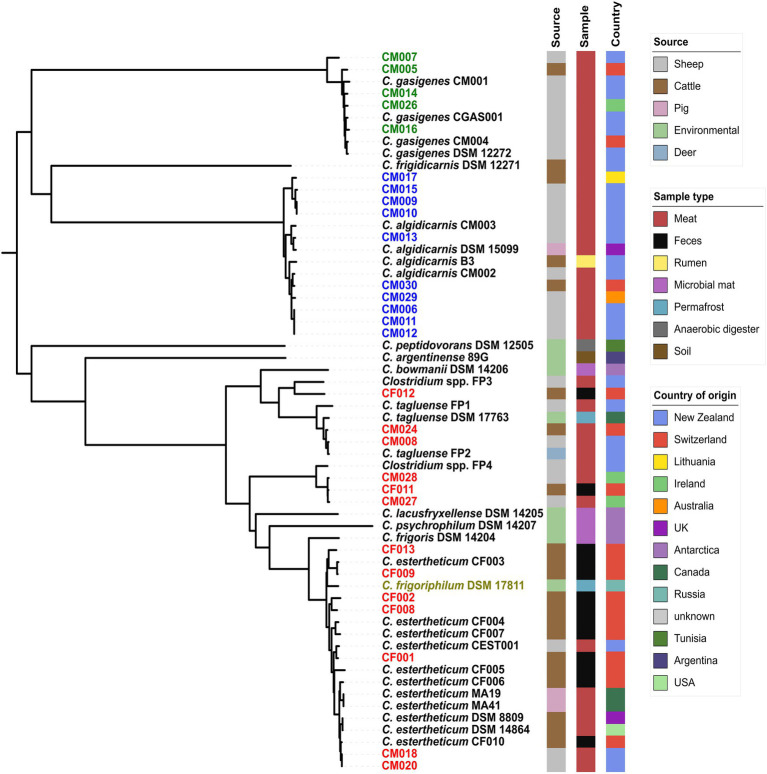
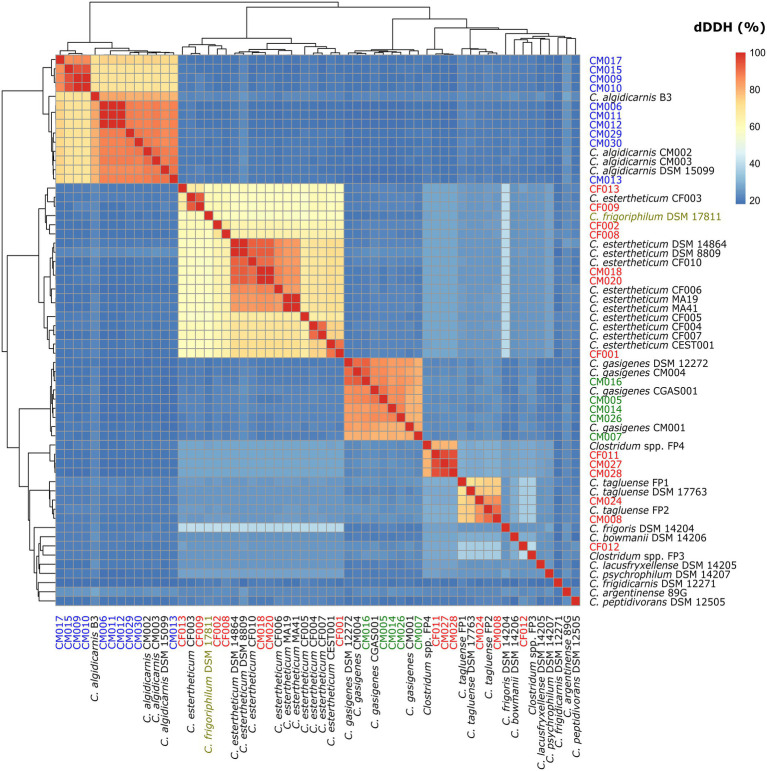
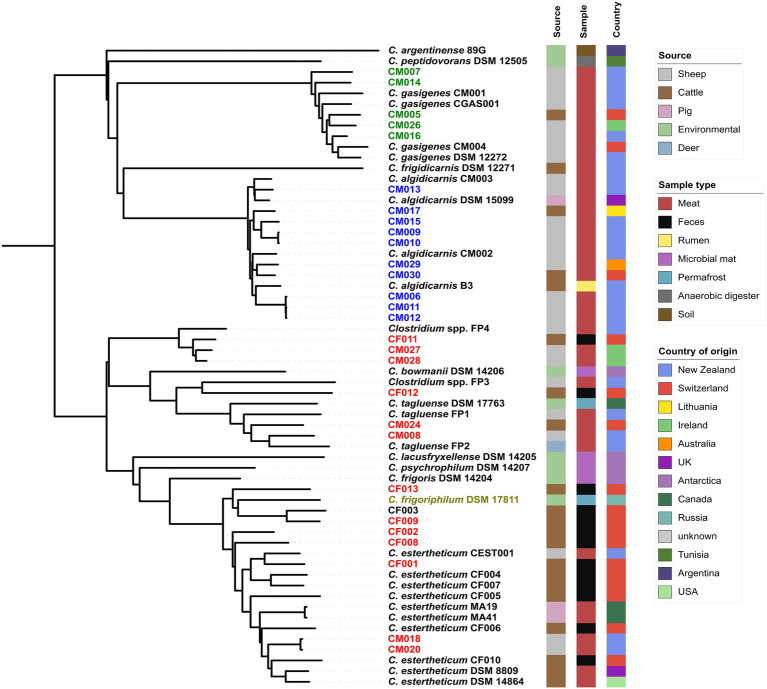
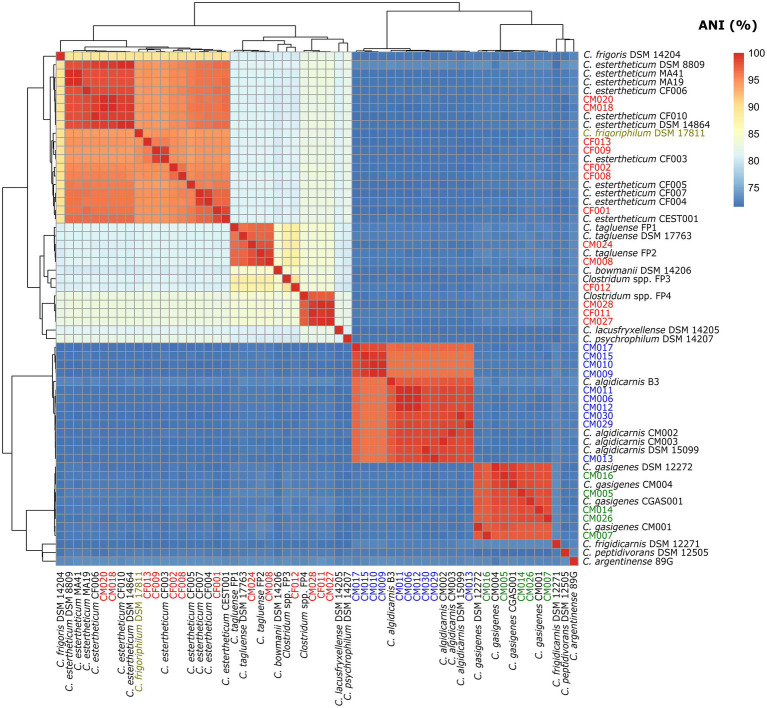
Isolates within the complex (CEC) have routinely been identified through the 16S rRNA sequence, but the high interspecies sequence similarity reduces the resolution necessary for species level identification and often results in ambiguous taxonomic classification. The current study identified CEC isolates from meat juice (MJS) and bovine fecal samples (BFS) and determined the phylogeny of species within the CEC through whole genome sequence (WGS)-based analyses. About 1,054 MJS were screened for CEC using quantitative real-time PCR (qPCR). Strains were isolated from 33 MJS and 34 BFS qPCR-positive samples, respectively. Pan- and core-genome phylogenomics were used to determine the species identity of the isolates. Average nucleotide identity (ANI) and digital DNA-DNA hybridization (dDDH) were used to validate the species identity. The phylogeny of species within the CEC was determined through a combination of these methods. Twenty-eight clostridia strains were isolated from MJS and BFS samples out of which 13 belonged to CEC. At 95% ANI and 70% dDDH thresholds for speciation, six CEC isolates were identified as genomospecies2 (=3), (=2) and genomospecies3 (=1). Lower thresholds of 94% ANI and 58% dDDH were required for the classification of seven CEC isolates into species and prevent an overlap between species and . Combination of the two species and abolishment of current subspecies classification within the species are proposed. These data demonstrate the suitability of phylogenomics to identify CEC isolates and determine the phylogeny within CEC.
梭菌属复杂菌群(CEC)内的分离株通常通过16S rRNA序列进行鉴定,但种间序列相似度高会降低物种水平鉴定所需的分辨率,且常常导致分类学分类不明确。本研究从肉汁样本(MJS)和牛粪样本(BFS)中鉴定出CEC分离株,并通过基于全基因组序列(WGS)的分析确定了CEC内各物种的系统发育关系。使用定量实时PCR(qPCR)对约1054份MJS样本进行CEC筛查。分别从33份MJS和34份BFS的qPCR阳性样本中分离出菌株。利用泛基因组和核心基因组系统发育基因组学来确定分离株的物种身份。使用平均核苷酸同一性(ANI)和数字DNA-DNA杂交(dDDH)来验证物种身份。通过这些方法的组合确定了CEC内各物种的系统发育关系。从MJS和BFS样本中分离出28株梭菌属菌株,其中13株属于CEC。在物种形成的ANI为95%和dDDH为70%的阈值下,6株CEC分离株被鉴定为基因组种2(=3)、基因组种1(=2)和基因组种3(=1)。将7株CEC分离株分类到物种1和物种2需要较低的ANI阈值94%和dDDH阈值58%,以防止物种1和物种2之间出现重叠。建议将这两个物种合并,并废除物种1内当前的亚种分类。这些数据证明了系统发育基因组学在鉴定CEC分离株和确定CEC内系统发育关系方面的适用性。