Fregoso Daniel R, Hadian Yasmin, Gallegos Anthony C, Degovics Doniz, Maaga John, Keogh Ciara E, Kletenik Isaiah, Gareau Melanie G, Isseroff R Rivkah
University of California, School of Medicine, Department of Dermatology, Davis, United States.
University of California, School of Veterinary Medicine, Department of Anatomy, Physiology and Cell Biology, Davis, United States.
Brain Behav Immun Health. 2021 May 28;15:100279. doi: 10.1016/j.bbih.2021.100279. eCollection 2021 Aug.
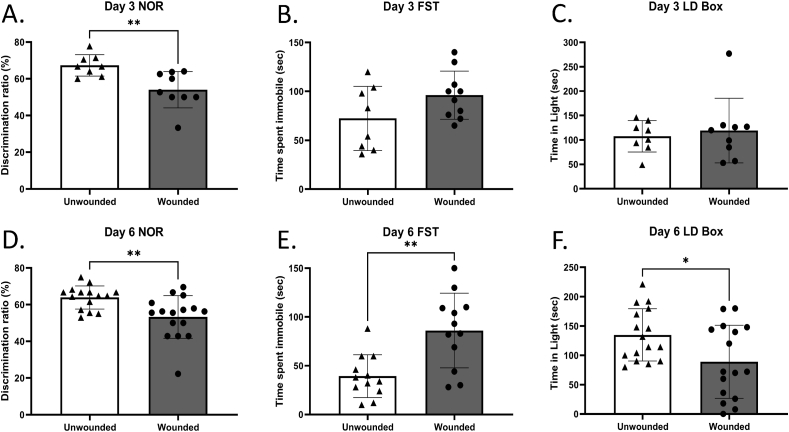
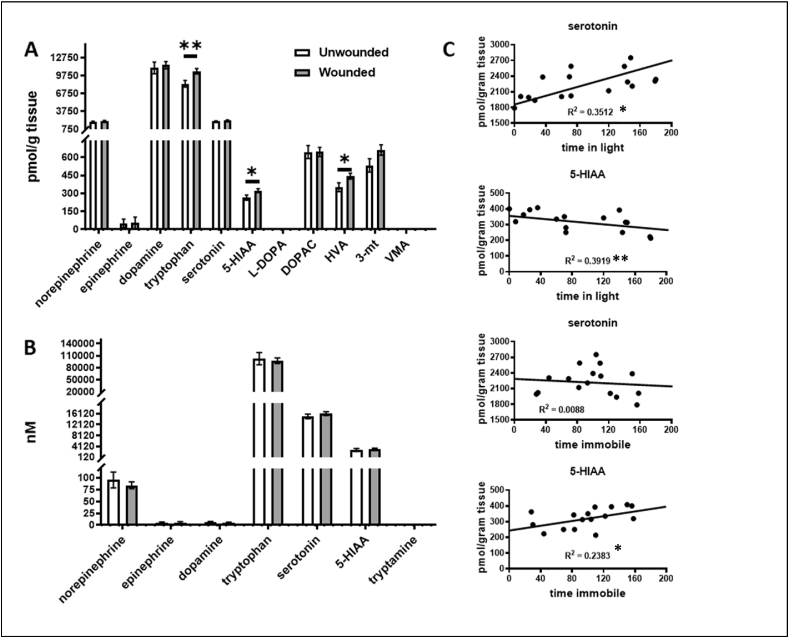
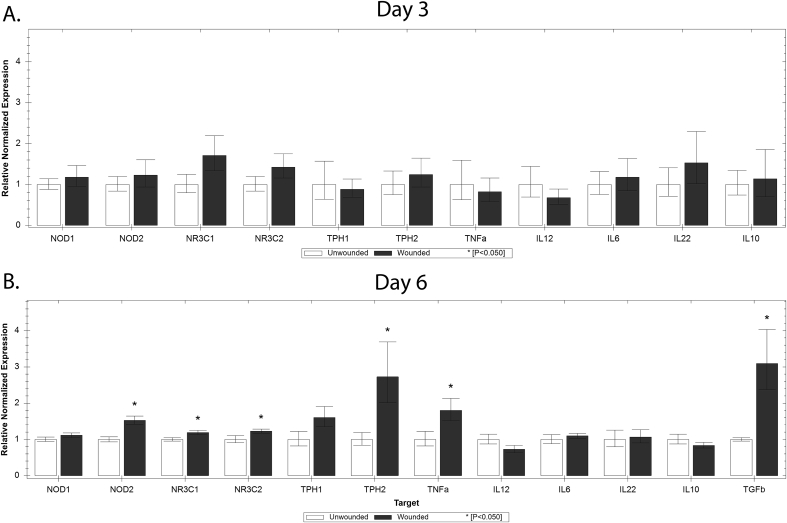
Patients with chronic wounds often have associated cognitive dysfunction and depression with an as yet unknown mechanism for this association. To address the possible causality of skin wounding inducing these changes, behavior and cognitive functions of female C57BL/6 mice with an excisional skin wound were compared to unwounded animals. At six days post wounding, animals exhibited anxiety-like behaviors, impaired recognition memory, and impaired coping behavior. Wounded animals also had concomitant increased hippocampal expression of Tnfa, the pattern recognition receptor (PRR) Nod2, the glucocorticoid receptors GR/Nr3c1 and Nr3c2. Prefrontal cortex serotonin and dopamine turnover were increased on day six post-wounding. In contrast to the central nervous system (CNS) findings, day six post -wounding serum catecholamines did not differ between wounded and unwounded animals, nor did levels of the stress hormone corticosterone, TNFα, or TGFβ. Serum IL6 levels were, however elevated in the wounded animals. These findings provide evidence of skin-to-brain signaling, mediated either by elevated serum IL6 or a direct neuronal signaling from the periphery to the CNS, independent of systemic mediators. Wounding in the periphery is associated with an altered expression of inflammatory mediators and PRR genes in the hippocampus, which may be responsible for the observed behavioral deficits.
慢性伤口患者常伴有认知功能障碍和抑郁症,这种关联的机制尚不清楚。为了探究皮肤损伤引发这些变化的可能因果关系,将有皮肤切除伤口的雌性C57BL/6小鼠的行为和认知功能与未受伤的动物进行了比较。在受伤后六天,动物表现出焦虑样行为、识别记忆受损和应对行为受损。受伤动物海马中肿瘤坏死因子α(Tnfa)、模式识别受体(PRR)核苷酸结合寡聚化结构域蛋白2(Nod2)、糖皮质激素受体GR/Nr3c1和Nr3c2的表达也随之增加。受伤后第六天,前额叶皮质血清素和多巴胺周转率增加。与中枢神经系统(CNS)的发现相反,受伤后第六天,受伤动物和未受伤动物的血清儿茶酚胺、应激激素皮质酮、肿瘤坏死因子α或转化生长因子β水平没有差异。然而,受伤动物的血清白细胞介素6水平升高。这些发现提供了皮肤与大脑信号传导的证据,其可能由血清白细胞介素6升高或从外周到中枢神经系统的直接神经元信号传导介导,独立于全身介质。外周损伤与海马中炎症介质和PRR基因表达的改变有关,这可能是观察到的行为缺陷的原因。