Negre Elodie, Coffy Amandine, Langlais Alexandra, Daures Jean-Pierre, Lavole Armelle, Quoix Elisabeth, Molinier Olivier, Greillier Laurent, Audigier-Valette Clarisse, Moro-Sibilot Denis, Westeel Virginie, Morin Franck, Roch Benoît, Pujol Jean-Louis
Department of Thoracic Oncology, Montpellier Regional University Hospital, Montpellier, France.
Laboratory of Biostatistics and Epidemiology, University Institute for Clinical Research, Montpellier University, Montpellier, France.
JTO Clin Res Rep. 2020 Feb 12;1(1):100016. doi: 10.1016/j.jtocrr.2020.100016. eCollection 2020 Mar.
This study aimed at generating a new simplified prognostic score (SPS) using common clinical and biological variables to discriminate a limited number of subgroups of patients with SCLC differing by their overall survival (OS).
The SPS was developed exploring the Montpellier University Hospital retrospective database of 401 patients over a 16-year period. All patients had received etoposide - platinum-based chemotherapy as first-line treatment. The SPS development took into account significant determinants of OS in the Cox model, weighted by their regression β coefficients. Validation of the consequent SPS has been done separately in a combined population of 213 patients accrued from two different published trials (NCT03059667 and NCT00930891).
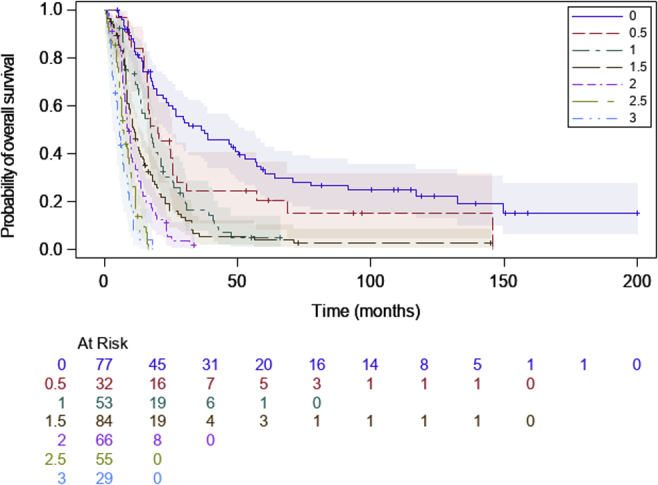
The significant independent determinants of OS included the following: (1) American Joint Committee on Cancer TNM stage IV (hazard ratio [HR]: 2.52; 95% confidence interval [CI]: 1.91-3.33); (2) Eastern Cooperative Oncology Group performance status greater than 1 (HR: 2.27; 95% CI: 1.79-2.87); (3) the presence of liver metastases (HR: 1.66; 95% CI: 1.29-2.15); and (4) neutrophil-to-lymphocyte ratio greater than 4 (HR: 1.39; 95% CI: 1.11-1.92). The SPS generated with these four variables, segregated three groups (good, intermediate, and poor prognosis) with respective median OS of 26.9 months (95% CI: 20.1-38.9), 11.5 months (95% CI: 9.8-13.0), and 6.8 months (95% CI: 5.8-8.3; log-rank < 10). Harrell's C statistic estimate was 0.68 ± 0.012, suggesting goodness of calibration. In the validation cohort, the SPS segregated the aforementioned three subgroups in a nearly similar manner, with respective median OS: 27.2, 12.3, and 8.6 months (log-rank < 10; Harrell's C statistic: 0.58 ± 0.02).
The SPS is easy to calculate in real-life practice and efficiently discriminates three populations with different prognoses. This study deserves further validation of this score in patients with SCLC receiving immunochemotherapy.
本研究旨在利用常见的临床和生物学变量生成一种新的简化预后评分(SPS),以区分小细胞肺癌(SCLC)患者中总体生存期(OS)不同的有限数量亚组。
通过探索蒙彼利埃大学医院16年间401例患者的回顾性数据库来开发SPS。所有患者均接受依托泊苷-铂类化疗作为一线治疗。SPS的开发考虑了Cox模型中OS的重要决定因素,并根据其回归β系数进行加权。随后在从两项不同的已发表试验(NCT03059667和NCT00930891)中收集的213例患者的联合人群中分别对生成的SPS进行验证。
OS的重要独立决定因素包括:(1)美国癌症联合委员会TNM分期IV期(风险比[HR]:2.52;95%置信区间[CI]:1.91 - 3.33);(2)东部肿瘤协作组体能状态大于1(HR:2.27;95%CI:1.79 - 2.87);(3)存在肝转移(HR:1.66;95%CI:1.29 - 2.15);以及(4)中性粒细胞与淋巴细胞比值大于4(HR:1.39;95%CI:1.11 - 1.92)。用这四个变量生成的SPS将患者分为三组(预后良好、中等和不良),各自的中位OS分别为:26.9个月(95%CI:20.1 - 38.9)、11.5个月(95%CI:9.8 - 13.0)和6.8个月(95%CI:5.8 - 8.3;对数秩检验<0.001)。Harrell's C统计量估计值为0.68±0.012,表明校准良好。在验证队列中,SPS以几乎相似的方式将上述三个亚组区分开来,各自的中位OS分别为:27.2、12.3和8.6个月(对数秩检验<0.001;Harrell's C统计量:0.58±0.02)。
SPS在实际临床实践中易于计算,并能有效区分三个预后不同的人群。本研究值得在接受免疫化疗的SCLC患者中进一步验证该评分。