Iams Wade T, Kopparapu Prasad R, Yan Yingjun, Muterspaugh Anel, Zhao Zhiguo, Chen Heidi, Cann Christopher, York Sally, Horn Leora, Ancell Kristin, Wyman Kenneth, Bertucci Caterina, Shaffer Tristan, Hodsdon Lauren A, Garg Kavita, Hosseini Seyed Ali, Lim Lee P, Lovly Christine M
Department of Medicine, Division of Hematology/Oncology, Vanderbilt University Medical Center, Nashville, Tennessee.
Vanderbilt-Ingram Cancer Center, Vanderbilt University Medical Center, Nashville, Tennessee.
JTO Clin Res Rep. 2020 Mar 12;1(2):100024. doi: 10.1016/j.jtocrr.2020.100024. eCollection 2020 Jun.
Most patients (70%) with limited-stage SCLC (LS-SCLC) who are treated with curative-intent therapy suffer disease relapse and cancer-related death. We evaluated circulating tumor DNA (ctDNA) as a predictor of disease relapse and death after definitive therapy in patients with LS-SCLC.
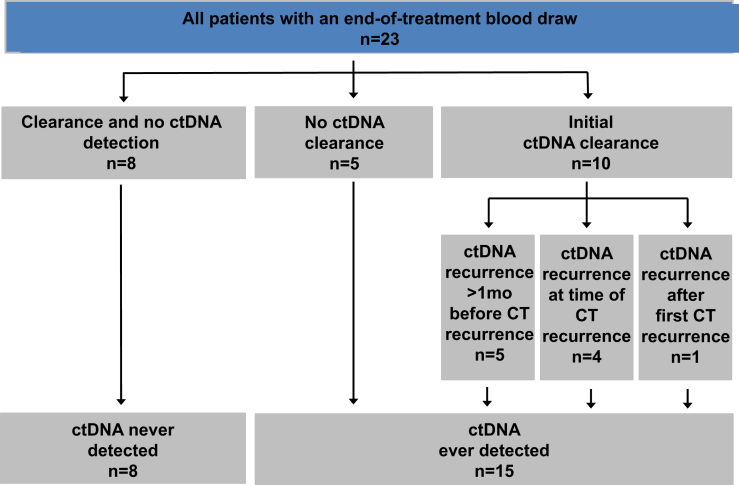
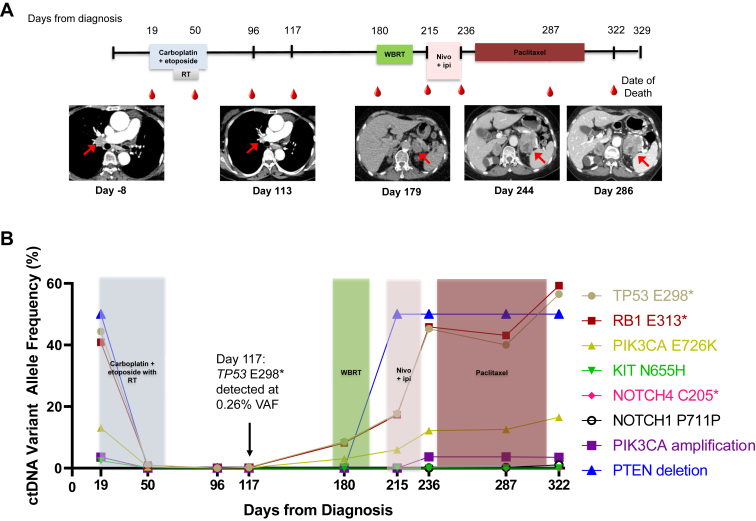
In our previous work, we developed a plasma-based ctDNA assay to sequence 14 genes (, , , , , , , , , , and ) that are frequently mutated in SCLC. In this work, we evaluated 177 plasma samples from 23 patients with LS-SCLC who completed definitive chemoradiation (n = 21) or surgical resection (n = 2) and had an end-of-treatment blood collection (median 4 d, range 0-40 d from treatment completion) plus monthly surveillance blood sampling. Median overall survival (OS) and progression-free survival (PFS) were compared using a Wilcoxon test.
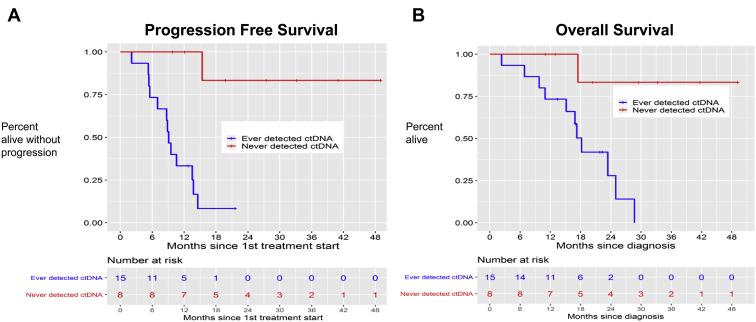
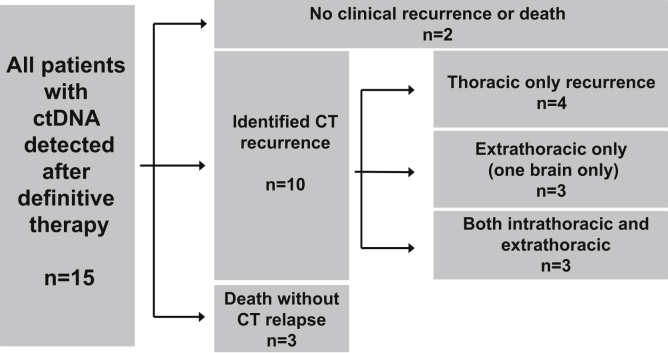
The median OS among patients in whom we ever detected ctDNA after definitive treatment (n = 15) was 18.2 months compared with a median OS of greater than 48 months among patients in whom we never detected ctDNA after definitive treatment (n = 8; = 0.081). The median PFS among patients in whom we ever detected ctDNA after definitive treatment was 9.1 months compared with a median PFS of greater than 48 months among patients in whom we never detected ctDNA after definitive treatment ( < 0.001).
Detection of ctDNA in patients with LS-SCLC after curative-intent therapy predicts disease relapse and death. Prospective trials using ctDNA as an integral biomarker for therapeutic selection should be considered in SCLC.
大多数接受根治性治疗的局限期小细胞肺癌(LS-SCLC)患者(70%)会出现疾病复发和癌症相关死亡。我们评估了循环肿瘤DNA(ctDNA)作为LS-SCLC患者根治性治疗后疾病复发和死亡的预测指标。
在我们之前的工作中,我们开发了一种基于血浆的ctDNA检测方法,用于对14个在SCLC中频繁突变的基因(、、、、、、、、、、和)进行测序。在这项工作中,我们评估了23例LS-SCLC患者的177份血浆样本,这些患者完成了根治性放化疗(n = 21)或手术切除(n = 2),并在治疗结束时采集了血液样本(中位数为4天,范围为治疗结束后0 - 40天),外加每月进行一次监测血液采样。使用Wilcoxon检验比较总生存期(OS)和无进展生存期(PFS)的中位数。
根治性治疗后曾检测到ctDNA的患者(n = 15)的OS中位数为18.2个月,而根治性治疗后从未检测到ctDNA的患者(n = 8; = 0.081)的OS中位数大于48个月。根治性治疗后曾检测到ctDNA的患者的PFS中位数为9.1个月,而根治性治疗后从未检测到ctDNA的患者的PFS中位数大于48个月( < 0.001)。
根治性治疗后LS-SCLC患者中检测到ctDNA可预测疾病复发和死亡。在SCLC中应考虑进行前瞻性试验,将ctDNA作为治疗选择的一个重要生物标志物。